Argentina
The GMI Secretariat prepared this profile using publicly available information. If you are a delegate and wish to submit edits or additions, please contact the Secretariat at secretariat@globalmethane.org.
Argentina is a founding member of the Global Methane Initiative (GMI), established in 2004, and participates in the Biogas and Oil & Gas Subcommittees.
Argentina supports methane emissions reduction through a framework of policies and measures that address the biogas, coal, and oil and gas sectors. These efforts support Argentina’s goals to achieve a 4.6% reduction in greenhouse gas emissions by 2030, and net neutrality by 2025.
On this page:
Methane Emissions Summary
The Energy and Agriculture, Forestry, and other Land Use sectors account for a significant portion of Argentina’s total 2018 greenhouse gas (GHG) emissions at 51%, and 39% respectively. The waste sector accounts for 4% of the total GHG emissions in 2018, with methane being the primary source.
GHG Emissions Trend by Sector, 1990-2018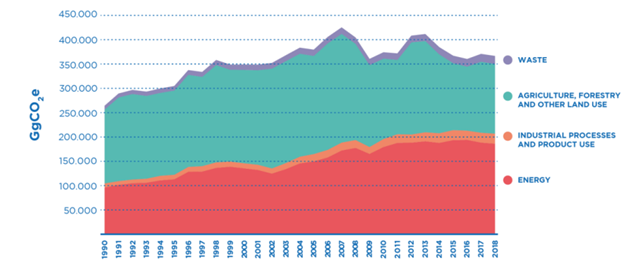
Methane Emissions in the Waste Sector Compared to CO2 and N2O, 2018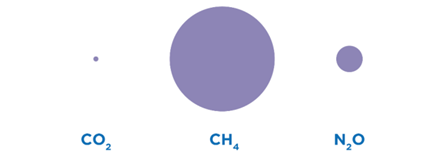
Methane Emissions in the Energy Sector Compared to CO2 and N2O, 2018
Methane Emissions in the Agriculture, Forestry, and Other Land Use Sector Compared to CO2 and N2O, 2018 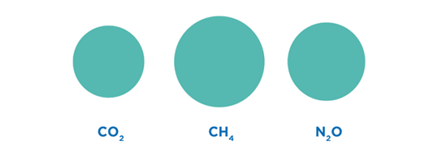
Source: National Inventory Report of the Fourth Biennial Update Report, Argentine Republic, Accessed September 2024: https://unfccc.int/documents/419772
Methane Commitments and Plans
Methane mitigation efforts in Argentina are guided by national and provincial commitments and plans. Argentina also participates in international partnerships dedicated to addressing climate change.
National
Argentina has a national adaptation plan to support the country’s climate targets and achieve emissions reductions goals.
- Climate Change Adaptation and Mitigation Plan, published in November 2023, implements a roadmap to achieve a 4.6% reduction in 2030 compared to a 2018 baseline. The plan includes 250 policy measures and prioritizes lowering emissions from agriculture and livestock activities, supporting the transition to clean energy and fuel, and reducing methane emissions.
- Argentina’s Second Nationally Determined Contributions, published in December 2020, establishes the goal that Argentina’s net emissions will not exceed 349 MtCO2e in 2030, and commits to methane emissions reductions at waste disposal sites and emissions removal through methane capture.
- In 2019, Argentina issued its National Agriculture and Climate Change Action Plan which identifies actions focused on reducing methane emissions in the agricultural sector by 27.75 MtCO2e by 2030.
- The 2030 Science, Technology and Innovation Plan implements an environment and sustainable development framework with a focus on greenhouse gas emissions reductions, increasing recycling in different waste streams, and reducing methane emissions from enteric fermentation.
- In 2016, Argentina established a National Cabinet of Climate Change to reduce emissions in accordance with the country’s commitments under the Paris Agreement.
International
Argentina contributes to international efforts to address methane emissions and reach global climate targets.
- Argentina joined the European Union to launch the Global Methane Pledge (GMP) in 2021 at the United Nations (UN) Climate Change Conference (COP26), committing to reducing global methane emissions by 30% from 2020 levels by 2030.
- As a partner of the Climate and Clean Air Coalition (CCAC) since 2018, Argentina supports efforts to reduce methane emissions.
Methane Actions
The following highlights a sampling of actions taken by Argentina to address methane, organized by GMI sector.
Biogas Sector
- Argentina’s 2006-2025 National Strategy for the Integrated Management of Urban Solid Waste focuses on establishing an integrated waste management system, addressing landfill emissions, and implementing pilot projects across municipalities.
- The RenovAr Auction Programme provides financial investments to renewable energy projects and led to a significant increase in renewable energy production and use, including biogas. (September 2018)
Coal Mine Sector
- The National Mining Sustainability Program, implemented under Argentina Productive 2030, prioritizes compliance with climate change goals and environmental best practices, reuse and rehabilitation of closed mining sites, and environmental management of mining waste during the entire life cycle of the mine. (March 2022)