Brazil
Brazil is a founding member of the Global Methane Initiative (GMI), launched in 2004, and has made significant strides in addressing methane emissions through the establishment of emissions goals and the publication of comprehensive plans and strategies.
Brazil has implemented a variety of measures aimed at reducing methane emissions, particularly through national policies and climate action initiatives. Notably, Brazil has launched several projects to promote the use of biogas as a clean energy alternative, which supports both its national objectives and international commitments for climate action. These efforts reflect Brazil's commitment to sustainable development while actively contributing to global efforts to mitigate climate change.
Brazil is currently active on the Biogas Subcommittee.
On this page:
Methane Emissions Summary
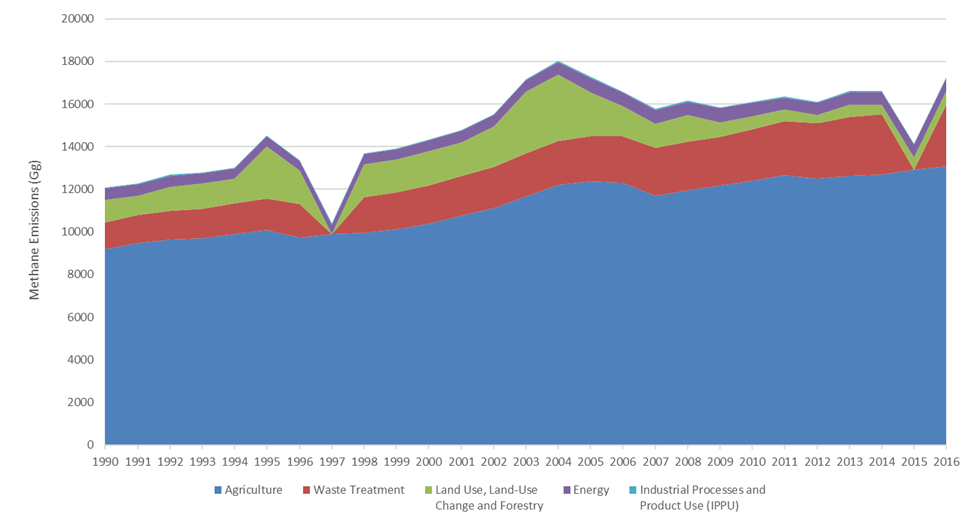
According to the Fourth Biennial Update Report of Brazil, published in 2020, methane emissions were estimated at 17,268.9 Gg in 2016, with the majority originating from the agriculture and waste sectors.
Methane Emissions Trend by Sector, 1990-2016
Methane Emissions Estimates by Sector with Uncertainty Analysis, 2016
| Sector | Uncertainty (%) | Emissions (Gg CH4) |
| Agriculture | 31 | 13,087.1 |
| Enteric Fermentation | 34 | 11,822.9 |
| Manure Management | 38 | 630.9 |
| Rice Cultivations | 45 | 459.9 |
| Burning of Crop Residues | 32 | 173.4 |
| Waste Treatment | 16 | 2,868.5 |
| Solid Waste | 23 | 1,497.1 |
| Wastewater | 23 | 1,371.4 |
| Industrial | 30 | 817.4 |
| Domestic | 35 | 554.0 |
| Land Use, Land-Use Change and Forestry | 72 | 672.0 |
| Energy | 49 | 604.9 |
| Fuel Combustion | 73 | 386.3 |
| Fugitive Emissions | 44 | 218.6 |
| Coal Mining | 73 | 56.8 |
| Extraction and Transportation of Oil and Natural Gas | 54 | 161.8 |
| Industrial Processes | 10 | 36.4 |
| Iron and Steel Production | 15 | 21.2 |
| Other Metallurgical industries | 15 | 3.3 |
| Chemical Industry | 17 | 11.9 |
| TOTAL | 24 | 17,268.9 |
Source: The Fourth Biennial Update Report of Brazil, 2020. https://unfccc.int/sites/default/files/resource/BUR4.Brazil.pdf
Methane Commitments and Plans
Brazil participates in international partnerships dedicated to addressing climate change.
National
Brazil supports and engages with international climate efforts to address methane challenges.
- Brazil joined the European Union to launch the Global Methane Pledge (GMP) in 2021 at the United Nations (UN) Climate Change Conference (COP26), committing to reducing global methane emissions by 30% from 2020 levels by 2030.
- Brazil has been a partner of the Climate and Clean Air Coalition since 2023, supporting activities to address air pollution and promote clean air initiatives.
- Brazil signed the Paris Agreement on climate change in April 2016, committing to significant measures to combat climate change. Specifically, Brazil strives to reduce GHG emissions to 50% below 2005 levels by 2030.
Methane Actions
The following highlights a sampling of actions taken in Brazil to address methane, organized by GMI sector.
Biogas Sector
- The Brazilian Ministry of Agriculture and Livestock partnered with CCAC, Embrapa, and Instituto 17 on a project Integrating Methane Mitigation Into National Agriculture Strategies – which is guided by the strategy of Brazil's ABC+ Plan for Adaptation and Low Carbon Emissions in Agriculture – that aims to develop data coordination and monitoring tools, as well as institutional capacity which will enable action to reduce methane emissions through manure management. (2023)
- The National Zero Methane Program was launched to stimulate the agriculture and livestock sectors by advancing the production and use of biomethane and biogas. The initiative will also support scientific and technical research on biogas and foster national and international cooperation to reduce methane emissions. (2022)
- The Brazilian government issued a decree and two executive orders to promote biogas as a renewable energy source, aiming to reduce GHG emissions and enhance sustainable energy. (2022)
- Brazil’s National Biofuels Policy, known as RenovaBio, was instituted in 2017 to increase the production and integration of biofuels into the national energy matrix. The policy aims to enhance energy security, reduce GHG emissions, and promote sustainable development through the use of renewable energy sources. (2017)
Oil & Gas Sector
- Brazil announced at the COP28 Global Methane Pledge Ministerial that its National Council of Energy Policy will establish guidelines on methane reduction in the oil and gas sector by the end of 2024, and the National Agency for Petroleum, Natural Gas and Biofuels (ANP) aims to finalize regulations by the end of 2025 based on these guidelines. (2023)
Cross Sector
- Established in December 2009, Law NO 12.187 establishes the national policy on climate change and sustainable development. The policy sets goals for emissions reductions, fosters renewable energy adoption, and integrates climate considerations into public policies to address both mitigation and adaptation challenges. (2009)
Ministries and Agencies Supporting Methane Actions
Explore the following websites to learn more about the Brazilian government agencies that address greenhouse gas emissions, including methane-specific programs.