Ethiopia
The GMI Secretariat prepared this profile using publicly available information. If you are an official representative and wish to submit edits or additions, please contact the Secretariat at secretariat@globalmethane.org.
Ethiopia joined the Global Methane Initiative (GMI) in 2010.
Methane mitigation efforts in Ethiopia are focused on the biogas sector, which is the largest contributor to methane emissions in the country. The Government of Ethiopia also participates in international partnerships to help reduce methane emissions.
On this page:
Methane Emissions Summary
Ethiopia has not published methane emissions data.
According to EPA’s non-CO2 Greenhouse Gas Data Tool, Global Non-CO2 Greenhouse Gas Emission Projections & Mitigation Potential: 2015-2050, the livestock sector accounts for more than half of Ethiopia’s estimated methane emissions and is projected to make up just over 60% of their total methane emissions in 2030. Livestock sources include enteric fermentation and manure management. The following charts illustrate the percentage of methane emissions by source for 2030 and provide estimates for projected methane emissions in Ethiopia through 2050. Data are presented in million metric tonnes carbon dioxide equivalent (MMTCO2e).
Methane Emissions by Source (Total = 139 MMTCO2e), 2030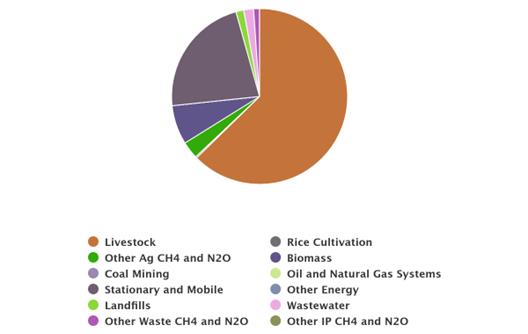
Source: U.S. EPA’s Non-CO2 Greenhouse Gas Data Tool based on U.S. EPA’s Global Non-CO2 Greenhouse Gas Emission Projections & Mitigation Potential: 2015-2050.
Methane Emissions Trend and Projections by Sector, 1990-2050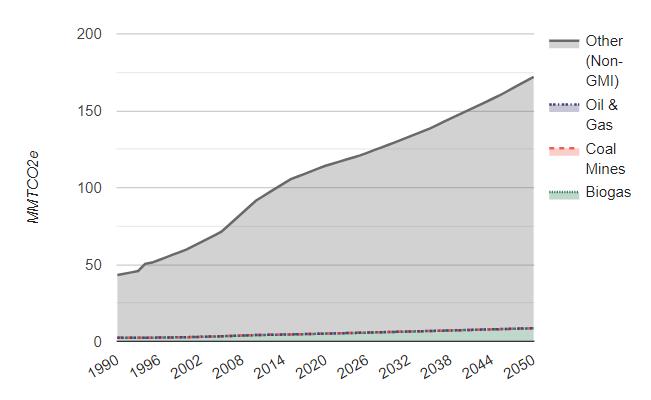
|
Sector |
2020 |
2030 |
2050 |
|---|---|---|---|
| Biogas | 5.041 | 6.166 | 8.562 |
| Coal Mines | 0 | 0 | 0 |
| Oil & Gas | 0 | 0 | 0 |
| Other (Non-GMI) | 109.168 | 123.272 | 163.436 |
Source: Global Non-CO2 Greenhouse Gas Emission Projections & Mitigation Potential: 2015-2050, U.S. EPA.
Methane Commitments and Plans
Methane mitigation efforts in Ethiopia are guided by national and international commitments and plans.
National
- Ethiopia has developed a long-term low emissions development strategy (LT-LEDS), which is built on the latest NDC submission. The LT-LEDS outline sectoral priority interventions and provides suggestions for reducing methane emissions from the wastewater, municipal solid waste, and agriculture sectors.
International
Ethiopia is an active participant in international efforts to address methane emissions and reach global climate targets.
- Ethiopia joined the Global Methane Pledge in 2021, agreeing to take voluntary actions to contribute to a collective effort to reduce global methane emissions by 30% from 2020 levels by 2030.
- Ethiopia has been a partner of the Climate and Clean Air Coalition since 2012, supporting activities to reduce methane and other short-lived climate pollutants.
Methane Actions
The following highlights a sampling of actions taken by Ethiopia to address methane, organized by GMI sector.
Biogas Sector
- Ethiopia’s Reppie Waste-to-Energy project is Africa’s first waste-to-energy facility. The facility is located within an open dumping site that processes approximately 1,400 tons of waste per day. This project was expected to significantly reduce methane emissions from the municipal waste sector and supply the community with electricity. (2017)
- The National Biogas Programme of Ethiopia supports the Government of Ethiopia’s efforts to develop a market-oriented biogas sector to reduce emissions and create domestic energy. This project is intended to support the installation of 18,000 high quality biogas plants.
Ministries and Agencies Supporting Methane Actions
Explore the following website to learn more about the government ministries addressing methane emissions in Ethiopia.