Pakistan
The GMI Secretariat prepared this profile using publicly available information. If you are a delegate and wish to submit edits or additions, please contact the Secretariat at secretariat@globalmethane.org.
Pakistan joined the Global Methane Initiative (GMI) in 2008 and serves on the Biogas, Coal Mines, and Oil & Gas Subcommittees.
Pakistan has an extensive national climate framework that includes specific measures to support methane abatement and achieve methane emission reduction goals across all sectors. These measures include a shift away from coal power generation towards renewable energy, increasing reliance on bio-methane as a fuel source, and minimizing methane emissions from enteric fermentation. Pakistan participates in climate action through international collaboration to address methane and achieve global emissions reduction goals.
On this page:
Methane Emissions Summary
In Pakistan, methane emissions are the second largest contributor to the energy sector, and the largest contributor to the Agriculture, Forestry & Other Land Use (AFOLU) sector. Livestock is a major driver of socio-economic development in Pakistan and is a significant source of income and employment for Pakistan’s rural population. Livestock is also a major contributor to methane emissions due to enteric fermentation and manure management. Within Pakistan’s livestock population, buffalo are the largest contributors to methane emissions from enteric fermentation at 48%, followed by cattle at 19%. Poultry is the primary source of emissions from manure management in Pakistan, comprising 86% of the total.
Energy Sector Emissions by Greenhouse Gas, 2018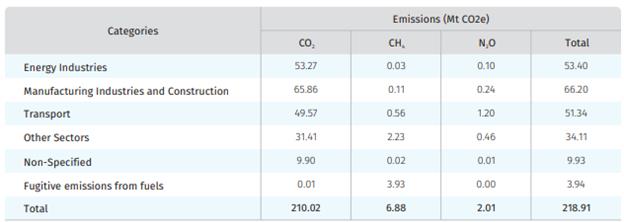
AFOLU Sector Emissions by Greenhouse Gas, 2018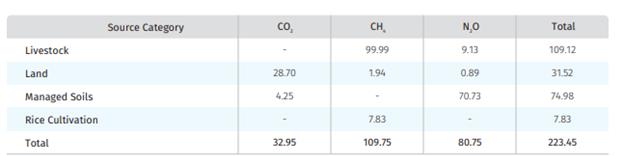
Methane Emissions from Enteric Fermentation by Animal Type, 2018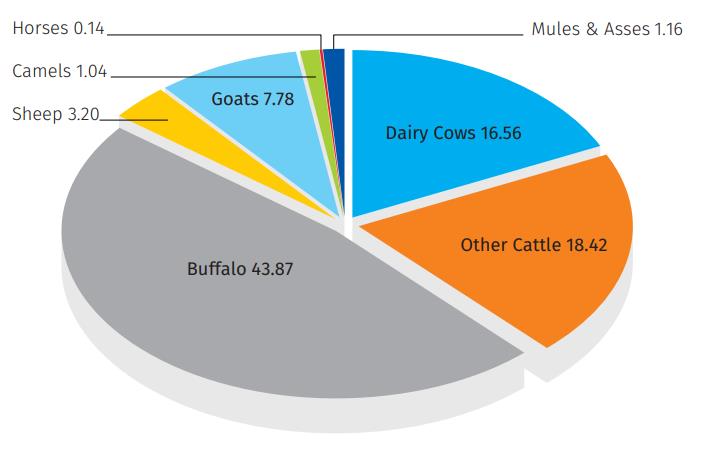
Methane Emissions from Manure Management by Animal Type, 2018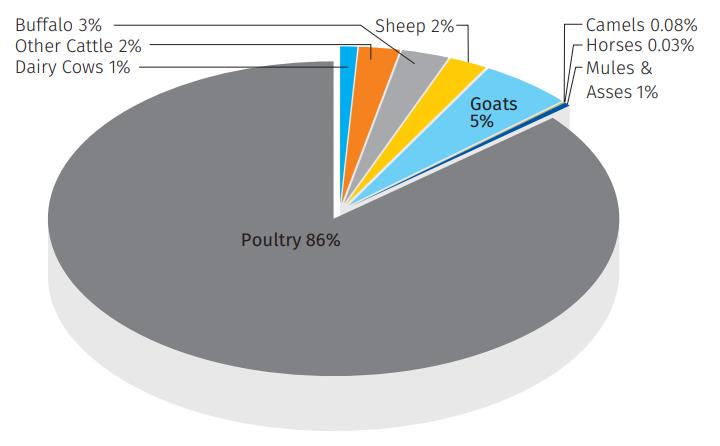
Source: Pakistan’s First Biennial Update Report, Ministry of Climate Change, April 2022: https://unfccc.int/sites/default/files/resource/Pakistan%E2%80%99s%20First%20Biennial%20Update%20Report%20%28BUR-1%29%20-%202022.pdf
Methane Commitments and Plans
Methane mitigation efforts in Pakistan are guided by federal and international commitments and plans. Pakistan also engages in partnerships dedicated to addressing methane.
National
Pakistan has a national adaptation plan and long-term multi-sectoral strategies to achieve methane emissions reductions.
- Pakistan’s First Biennial Update Report on Climate Change was published in 2022 and provides a summary of methane emission trends and methane emission reduction efforts in the agriculture, transportation, livestock, and energy sectors in Pakistan.
- Pakistan’s National Climate Change Policy, updated in 2021, supports the development of biogas and manure digesters to reduce methane emissions from enteric fermentation.
- Pakistan’s 2021 Updated Nationally Determined Contributions (NDC) sets the goal of up to a 50% reduction in total greenhouse gas emissions by 2030. The NDCs includes measures to utilize bio-methane as a fuel source for rural households.
- The National Adaptation Plan, published in 2023, affirms Pakistan’s commitment to the Global Methane Pledge and to reduce methane emissions nationwide.
- Net Zero Pakistan is a national coalition supporting Pakistan’s decarbonization efforts and achievement of climate goals. The Net Zero strategy recognizes methane in the waste sector as a significant contributor to greenhouse gas emissions.
International
Pakistan participates in numerous collaborative international efforts to implement climate action across the world.
- Pakistan joined the Global Methane Pledge (GMP) in 2021 at the United Nations (UN) Climate Change Conference (COP26), agreeing to take voluntary actions to contribute to a collective effort to reduce global methane emissions by 30% from 2020 levels by 2030.
- Pakistan has been a member of the Clean Air Coalition (CCAC) since 2017, supporting activities to reduce methane and other short-lived climate pollutants.
Methane Actions
The following highlights a sampling of actions taken by Pakistan to address methane, organized by GMI sector.
Biogas Sector
- Pakistan approved the development of a 40 MW wastewater treatment plant in Lahore. Once construction is complete, expected in 2026, approximately 2,000 tonnes of municipal solid waste will be processed daily. (2018)
Coal Sector
- In 2020, the government of Pakistan announced a halt in construction of new coal power plants to support the country’s shift from coal power to renewable energy.
Ministries and Agencies Supporting Methane Actions
Explore the following website to learn more about the government ministries addressing methane emissions.