Bulgaria
The GMI Secretariat prepared this profile using publicly available information. If you are an official representative and wish to submit edits or additions, please contact the Secretariat at secretariat@globalmethane.org.
Bulgaria joined the Global Methane Initiative (GMI) in 2009.
Bulgaria is a regional leader in greenhouse gas and methane emissions reductions. The country’s diverse set of national climate measures address the transportation, energy, agriculture, and waste sectors, and support Bulgaria’s ambitious emissions reduction targets. In addition to their national climate commitments, Bulgaria actively engages in international efforts to address methane within the European Union, and across the globe.
On this page:
Methane Emissions Summary
Since 1988, Bulgaria has achieved nearly 50% reduction in greenhouse gas emissions from key sectors. Methane emissions in Bulgaria have decreased by 58% between 1988 and 2017. A large share of the methane emissions reductions is a result of improvements in waste collection and treatment and the reduction of animal husbandry in the agriculture sector.
Total Greenhouse Gas Emission Reduction by Sector from 1990 to 2017
|
Greenhouse Gas Source and Sink Categories |
Change from base to latest reported year |
|---|---|
| 1. Energy | -45.14 |
| 2. Industrial Processes and Product Use | -52.29 |
| 3. Agriculture | -52.35 |
| 4. Land Use, Land-Use Change and Forestry (LULUCF) | -36.64 |
| 5. Waste | -54.01 |
| Total (including LULUCF | -48.76 |
Emissions Trend by Greenhouse Gas, 1988-2017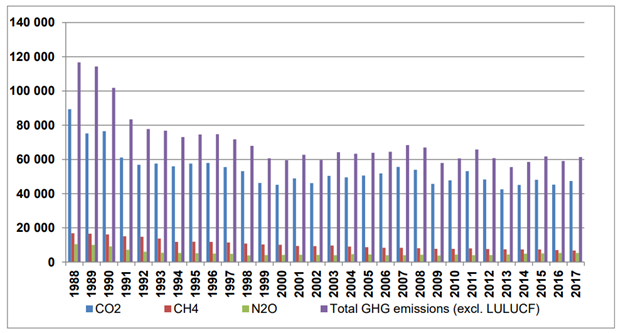
Source: Bulgaria’s Fourth Biennial Report, Ministry of Environment and Waster of Bulgaria, 2019. https://www4.unfccc.int/sites/SubmissionsStaging/NationalReports/Documents/6058271_Bulgaria-BR4-1-BG_BR4.pdf
Methane Commitments and Plans
Methane mitigation efforts in Bulgaria are guided by federal and international commitments and plans. Bulgaria also engages in global partnerships dedicated to addressing methane.
National
Bulgaria has national plans and climate strategies to support its methane emissions reduction goals.
- Bulgaria’s 2024 Draft Updated National Energy and Climate Plan implements clear climate goals and measures that focus on energy efficiency infrastructure, decarbonization, an increase in biogas production and consumption, reducing dependence on fuel, and achieving climate neutrality by 2050.
- Bulgaria’s Long-Term Climate Change Mitigation Strategy by 2050, released in March 2022, aims to achieve climate neutrality by 2050 through greenhouse gas emissions reductions, enhanced energy efficiency, and an increase in the production of renewable energy. It includes measures to reduce methane emissions.
- Bulgaria’s National Strategy on Adaptation to Climate Change and Action Plan sets the country’s comprehensive framework for climate change action across all sectors. The plan includes measures to improve waste management practices, use of biogas for fertilization, and reducing methane emissions through improved agricultural practices.
- The 2019 Integrated Energy and Climate Plan of The Republic of Bulgaria establishes the country’s climate goals in support of achieving the European Union’s 2030 climate and energy targets and includes measures to increase the production, capture and use of biogas.
International
Bulgaria actively supports and contributes to international efforts to address methane emissions and reach global climate targets.
- The update of the Nationally Determined Contributions (NDCs) of the European Union and its Member States was submitted in 2023, and sets a new target of reducing greenhouse gas emissions by 62 percent by 2030, as compared to 2005 emission levels.
- Bulgaria joined the European Union to launch the Global Methane Pledge (GMP) in 2021 at the United Nations (UN) Climate Change Conference (COP26), committing to reducing global methane emissions by 30% from 2020 levels by 2030.
- The Third National Climate Action Plan aims to address emissions across all sectors to mitigate climate change in Bulgaria. In the agriculture sector, the plan will measure and reduce methane emissions from organic fermentation in livestock farming, and improve manure management.
Methane Actions
The following highlights a sampling of actions taken by Bulgaria to address methane, organized by GMI sector.
Biogas Sector
- The Renewable Energy Act promotes the use of renewable energy sources, biogas and green hydrogen, and deployment of new technologies to reduce the cost and expand the use of renewable energy. (October 2018)
Ministries and Agencies Supporting Methane Actions
Explore the following websites to learn more about the government ministries addressing greenhouse gas emissions, including methane emissions, in Bulgaria.