United States
Joined GMI in 2004.
The United States (U.S.) is a founding member of the Global Methane Initiative (GMI). The U.S. has provided significant support as the host for the GMI Secretariat and has served in leadership roles in the Steering Committee and Biogas and Coal Mines Subcommittees.
For decades, the U.S. has pursued a variety of methane mitigation approaches and helped other nations develop robust capacity to address methane issues and opportunities. These efforts include strategic international partnerships, regulatory policy, voluntary outreach programs, project financing, development of numerous assessment tools for feasibility studies and project planning, and collaboration with industry to reduce the negative climate effects of methane emissions as well as the use of technologies to capture methane as a valuable energy source.
On this page:
Methane Emissions Summary
Annually, the U.S. Environmental Protection Agency (EPA) develops the Inventory of U.S. Greenhouse Gas Emissions and Sinks. Preparation of the report, which is submitted to the United Nations in accordance with the Framework Convention on Climate Change and the Paris Agreement, includes collaboration with experts from government agencies, academic institutions, industry associations, consultants, and environmental organizations.
Methane Emissions by Source, 2022
In 2022, methane emissions accounted for approximately 11.1% of all greenhouse gas emissions in the U.S. The primary sources of methane emissions from human activities in the U.S. are activities in the agriculture (e.g., enteric fermentation and manure management) and energy sectors (e.g., natural gas and petroleum systems).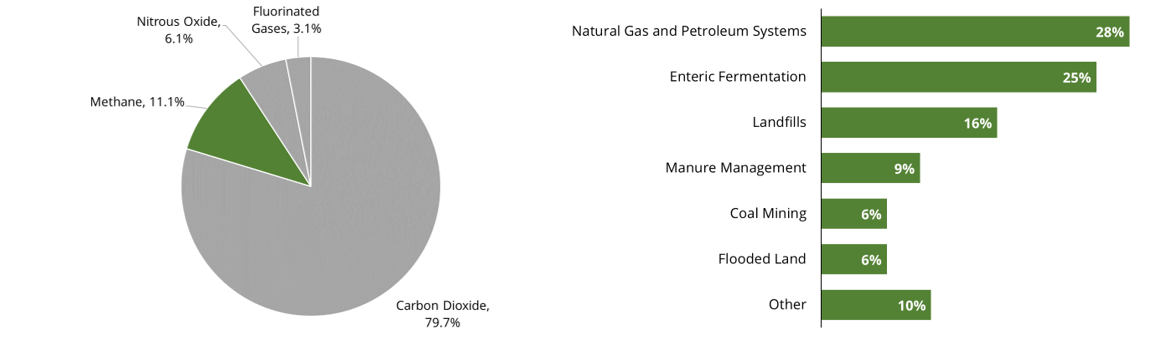
Source: U.S. Environmental Protection Agency, Overview of Greenhouse Gases, accessed August 2024, https://www.epa.gov/ghgemissions/overview-greenhouse-gases#methane.
Trends in U.S. Methane Emissions by Sector, 1990-2022
From 1990-2022, methane emissions decreased in the U.S. by approximately 17.7%.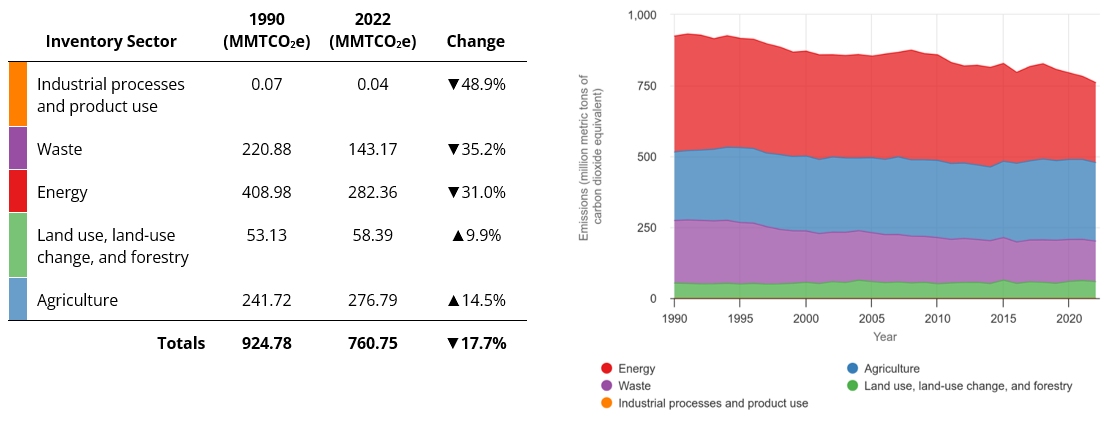
Source: U.S. Environmental Protection Agency, Greenhouse Gas Inventory Data Explorer, accessed August 2024, https://cfpub.epa.gov/ghgdata/inventoryexplorer/
Methane Commitments and Plans
National
- National Action Plans:
- In November 2021, the U.S. released a Methane Emissions Reduction Action Plan to accelerate the pace of methane reductions in the U.S.
- The U.S. released the National Strategy to Advance an Integrated U.S. Greenhouse Gas Measurement, Monitoring, and Information System in November 2023 to enhance the coordination and integration of greenhouse gas measurement, monitoring, and information efforts across the Federal government.
- Greenhouse Gas Reporting Program (GHGRP): In October 2009, the U.S. EPA promulgated the GHGRP which requires facility-specific reporting of greenhouse gas (GHG) data and other relevant information from large GHG emission sources, fuel and industrial gas suppliers, and CO2 injection sites across 41 sectors in the U.S. The GHGRP requires reporting of methane emissions, including from oil & gas facilities, municipal solid waste landfills, and underground coal mines that are subject to the rule. The program is based on transparency and annual data is shared publicly on the EPA website via the “FLIGHT” data publication tool.
- In May 2024, EPA released a rule to expand and update methane emissions reporting requirements for petroleum and natural gas systems under Subpart W of the regulation to ensure greater transparency and accountability for methane pollution from oil and natural gas facilities by improving the accuracy of annual emissions reporting from these operations.
- Voluntary Partnership Programs: Since the mid-1990s, the U.S. EPA has hosted sector-based voluntary partnership programs:
- The AgSTAR Program promotes the use of biogas recovery systems to reduce methane emissions from livestock waste.
- The Coalbed Methane Outreach Program promotes reduction of methane emissions from coal mining activities.
- The Landfill Methane Outreach Program promotes the use of landfill gas as a renewable energy resource.
- The Natural Gas STAR Program provides outreach and technical guidance to identify and implement technologies and practices to reduce methane emissions from the oil and gas sector.
International
- The Arctic Council:
- The U.S. served as Chair of the Arctic Council from 1998-2000, and again from 2015-2017.
- The U.S. EPA serves as a delegate on the Expert Group on Black Carbon and Methane whose objective is to periodically assess progress of the implementation of the Arctic Council’s Framework for Action on Black Carbon and Methane, and to inform policy makers from Arctic states and for participating Arctic Council Observer states.
- Climate and Clean Air Coalition:
- The U.S. helped launch the Climate and Clean Air Coalition to Reduce Short-Lived Climate Pollutants (including methane) in 2012 and has played a significant role in providing funding and leadership in the Climate and Clean Air Coalition (CCAC). CCAC addresses climate change by mitigating short-lived climate pollutants, including methane.
- The U.S. serves as a Co-Chair for CCAC. See the U.S. summary page here.
- Global Methane Pledge:
- The U.S. joined the European Union to launch the Global Methane Pledge (GMP) in 2021 at the United Nations (UN) Climate Change Conference of the Parties (COP26).
- As a “GMP Champion,” the U.S. provides leadership to advance the work of the Pledge.
- See the U.S. GMP summary page here.
- Global Methane Initiative:
- The U.S. was a Charter member of the Methane to Markets Partnership, launched in 2004, which was rechartered in 2010 as the Global Methane Initiative (GMI).
- The U.S. currently serves as Chair of the GMI Steering Committee, Co-Chair of the Coal Mines Subcommittee, and Co-Chair of the Oil & Gas Subcommittee.
- International Methane Emissions Observatory (IMEO):
- The U.S. Department of State and European Union have provided $9.5 million to support IMEO’s scientific assessments of methane emissions and mitigation potential in the oil and gas sector that are aligned with the Global Methane Pledge Energy Pathway.
- International Panel on Climate Change:
- The U.S. provides technical support for the Intergovernmental Panel on Climate Change (IPCC) through capacity building and other efforts to improve development of national greenhouse gas inventories.
- The U.S. serves as the co-chair for Working Group III: Mitigation of Climate Change that focuses on climate change mitigation, greenhouse gas emission reduction, and removal of greenhouse gases from the Earth’s atmosphere.
- Monitoring frameworks for methane from the oil & gas industry:
- The U.S. Department of Energy is leading an international effort, the Methane Monitoring, Reporting, and Verifying (MMRV) Framework Working Group, to provide consistent and reliable information about greenhouse gas emissions resulting from natural gas operations.
- The U.S. contributes expertise to the UN Economic Commission for Europe (UNECE), including support for:
- World Bank's Global Flaring and Methane Reduction Partnership (GFMR): The U.S. supported the transfer of at least $1.5 million to the GFMR, a multi-donor trust fund composed of governments, oil companies, and multilateral organizations committed to ending routine gas at oil production sites across the world and reducing methane emissions from the oil and gas sector to near zero by 2030.
Methane Actions
The following highlights actions taken in the U.S. to address methane, organized by GMI sector.
Oil & Gas Sector
- The Inflation Reduction Act of 2022 provided new authorities under the Clean Air Act to reduce methane emissions from the petroleum and natural gas sector through the creation of the Methane Emissions Reduction Program, a program established to provide more than $1 billion in financial and technical assistance, establish a Waste Emissions Charge for methane, and require revisions to oil and gas reporting requirements.
- In support of the Methane Emissions Reduction Program, the U.S. EPA and the U.S. Department of Energy (DOE) have partnered to award $350 million in formula grant funding to 14 states and announced the availability of $850 million in federal competitive grant funding to help monitor, measure, quantify, and reduce methane emissions from the oil and gas sectors.
- The U.S. Department of Transportation’s Pipeline and Hazardous Materials Safety Administration announced $200 million in funds available for grants under the Natural Gas Distribution Infrastructure Safety and Modernization grant program for repairing or replacing old, high risk, leaky methane pipes. (June 2024)
- The U.S. EPA issued new Clean Air Act rules that will reduce methane emissions from oil and natural gas operations covered by the rule by nearly 80 percent compared to emissions without the rule. The rule includes, for the first time, methane and other harmful air pollution from existing sources as well as provisions to address “super emitters”. (December 2023)
- The U.S. DOE Office of Fossil Energy and Carbon Management announced $30 million in funding for research projects to reduce or eliminate natural gas flaring at oil production sites. (September 2023)
- The U.S. Department of Commerce and Department of State launched the Methane Abatement for Oil and Gas: Handbook for Policymakers to empower legislators, ministries, regulators, and national oil company officials to adopt and enforce legal instruments that will rapidly and effectively reduce methane emissions from the oil and gas sector. (September 2023)
- The U.S. Department of Interior allocated $4.7 billion for plugging and remediating orphaned oil and gas wells on federal lands. (June 2023)
Biogas Sector
- The U.S. EPA has established regulations for landfills under the Clean Air Act that require landfills above a certain size and emissions threshold to install landfill gas collection and control systems and destroy the methane with a certain percentage efficiency. In 2024, the White House announced that the Agency will issue a proposed rule in 2025 to update Clean Air Act emission standards for new and existing municipal solid waste landfills to reduce methane and other harmful emissions.
- The U.S. EPA, the U.S. Department of Agriculture (USDA), and the U.S. Food and Drug Administration released the draft National Strategy for Reducing Food Loss and Waste and Recycling Organics. (June 2024)
- The U.S. EPA announced grant recipients of the Solid Waste Infrastructure for Recycling Grants Program for projects that reduce methane, including organics recycling, composting, and anaerobic digestion. (November 2023)
- The U.S. Agency for International Development has formed new partnerships with nine private companies to address food loss and waste under its Food Loss and Waste Accelerator program (September 2023).
- The USDA announced the investment of $9.4 million to support local governments in the development of scalable waste management plans to reduce and divert food waste from landfills. (February 2023)
- The USDA extended $145 million to support biogas projects under the Rural Energy for America Program. (October 2023)
- The USDA announced the investment of $8 million for methane research projects. (May 2023)
- The Inflation Reduction Act provides an additional $19.5 billion over 5 years to support USDA’s conservation programs that yield climate change mitigation benefits. This funding includes $8.45 billion for the Environmental Quality Incentives Program, $4.95 billion for the Regional Conservation Partnership Program, $3.25 billion for the Conservation Stewardship Program, $1.4 billion for the Agricultural Conservation Easement Program, $1 billion for Conservation Technical Assistance, and $300 million to measure, evaluate, and quantify carbon sequestration and greenhouse gas emission reductions from conservation investments
- The USDA invested more than $3 billion to help farmers reduce methane emissions under the Partnerships for Climate-Smart Commodities program. (2022)
- The USDA is implementing a Climate-Smart Agriculture and Forestry Strategy to deliver measurable emissions reductions and carbon sequestration through conservation actions, source sustainable bioproducts and fuels, and decrease wildfire risk fueled by climate change (May 2021).
Coal Mines Sector
- The U.S. Department of Interior made $725 million of funds available to 22 states and the Navajo Nation for reclaiming abandoned coal mines and eliminating sources of water and methane pollution. (June 2023)
Cross-Sector
- More than $4 billion in Climate Pollution Reduction Grants were awarded by the U.S. EPA in 2024 to reduce greenhouse gas emissions, including methane emissions from oil and gas sites, landfills, and closed mines in states across the U.S. (2024)
- White House announcements:
- The White House hosted a Super Pollutants Summit to announce new efforts to advance detection and reporting of super pollutants. (July 2024)
- The White House hosted the Methane Summit (July 2023), and nearly 100 actions were completed in 2023 to reduce methane emissions, summarized in the report, Accelerating Progress: Delivering on the U.S. Methane Emissions Reduction Action Plan. (December 2023)
- The U.S. DOE provided funding of nearly $47 million for research projects under the Innovative Methane Measurement, Monitoring, and Mitigation Technologies program. (March 2023)
- The National Aeronautics and Space Administration (NASA) launched the Earth Surface Mineral Dust Source Investigation (EMIT) mission aboard the International Space Station to collect detailed data about how dust affects the earth’s climate system. (July 2022)
Ministries and Agencies Supporting Methane Actions
Many U.S. government agencies address greenhouse gas emissions and climate change, including methane-specific programs. Explore the following websites to learn more.
- U.S. Environmental Protection Agency
- National and Aeronautics and Space Administration
- U.S. Agency for International Development
- U.S. Department of Agriculture
- U.S. Department of Energy
- U.S. Department of Interior
- U.S. Department of State
- U.S. Department of Transportation
- U.S. Department of Commerce
- U.S. Trade and Development Agency