Denmark
Denmark joined the Global Methane Initiative (GMI) in 2022 and participates on the Biogas Subcommittee.
Denmark has introduced methane emissions reduction measures and policies, with a particular focus on the biogas sector, in support of the country’s ambitious climate targets and goal to reduce greenhouse gas emissions by 70 percent by 2030. These efforts include active participation in international climate agreements, a comprehensive national climate action framework, and regional leadership in the transition to clean energy.
On this page:
Methane Emissions Summary
In 2020, methane made up 17.1% of Denmark’s total greenhouse gas emissions. The primary sources of anthropogenic methane in the country are agriculture, landfills, and the energy sector, with agriculture being the highest contributor.
Methane Emissions by Sector, 2020

Source: Denmark’s National Inventory Report 2022 – Emission Inventories 1990-2020. 2022. https://dce2.au.dk/pub/SR494.pdf.
Between 1990 and 2020, methane emissions from enteric fermentation decreased by approximately 9 percent due to a decrease in the number of cattle. However, methane emissions from manure management increased by 18 percent due to the transition to slurry-based housing systems.
Denmark’s ban on landfilling of combustible waste has led to a significant decrease in methane emissions from landfills.
Methane Emissions Trend, 1990-2020
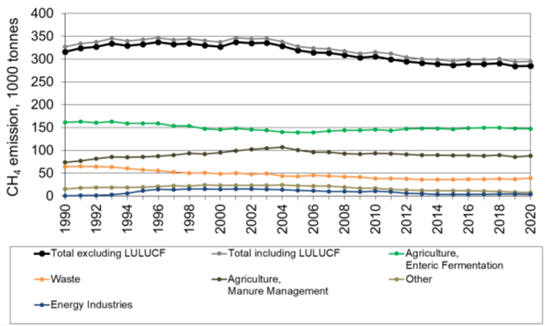
Source: Denmark’s National Inventory Report 2022 – Emission Inventories 1990-2020. 2022. https://dce2.au.dk/pub/SR494.pdf
The production of biogas in Denmark is increasing rapidly and is expected to continue to grow throughout the next decade.
Historical and Expected Future Biogas Production, 2012-2035
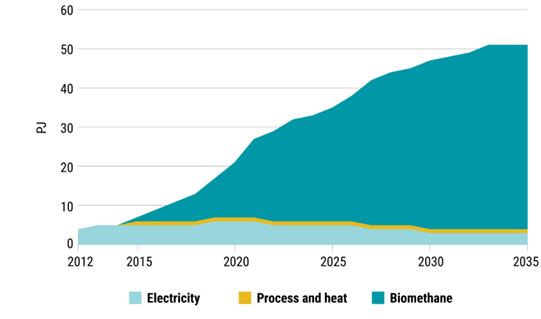
Source: Danish Energy Agency, Accessed September 2024: https://ens.dk/en/our-responsibilities/bioenergy/biogas-denmark
Methane Commitments and Plans
Methane mitigation efforts in Denmark are guided by federal and international commitments and plans. Denmark also engages in partnerships dedicated to addressing methane.
National
Denmark has a national climate plan and multi-sectoral strategies to achieve emissions reductions goals.
- Denmark’s Eighth National Communication on Climate Change was published in 2023 and reflects Denmark’s continued commitment to methane mitigation across the agriculture, waste, and energy sectors. As of 2020, methane emissions were down by 10% based on the 1990 baseline level.
- Denmark’s Climate Status and Projection 2021 offers insight into Denmark’s progress towards its environmental targets. The country’s methane emissions from landfills are expected to decrease by 81% by 2030.
- Denmark’s Green Gas Strategy was launched in 2021 and supports the county’s efforts to implement energy efficiency improvements, electrification of the Danish energy system, and increased production of biogas. The plan prioritizes the reduction of methane loss from biogas plants and will support regulatory measures to increase the monitoring of methane emissions.
- Climate Programme 2020 established an extensive list of guiding principles to support Denmark’s target of being a climate-neutral society by no later than 2050. This includes a goal to lower methane emissions from cattle by 35–40%
- Denmark’s National Energy and Climate Plan addresses climate action during 2021-2030 and focuses on decarbonization and the deployment of renewable energy, energy efficiency, energy security, the energy market, and research
International
Denmark actively supports international efforts to address methane emissions and reach global climate targets
- Denmark is a signatory of the Global Methane Pledge.
- The update of the Nationally Determined Contributions (NDC) of the European Union and its Member States was submitted in 2023, and sets the new target of reducing greenhouse gas emissions by 62 percent by 2030, as compared to 2005 emission levels.
- Denmark committed to the World Bank Group’s Zero Routine Flaring by 2030 Initiative in 2015.
- As a partner of the Climate and Clean Air Coalition since 2012, Denmark supports efforts focused on waste and household energy.
Methane Actions
The following highlights actions taken in Denmark to address methane, organized by GMI sector.
Biogas Sector
- In partnership with industry, agriculture, and environmental organizations, Denmark signed the Agreement on a Green Denmark which introduces a tax on carbon emissions from livestock starting in 2030 and increasing efforts to develop new climate technologies and initiatives. (2024)
- New regulation regarding the reduction of methane emissions from biogas production was implemented as of January 1st 2023, with annual mandatory leak detection and repair, self-monitoring programme, and cap on emissions from point sources. The guidance document outlines the procedure for the reporting to the Danish Energy Agency (DEA).
- Denmark allocated 2.9 billion DKK ($434 million USD) to support biogas and other green gasses between 2020 and 2030 in the green transition of industry outlined in the Danish Climate Agreement for Energy and Industry 2020. (2020)
- The 2012 Energy Agreement established 62 actions to improve energy efficiency, reliance on renewable energy in Denmark, and the availability of biogas for electricity and heat production. (2012)
Cross-Sector
- Denmark’s new economic model, Green Tax Reform, assesses the environmental impact of economic activity and policies. (February 2024)
- The Green Transition of the Agricultural Sector Agreement implements methane emission reduction requirements on the methane produced from enteric rumen fermentation, and from the use of feed additives for livestock. (October 2021)
- The Danish Climate Act of 26 June 2020 set a target of 70 percent greenhouse gas emissions reduction by 2030 compared to a 1990 baseline. (June 2020)
- The 1997 Statutory Order on Waste introduced a ban on the landfilling of combustible waste has resulted in a significant and lasting reduction in methane from landfills. The law is a large contributing factor to Denmark’s steady decrease in methane emissions from the waste sector. (1997)
Ministries and Agencies Supporting Methane Actions
Explore the following websites to learn more about the government ministries addressing methane emissions.
- Ministry of Climate, Energy, and Utilities
- Danish Council on Climate Change
- Environmental Protection Agency
- Ministry of Environment and Gender Equality
- Danish Energy Agency
- Ministry of Food, Agriculture and Fisheries of Denmark
- Ministry of Foreign Affairs
- Ministry of Transport
- Ministry of the Green Tripartite