Indonesia
The GMI Secretariat prepared this profile using publicly available information. If you are a delegate and wish to submit edits or additions, please contact the Secretariat at secretariat@globalmethane.org.
Indonesia joined the Global Methane Initiative in 2010 and participates in the Steering Committee and on the Biogas and Oil & Gas Subcommittees.
As a part of its broader climate strategy, Indonesia has implemented ambitious methane mitigation measures and policies to support landfill gas recovery efforts, methane capture and utilization, sustainable land management, and transition to clean energy alternatives. These efforts involve a robust national climate framework, as well as participation in international collaboration efforts to achieve emissions reduction targets.
On this page:
Methane Emissions Summary
Indonesia’s long-term strategy for reducing greenhouse gas (GHG) emissions addresses methane emitted from waste treatment processes and enteric fermentation. More significant efforts are directed towards abating GHG emissions from the energy sector. Coal, oil, and natural gas provide the majority of energy in Indonesia, and the uses of that energy have increased emissions by nearly 4 percent each year (2000-2019), with power plants and refineries contributing the highest percentage of emissions. The Low Carbon Scenario Compatible with Paris Agreement (LCCP) shows dramatic reductions in energy sector emissions through 2050.
Energy Supply Sources, 2000-2019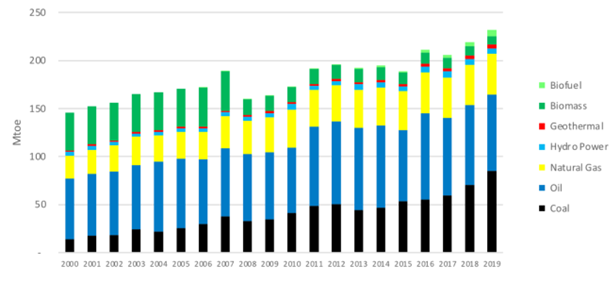
GHG Emission Sources, 2000-2019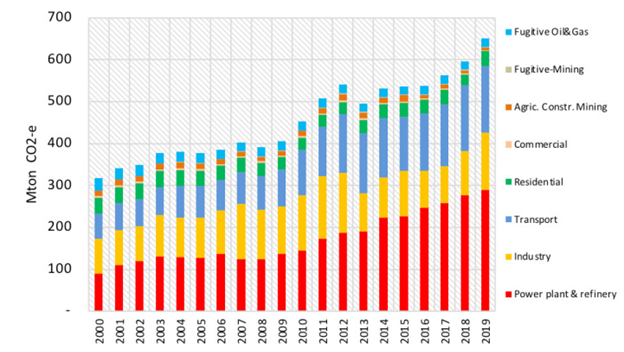
Projected Scenarios for GHG Emission Reductions Through 2050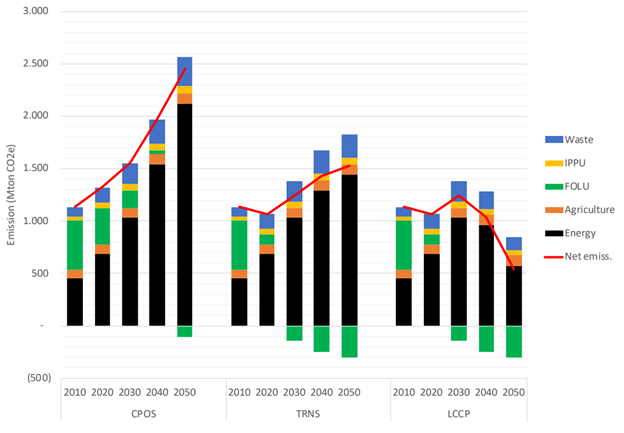
Source: Republic of Indonesia, Indonesia Long-Term Strategy for Low Carbon and Climate Resilience 2050, Accessed September 2024: https://unfccc.int/sites/default/files/resource/Indonesia_LTS-LCCR_2021.pdf
Methane Commitments and Plans
National
Indonesia has a national plan and multi-sectoral strategies to achieve emissions reductions goals.
- In 2021, Indonesia released its 2021 Long-Term Strategy for Low Carbon and Climate Resilience 2050 which establishes the country’s plan to reduce methane emissions in the waste and agriculture sectors.
- Indonesia’s 2021 Enhanced Nationally Determined Contributions reflect the country’s latest and more ambitious climate goals, including new greenhouse gas reduction goals and a targeted 1.2 million tons in methane recovery.
- Indonesia announced the National Biodiversity Strategy and Action Plan (INBSAP) in 2016.
- The Ministry of National Development Planning unveiled the National Action Plan for Climate Change Adaptation in 2014.
- In support of Indonesia’s goal of net-zero emissions by 2060, the REDD+ National Strategy, released in September 2012, establishes a national framework to reduce greenhouse gas emissions, through land management practices.
- Indonesia’s National Action Plan to Reduce Greenhouse Gas emissions of 2011 provides a national guideline for emissions reductions.
International
Indonesia actively supports and participates in international efforts to address methane emissions and reach global climate targets.
- At the Conference of Parties in 2021, Indonesia joined many countries in signing the Coal to Clean Power Transition statement, a collaborative effort to accelerate the deployment of clean power and transition from unabated generation of coal power.
- Indonesia signed the United Nations Paris Agreement in 2016.
Methane Actions
The following highlights actions taken in Indonesia to address methane, organized by GMI sector.
Biogas
- The Indonesia Domestic Biogas Program supports the shift to renewable energy, aims to improve waste management practices, and supports the monitoring of methane emission and methane capture activities. (2021)
- Government Regulation no. 81 of 2012 on Waste Management provides a framework for reducing methane emissions in the waste sector by improving waste segregation at the source, enforcing methane emissions standards for landfills, and supporting the development of waste-to energy facilities. (2012)
Cross-Sector
- Indonesia’s Government Regulation no. 22 of 2021 on Environmental Protection, Organisation and Management established a comprehensive framework for managing environmental actions across all sectors. (2021)
- The Government of Indonesia initiated the Climate Village Programme (PROKLIM) (2012) to address climate vulnerabilities by recognizing and supporting community climate action projects.
- The President Regulation 71/2011 on the Implementation of a National Greenhouse Gases Inventory established a greenhouse gas inventory guideline. (2011)
- Indonesia’s Law No. 32/2009 on Protection and Management of Environment is one of the country’s foundational environmental laws and provides the legal basis for enforcing environmental regulations and prohibiting actions that cause environmental damage. (2009)
Ministries and Agencies Supporting Methane Actions
Explore the following websites to learn more about the government ministries addressing greenhouse gas emissions and climate change in Indonesia.