Germany
The GMI Secretariat prepared this profile using publicly available information. If you are a delegate and wish to submit edits or additions, please contact the Secretariat at secretariat@globalmethane.org.
Germany is a founding member of the Global Methane Initiative (GMI), established in 2004, and participates in the Biogas Subcommittee.
Germany has made significant progress in reducing methane emissions as part of its comprehensive climate strategy. By improving practices in agriculture, waste management, and the energy sector, the country has committed to lowering methane output. In recent years, Germany has actively promoted energy efficiency and the use of renewable energy, including biomass. These efforts, driven by technological advancements and strengthened environmental regulations, have led to a steady reduction in methane emissions. This progress aligns with Germany’s broader climate goals and demonstrates its commitment to addressing methane emissions and mitigating climate change.
On this page:
Methane Emissions Summary
According to Germany’s National Inventory Report, methane emissions accounted for 6% of the country’s GHG emissions in 2021, stemming primarily from livestock, fuel distribution, and landfills. Since 1990, the energy and waste sectors have contributed significantly to methane emissions reductions in Germany. Methane emissions fell at a slower rate in the agriculture sector.
Methane Emissions Trend by Sector, 1990-2022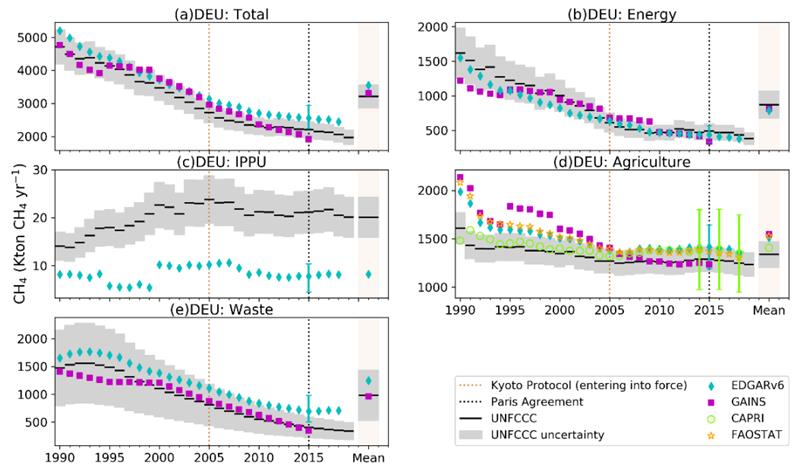
Source: Germany’s National Inventory Report (NIR), 2023. https://unfccc.int/documents/627785
Methane Commitments and Plans
Methane mitigation efforts in Germany are guided by national and subnational commitments and plans. Germany also participates in international partnerships dedicated to addressing climate change.
National
Germany has a national climate plan to support the country’s climate targets and achieve methane emissions reductions goals.
- Germany submitted its final National Energy and Climate Plan (NECP) to the European Commission, which includes measures related to lowering methane. (2024)
- Released in 2017, Germany’s Seventh National Communication on Climate Change report to the United Nations Framework Convention on Climate Change (UNFCC) describes the country’s actions and identifies steps taken and progress towards reducing methane emissions.
International
Germany actively supports and contributes to international efforts to address methane emissions and reach global climate targets.
- Germany joined the Global Methane Pledge (GMP) at its launch in 2021 at the United Nations (UN) Climate Change Conference (COP26). As a “Global Methane Pledge Champion,” Germany provides leadership to advance the work of the GMP.
- Germany signed the Paris Agreement on climate change in April 2016, committing to significant measures to combat climate change, including reducing methane emissions.
- Germany has been a partner of the Climate and Clean Air Coalition since 2012, supporting activities to reduce methane and other short-lived climate pollutants.
Methane Actions
The following highlights a sampling of actions taken by Germany to address methane, organized by GMI sector.
Biogas Sector
- As part of its Climate Action Program 2030, the German government has implemented several initiatives to mitigate food waste and promote sustainable agriculture. These initiatives highlight the importance of sustainable farming practices and address the issue of unnecessary food waste.
Ministries and Agencies Supporting Methane Actions
Many German ministries and offices address greenhouse gas emissions and climate change, including methane-specific programs. Explore the following websites to learn more.
- Umwelt Bundesamt
- Ministry of Food and Agriculture
- Ministry for Economic Affairs and Climate Action
- Ministry for the Environment, Nature Conservation, Nuclear Safety and Consumer Protection
- Federal Foreign Office
- Federal Institute for Geosciences and Natural Resources
- Ministry for Economic Cooperation and Development