Poland
The GMI Secretariat prepared this profile using publicly available information. If you are a delegate and wish to submit edits or additions, please contact the Secretariat at secretariat@globalmethane.org.
Poland joined the Global Methane Initiative (GMI) in 2007 and serves on the Biogas, Coal, and Oil & Gas Subcommittees.
Poland is taking meaningful steps to tackle methane emissions through a variety of strategies and actions. Through national and international commitments, the country is actively working to reduce methane output by promoting the use of biogas and biomethane, supporting sustainable agriculture, and increasing methane capture from the coal mines sector. These efforts, along with international initiatives, demonstrates Poland’s commitment to global efforts in reducing methane emissions and combating climate change.
On this page:
Methane Emissions Summary
According to Poland’s National Inventory Report, published in 2023, methane emissions accounted for 10.7% of total emissions in 2021, amounting to 1,525.17 kilotons (kt). The majority of these emissions originated from the energy sector (54%) the agriculture sector (37.5%), and the waste sector (8.4%).
Methane Emissions by Sector, 2021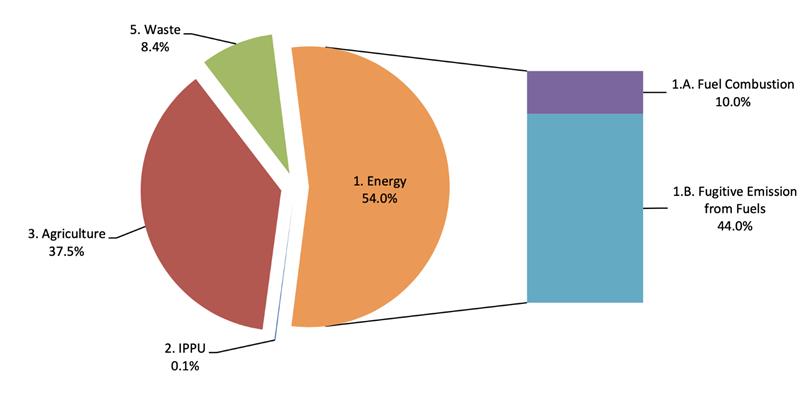
Source: Source: Poland’s National Inventory Report, 2023. https://unfccc.int/documents/627153
Methane Commitments and Plans
Methane mitigation efforts in Poland are guided by national and international commitments and plans.
National
Poland has outlined strategies and commitments to address methane emissions at the national level in their energy action plan.
- Poland’s National Action Plan in the Field of Energy and Climate by 2030, published in 2019, outlines strategies to reduce methane emissions. Key components of the plan include promoting the increased use of biogas and biomethane, as well as minimizing methane emissions associated with fuel production and distribution. Additionally, the plan outlines initiatives to tackle methane emissions from the agriculture and coal mining sectors.
International
Poland is an active participant in international commitments and efforts to reduce methane emissions to reach global climate targets.
- Poland joined the Global Methane Pledge (GMP) in 2021 at the United Nations (UN) Climate Change Conference (COP26), agreeing to take voluntary actions to contribute to a collective effort to reduce global methane emissions by 30% from 2020 levels by 2030.
- Poland contributes expertise and resources to the UN Economic Commission for Europe (UNECE), including support for the UNECE Group of Experts on Gas and Group of Experts on Coal and Just Transition whose activities are focused on methane abatement, among other sustainable development goals.
- Poland has been a partner of the Climate and Clean Air Coalition since 2013, supporting activities to reduce methane and other short-lived climate pollutants.
Methane Actions
The following highlights a sampling of actions taken by Poland to address methane, organized by GMI sector.
Biogas Sector
- Poland signed an agreement aimed at enhancing the biogas and biomethane sector. This initiative seeks to promote local Polish technologies and entrepreneurs in biogas production. The agreement facilitates collaboration among various stakeholders to support the development of biogas and biomethane plants and advance the country’s energy transition. (November 2021)
Coal Mines Sector
- In 2017, the International Center of Excellence on Coal Mine Methane was opened in Poland. The center aims to support safer and more sustainable coal mining practices by focusing on methane management of coal mines. (June 2017)
Cross-Sector
- In 2021, Poland adopted the Energy Policy of Poland Until 2040 (EPP2040), which aims to support the energy transition and reduce methane emissions through various initiatives. The policy promotes biomethane use, coalbed methane extraction, and capturing surplus methane from coal mining and ventilation air.
Ministries and Agencies Supporting Methane Actions
Explore the following websites to learn more about the government ministries addressing methane emissions.