Türkiye
Türkiye joined the Global Methane Initiative (GMI) in 2010 and provides support as a member of the Steering Committee and the Biogas, Coal Mines, and Oil & Gas Subcommittees.
The Turkish government has committed to a range of environmental mitigation measures to address climate change, including policies to reduce methane emissions. Specifically, Türkiye is targeting methane by investing in renewable energy sources, improving sustainable agricultural practices, promoting the use of biogas from organic waste, and increasing the efficiency of waste treatment. In addition to its national climate strategy, Türkiye has committed to international climate agreements that highlight methane reduction goals and greenhouse gas mitigation measures.
On this page:
Methane Emissions Summary
Methane emissions in Türkiye increased by 52% between 1990 and 2021. Methane is the country’s second most significant greenhouse gas, after CO2. Enteric fermentation from agriculture and solid waste disposal from the waste sector are the most significant sources of Türkiye’s methane emissions.
Türkiye’s Methane Emissions (kt) by Sector, 1990-2021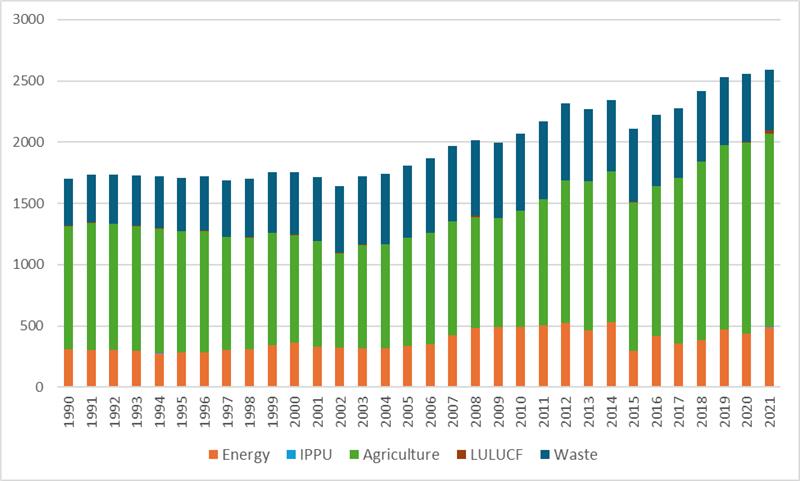
Source: Turkish Statistical Institute, Turkish Greenhouse Gas Inventory 1990-2021 Under the UNFCCC, accessed October 2024
The recovery of methane from waste disposal sites and wastewater treatment plants increased significantly from 2002 onwards. The number of landfill sites with methane recovery increased from 1 in 2002 to 84 in 2022 and the amount of methane recovered in these facilities rose to 303 kt from 2.2 kt. Likewise, the number of wastewater biogas facilities with methane recovery increased from 2 to 25 between 2002 to 2020, bringing a rise in methane recovery from 8.5 kt to 30.9 kt.
Recovered Methane from Solid Waste Treatment Facilities, 2002-2020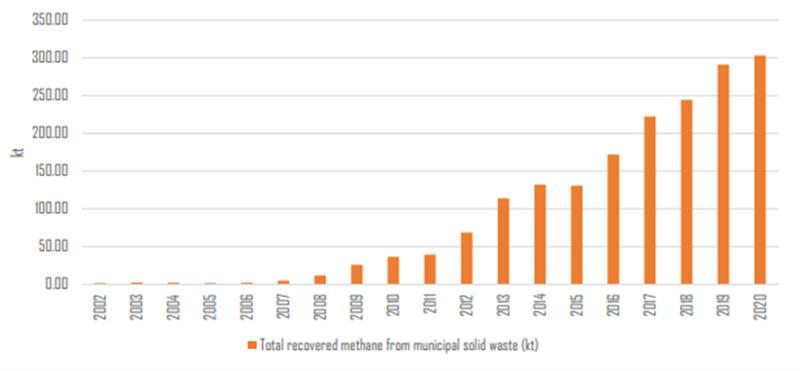
Recovered Methane from Wastewater Treatment Facilities, 2002-2020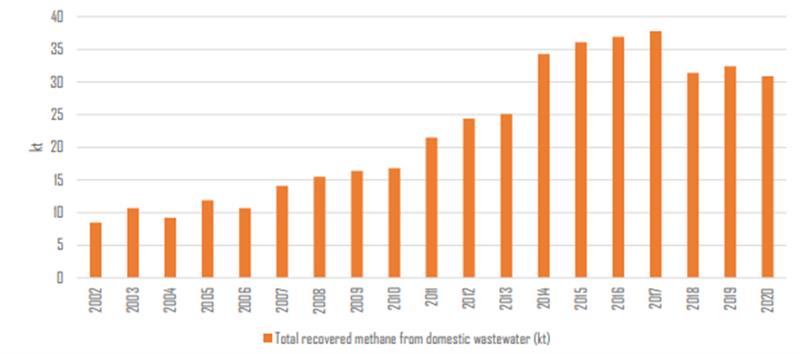
Source: Republic of Türkiye Ministry of Environment and Urbanization, Eighth National Communication of Türkiye Under the United Nations Framework Convention on Climate Change (UNFCCC).
Methane Commitments and Plans
National
Türkiye has in place a national action plan, regulations, and strategies.
- The 2024 Twelfth Development Plan outlines Türkiye’s sustainability and social development goals, including strategies for reducing methane emissions by studying alternative feeding sources for livestock and methane emissions in the mining sector.
- The Eighth National Communication and Fifth Biennial Report of Türkiye Under the UNFCCC, published in 2023, includes details on the country’s methane emissions and methane recovery activities.
- The 2023 Republic of Türkiye Updated First Nationally Determined Contribution establishes Türkiye’s new climate targets including a 41% reduction in greenhouse gas emissions by 2030 and the long-term goal of achieving a net zero target by 2053. Türkiye commits to reducing methane emissions in the agricultural, waste, energy, and land sectors.
- The Climate Change Mitigation Strategy and Action Plan 2024-2030 provides a wide range of sectoral strategies and action items to reduce emissions across the economic sectors, including specific measures to reduce methane emissions.
- Türkiye’s National Energy Plan (2020 – 2035) outlines actions to increase use of renewable energy sources to achieve the country’s 2053 Net Zero Emissions target.
- The 2017 Wastewater Treatment Action Plan aims to improve Türkiye’s wastewater treatment capacity, and increase the number of wastewater biogas facilities with methane recovery.
- Türkiye’s 2016 Waste Management Action Plan aims to support sustainable waste management strategies and improve waste recycling and recovery activities.
International
Türkiye engages with international efforts to address methane challenges.
- Türkiye signed the United Nations Paris Agreement in 2016 and ratified the Agreement in 2021.
- In 2004, Türkiye ratified the United Nations Framework Convention on Climate Change (UNFCCC).
Methane Actions
The following highlights actions taken in Türkiye to address methane, organized by GMI sector.
Biogas Sector
- Biomethanization and composting facilities are being rapidly established in Türkiye, allowing organic waste to be utilized as products for energy and agriculture. Renewable energy generation in Türkiye is supported by the Renewable Energy Resources Support Mechanism (YEKDEM in Turkish). Both landfill facilities that capture landfill gas and biomethanization facilities that produce biogas are eligible for guaranteed tariffs set for the first 10 years. The number of these facilities, supported by YEKDEM, is rapidly increasing. According to YEKDEM data from 2023, the annual production capacity registered under licenses at 99 energy production facilities (landfill gas + biomethanization) across 60 provinces totals 5,293,425 MWh. These facilities have reached an installed capacity of 501 MW and have contributed to greenhouse gas reduction and renewable energy production through methane utilization.
Coal Mines Sector
- Turkish Petroleum Law No. 6491 implemented new regulatory limits on methane gas production in mining operations. (2016)
Cross-Sector
- The Turkish Greenhouse Gas Inventory 1990-2021 provides a comprehensive assessment of Türkiye’s methane emissions sources which include agricultural practices, landfill sites and waste management, and livestock.
- The Climate Change Mitigation Strategy and Action Plan 2024-2030 includes 49 strategies and 260 actions in 7 main mitigation sectors (energy, industry, buildings, transport, waste, agriculture, LULUCF) and cross-cutting areas.
- The Green Deal Action Plan of Türkiye outlines 32 targets and 81 actions designed to reduce greenhouse gas emissions, increase use of renewable energy, and build climate conscious infrastructure. (July 2021)
Ministries and Agencies Supporting Methane Actions
Explore the following websites to learn more about the ministries that address greenhouse gas emissions and climate change.