showcase_l_Page_14.png

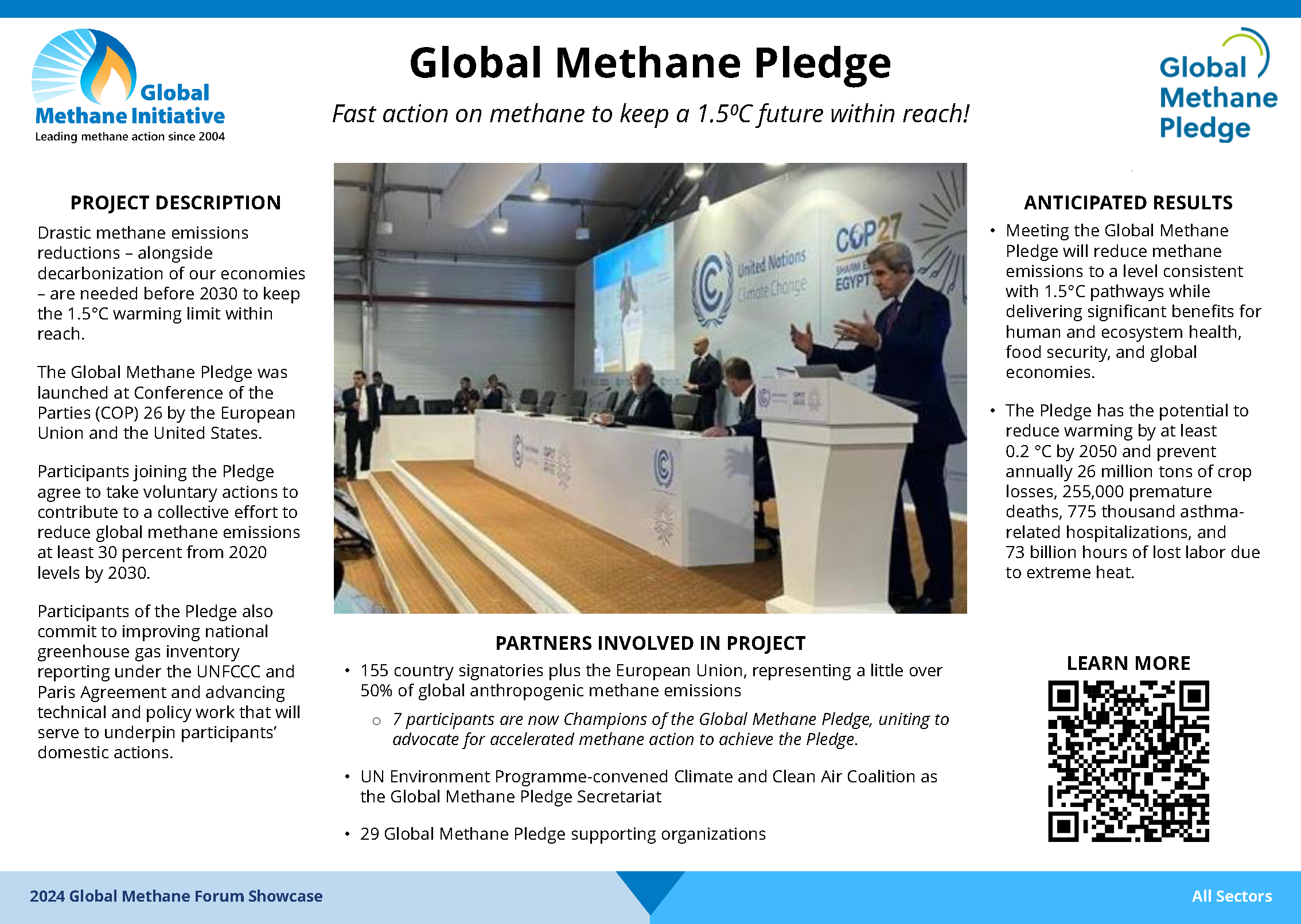
Global Methane Pledge

The Global Methane Pledge was launched in 2021 by the European Union and the United States. The Pledge is represented by 155 countries (as of March 2024). Meeting the Global Methane Pledge will reduce methane emissions to a level consistent with 1.5˚C pathways while delivering significant benefits for human and ecosystem health, food security, and global economies. The Pledge has the potential to reduce warming by 0.2˚C by 2050 and to prevent numerous losses of food, human life, and labor.

Partners

  • U.S. Environmental Protection Agency (U.S. EPA)
  • 155 country signatories plus the European Union
  • UN Environment Programme (UNEP)
  • Climate & Clean Air Coalition (CCAC)
  • 29 Global Methane Pledge supporting organizations
Download
Topic
Region
Language
Publish Date
01 Jan 2022
showcase_l_Page_21.png

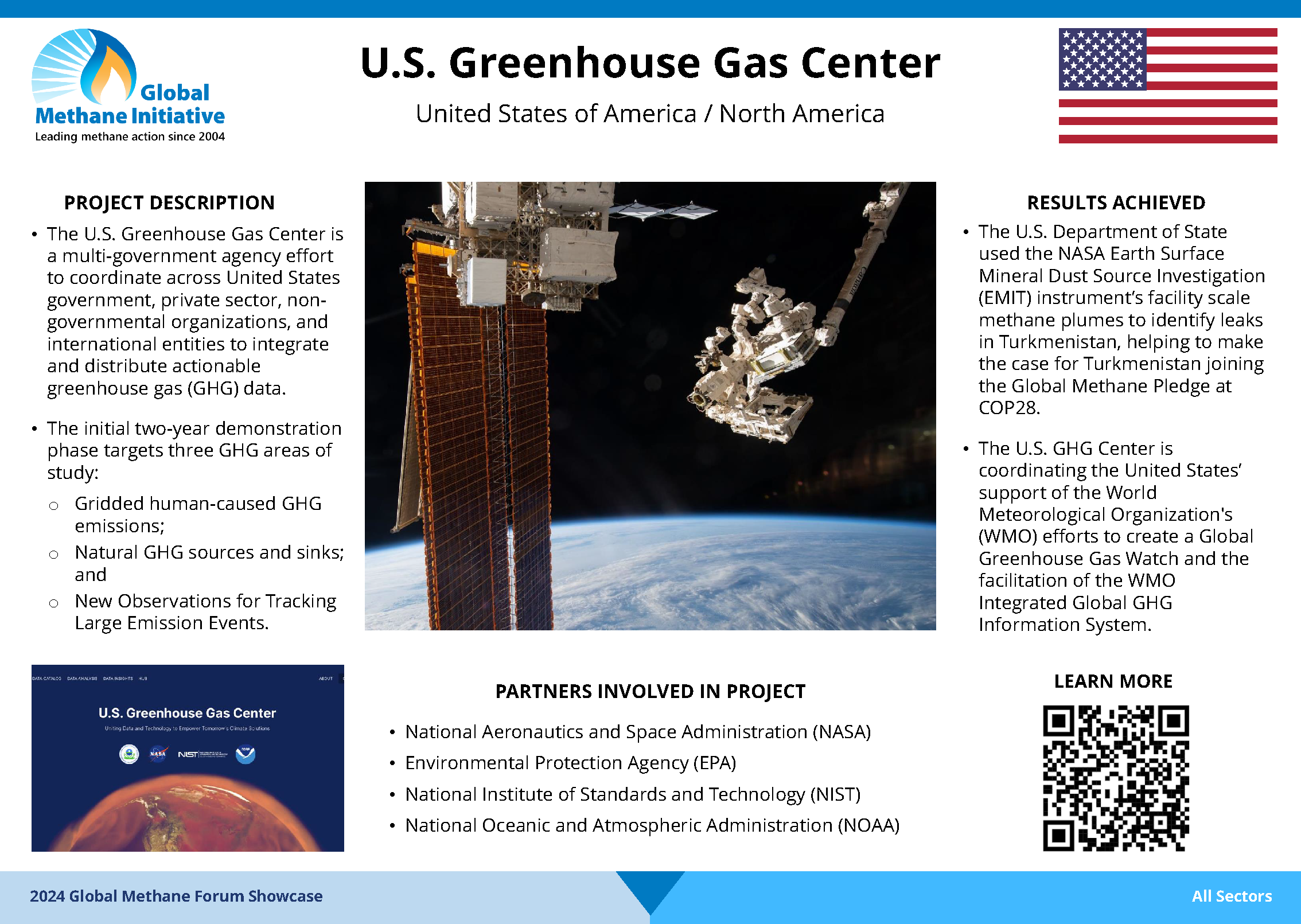
U.S. Greenhouse Gas Center

The U.S. Greenhouse Gas Center is a multi-government agency effort to coordinate across the United States government, private sector, non-governmental organizations, and international entities to integrate and distribute actionable greenhouse gas (GHG) data. The initial 2-year demonstration phase targets three GHG areas of study: gridded human-caused GHG emissions; natural GHG sources and sinks; and new observations for tracking large emission events. The Center has already helped make the case for Turkmenistan to join the Global Methane Pledge and is coordinating U.S. support of the World Meteorological Organization's efforts to create a Global Greenhouse Gas Watch.

Partners

  • National Aeronautics and Space Administration (NASA)
  • U.S. Environmental Protection Agency (U.S. EPA)
  • National Institute of Standards and Technology
  • National oceanic and Atmospheric Administration
Download
Topic
Region
Language
Publish Date
01 Jan 2023
showcase_l_Page_11.png

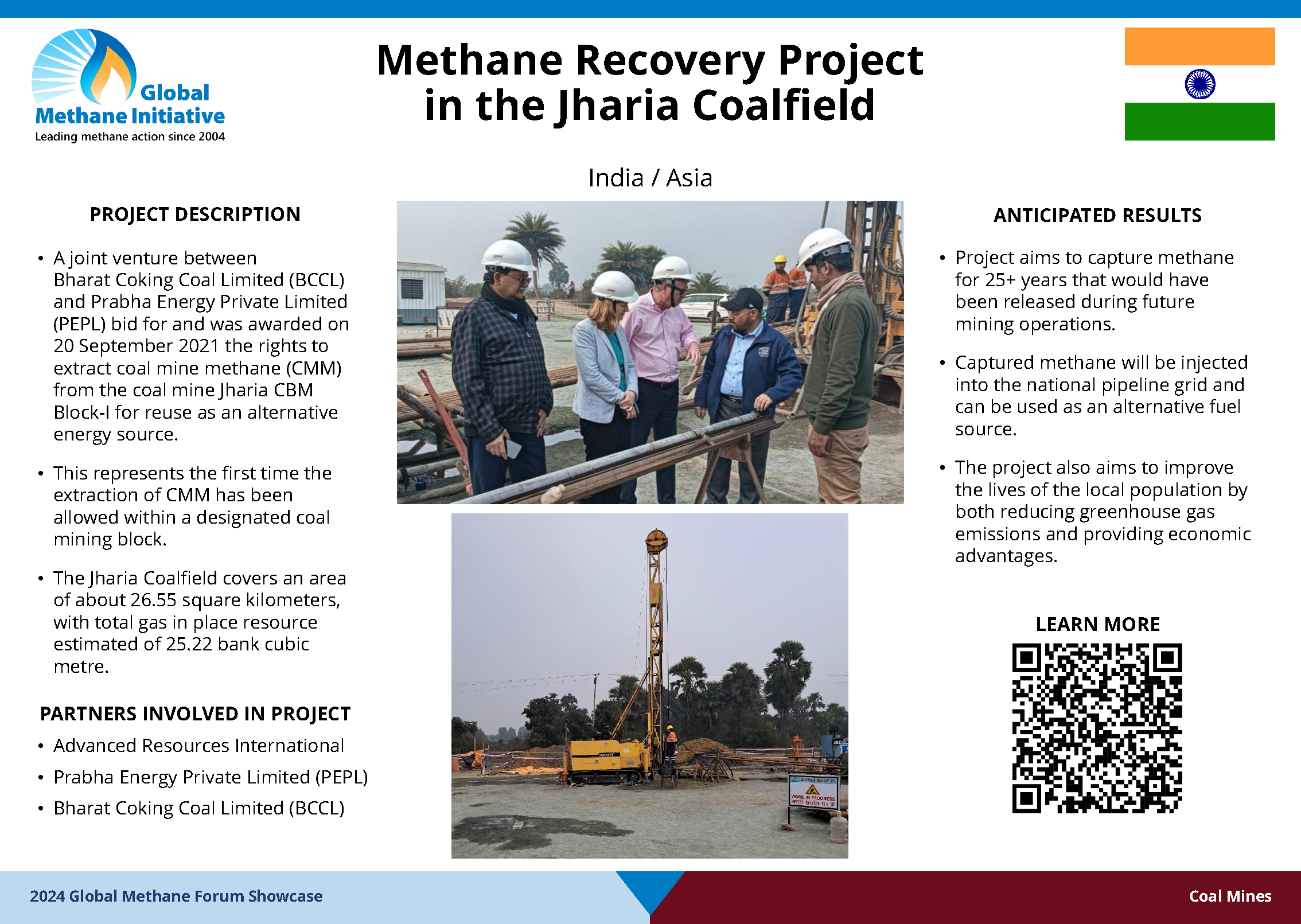
Methane Recovery Project in the Jharia Coalfield

A joint venture bid was awarded for the rights to extract coal mine methane from the coal mine Jharia CBM Block-I for reuse as an alternative source. The project aims to capture methane for 25+ years. The methane will then be injected into the national pipeline grid and can be used as an alternative energy source. Lives of the local population should be improved by both reducing greenhouse gas emissions and providing economic advantages.

Partners

  • Advanced Resources International
  • Prabha Energy Private Limited
  • Bharat Coking Coal Limited
Download
Topic
Region
Language
Publish Date
01 Jan 2024
thumb-Best Practice Guidance for Effective Management of Coal Mine Methane at National Level.png

Best Practice Guidance for Effective Management of Coal Mine Methane at National Level: Monitoring, Reporting, Verification and Mitigation

GMI led the development of this resource on monitoring, reporting and verification (MRV) of methane emissions from coal mining. The report, Best Practice Guidance for Effective Management of Coal Mine Methane at National Level: Monitoring, Reporting, Verification and Mitigation, was published jointly with the UNECE Group of Experts on Coal Mine Methane and Just Transition. The document aims to assist countries with designing national systems to quantify and report methane emissions from coal mines. National MRV programs have the potential to not only help countries better understand their emissions from coal mining, but also to identify opportunities for mitigation. In particular, MRV can help assess and track the effectiveness of adopted climate policies.

Download
Topic
Language
Publish Date
01 Jan 2022
thumb-Global Methane Emissions from Coal Mining to Continue Growing Even with Declining Coal Production.png

Global Methane Emissions from Coal Mining to Continue Growing Even with Declining Coal Production

Coal mines are one of the largest sources of anthropogenic methane emissions. As the world produces more coal, coal mines get deeper every year, and methane emissions grow with increasing mining depth. Mine operators also abandon old coal mines, which still emit methane into the atmosphere. The U.S. EPA, in collaboration with the Global Methane Initiative and several other organizations, co-authored this paper that presents projections of global methane emissions from coal mining under different coal extraction scenarios and with increasing mining depth through 2100. The study estimates methane emissions from underground and surface coal production while accounting for the increase in mining depth using several new and compiled data sets. The results show that total methane emissions from coal mining are higher than suggested by previous studies. More importantly, methane emissions from the growing number of abandoned mines increase faster than methane emissions from existing mines. Abandoned mine methane emissions continue through the century even with aggressive mitigation actions. The study concludes that future methane emissions are significantly higher than those in previous studies and that methane resources at abandoned mines will grow regardless of future coal production. This research provides insights for improving future emissions inventories.

Download
Topic
Language
Publish Date
01 Jan 2020
thumb-san-juaquin.jpg

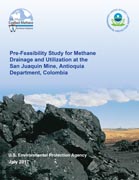
Pre-Feasibility Study for Methane Drainage and Utilization at the San Juaquin Mine, Antioquia Department, Colombia

This pre-feasibility study was completed to determine the feasibility of a coal mine methane (CMM) capture and utilization project at the San Juaquin Mine. Specifically, this study aimed to evaluate the technical and economic viability of methane drainage utilizing vertical pre-drainage boreholes drilled from the surface and in-seam pre-drainage boreholes drilled from within mine workings, and to identify end-use options.

Download
Topic
Language
Publish Date
01 Jan 2021
thumb-CMM 101.jpg

Basics of Coal Mine Methane Training (Indonesian)

Dasar-dasar Metana Tambang Batu Bara

Pelatihan ini dikembangkan oleh Badan Perlindungan Lingkungan Amerika Serikat (United States Environmental Protection Agency/USEPA) dalam mendukung kegiatan sukarela untuk mengurangi emisi metana dalam Program Penjangkauan Gas Metana Batu Bara (Coalbed Methane Outreach Program/CMOP) dan Inisiatif Metana Global (GMI).

Dalam pelatihan ini, Anda akan mempelajari topik-topik berikut ini:

  • Mengapa terdapat metana dalam batu bara?
  • Apa metode utama untuk mengekstrak batu bara?
  • Apa karakteristik emisi metana dari tambang batu bara, atau yang dikenal sebagai metana tambang batu bara (coal mine methane/CMM)?
  • Bagaimana metana ditangkap menggunakan ventilasi tambang dan drainase gas?
  • Apa penggunaan yang bermanfaat dari metana yang ditangkap?

Melihat pelatihan.

Topic
Language
Publish Date
05 Oct 2024
thumb-CMM 101.jpg

Basics of Coal Mine Methane Training (Spanish)

Conceptos básicos del metano de las minas de carbón

Esta capacitación fue desarrollada por la Agencia de Protección Ambiental de los Estados Unidos (USEPA) en apoyo de las actividades voluntarias para reducir las emisiones de metano en el marco del Programa de Alcance del Metano de Capas de Carbón (CMOP) y la Iniciativa Global de Metano (GMI). En este curso aprenderás sobre los siguientes temas:

  • ¿Por qué hay metano en el carbón?
  • ¿Cuáles son los principales métodos de extracción del carbón?
  • ¿Cuáles son las características de las emisiones de metano de las minas de carbón, también conocidas como metano de las minas de carbón (CMM)?
  • ¿Cómo se captura el metano usando la ventilación de la mina y el drenaje de gas?
  • ¿Cuáles son los usos beneficiosos del metano capturado?

Ver el Conceptos básicos del metano de las minas de carbon curso.

Topic
Language
Publish Date
13 Jan 2023
thumb-CMM 101.jpg

Basics of Coal Mine Methane Training

This training provides basic information about methane that is emitted through coal mining and summarizes potential mitigation options. The training was developed by U.S. EPA and reviewed by the Coal Mines Subcommittee in support of voluntary activities to reduce methane emissions under the Coalbed Methane Outreach Program (CMOP) and the Global Methane Initiative (GMI). 

The following topics are covered in the course:

  • Why is there methane in coal?
  • What are the primary methods of extracting coal?
  • What are the characteristics of methane emissions from coal mines?
  • How is methane captured using mine ventilation and gas drainage?
  • What are the beneficial uses of captured methane?

View the Basics of Coal Mine Methane Training Course.

A text version of the training is provided below.

Download
Topic
Language
Publish Date
05 Sep 2024
thumb-amm.png

Conducting Pre-Feasibility Studies for Abandoned Mine Methane Projects Training

The U.S. EPA is developing this training course in support of the GMI and in conjunction with the United Nations Economic Commission for Europe (UNECE). This course introduces principles for assessing the potential of developing projects to mitigate Abandoned Mine Methane (AMM). Determining if an AMM project is feasible requires an assessment of the project’s potential through a pre-feasibility study. Such studies are typically carried out by a project developer, or another third party, in partnership with a government organization.

AMM project developers, third parties, mining company personnel, and government officials can all benefit from this training. The course is divided into seven separate modules, six of which are now available.

A text version of each online module is available below.

Download
Topic
Language
Publish Date
01 Jul 2022
Subscribe to Coal Mines