showcase_p_Page_07.png

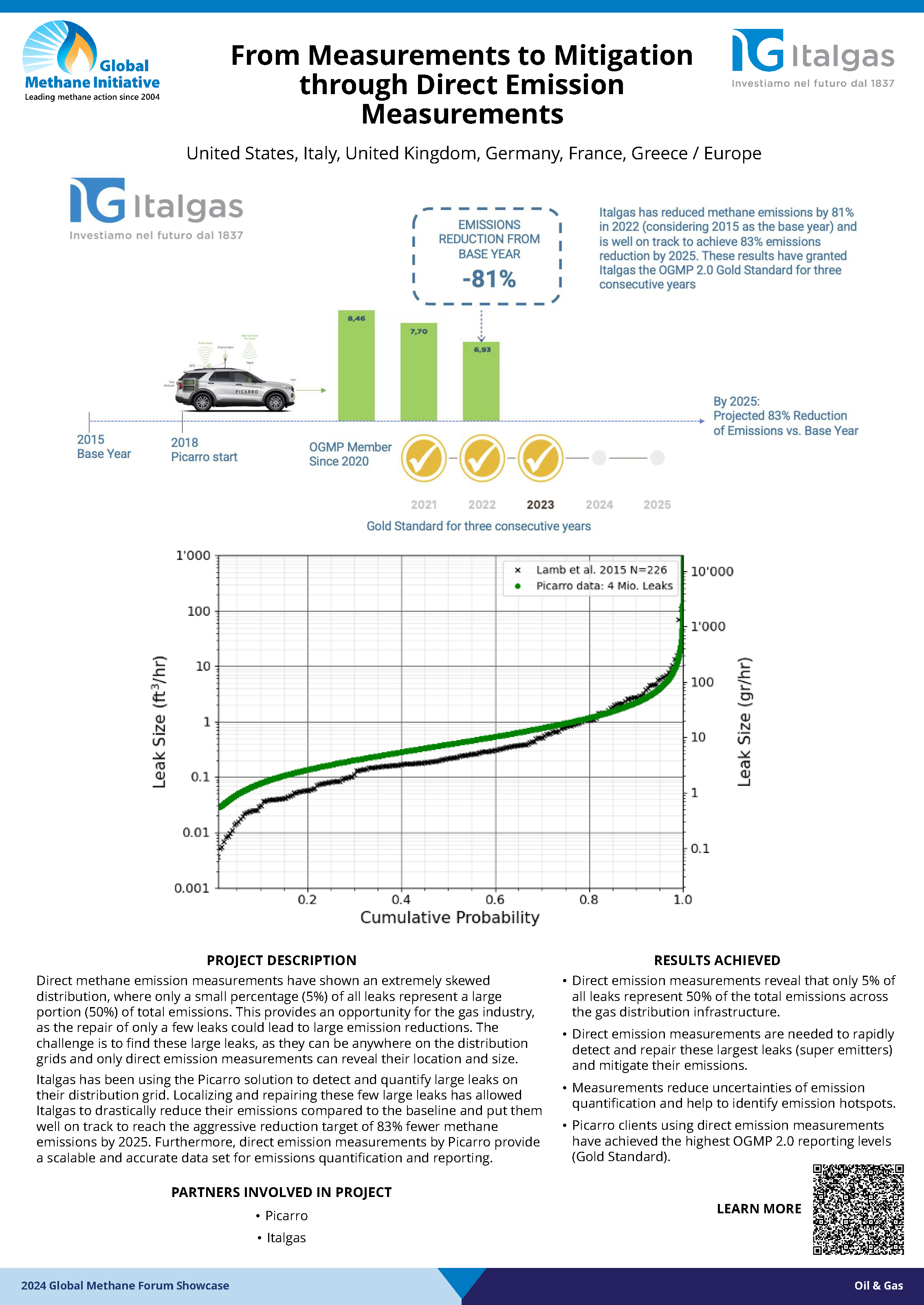
From Measurements to Mitigation through Direct Emission Measurements

Italgas has been using the Picarro solution to detect and quantify large leaks on the distribution grid. Localizing and repairing these few large leaks has allowed Italgas to drastically reduce their emissions compared to the baseline and put them well on track to reach the aggressive reduction target of 83% fewer methane emissions by 2025. Picarro clients using direct emission measurements have achieved the highest OGMP 2.0 reporting levels (Gold Standard).


Partners

  • Picarro
  • Italgas
Download
Topic
Region
Language
Publish Date
01 Jan 2018
showcase_l_Page_21.png

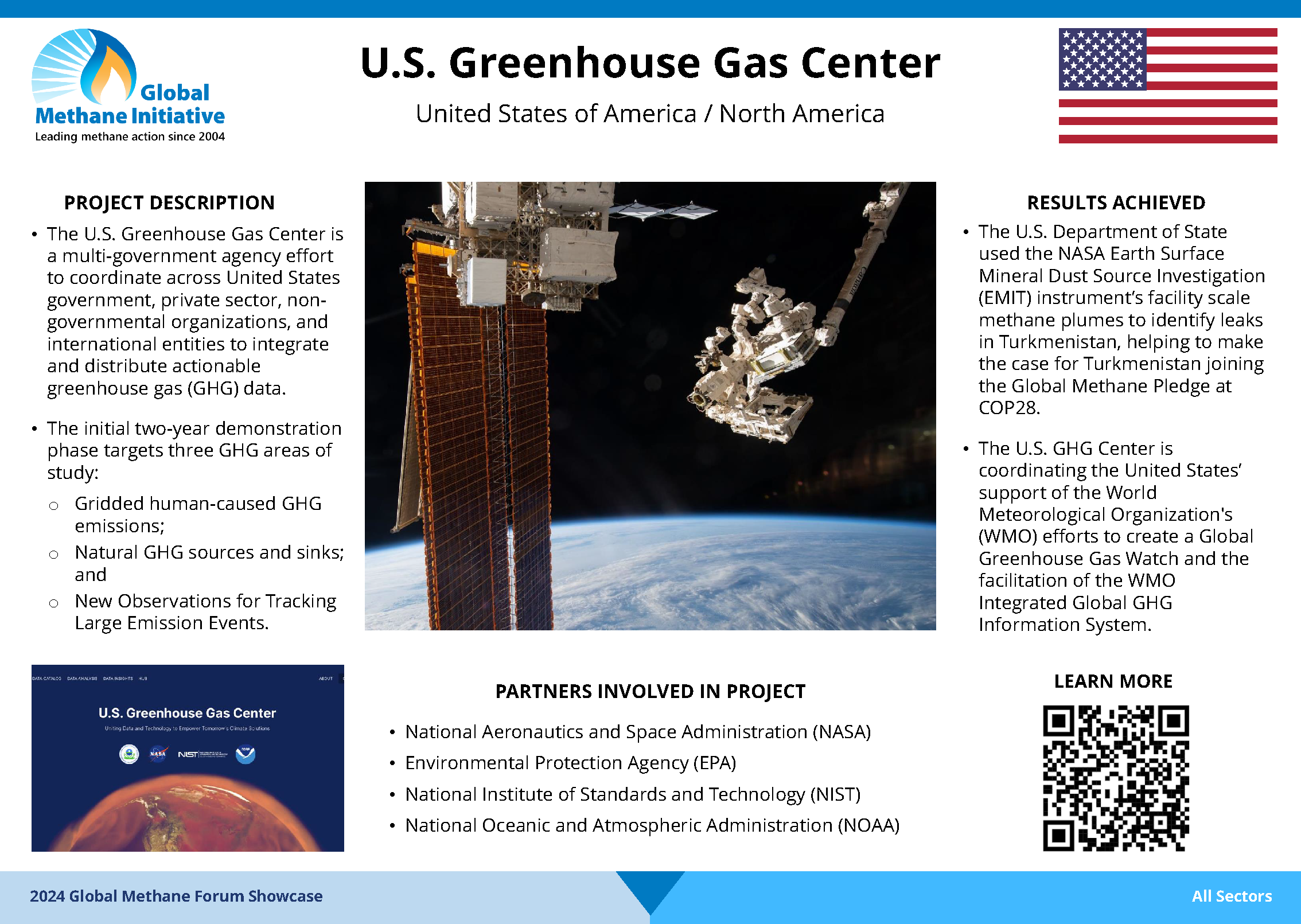
U.S. Greenhouse Gas Center

The U.S. Greenhouse Gas Center is a multi-government agency effort to coordinate across the United States government, private sector, non-governmental organizations, and international entities to integrate and distribute actionable greenhouse gas (GHG) data. The initial 2-year demonstration phase targets three GHG areas of study: gridded human-caused GHG emissions; natural GHG sources and sinks; and new observations for tracking large emission events. The Center has already helped make the case for Turkmenistan to join the Global Methane Pledge and is coordinating U.S. support of the World Meteorological Organization's efforts to create a Global Greenhouse Gas Watch.

Partners

  • National Aeronautics and Space Administration (NASA)
  • U.S. Environmental Protection Agency (U.S. EPA)
  • National Institute of Standards and Technology
  • National oceanic and Atmospheric Administration
Download
Topic
Region
Language
Publish Date
01 Jan 2023
showcase_l_Page_04.png

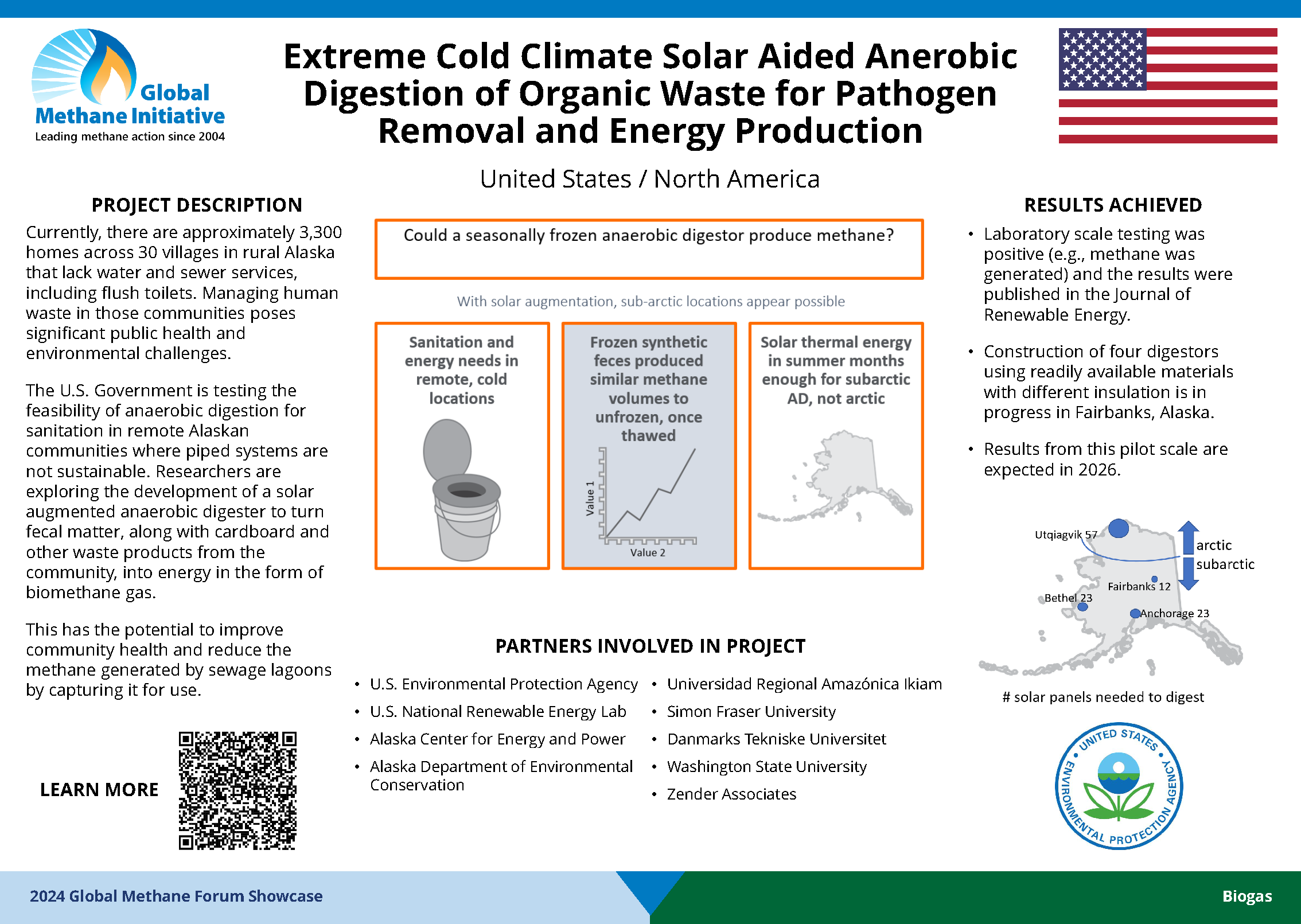
Extreme Cold Climate Solar Aided Anerobic Digestion of Organic Waste for Pathogen Removal and Energy Production

The United States Government is testing the feasibility of anaerobic digestion for sanitation in remote Alaskan Communities where piped systems are not sustainable. Researchers are exploring the development of a solar augmented anaerobic digester to turn fecal matter, along with cardboard and other waste products from the community, into energy in the form of biomethane gas. Four digesters are being constructed using different insulation and the results from this pilot are expected in 2026.

Partners

  • U.S. Environmental Protection Agency (U.S. EPA)
  • U.S. National Renewable Energy Lab
  • Alaska Center for Energy and Power
  • Alaska Department of Environmental Conservation
  • Universidad Regional Amazonica Ikiam
  • Simon Fraser University
  • Danmarks Tekniske Univ
Download
Topic
Region
Language
Publish Date
01 Jan 2023
showcase_l_Page_22.png

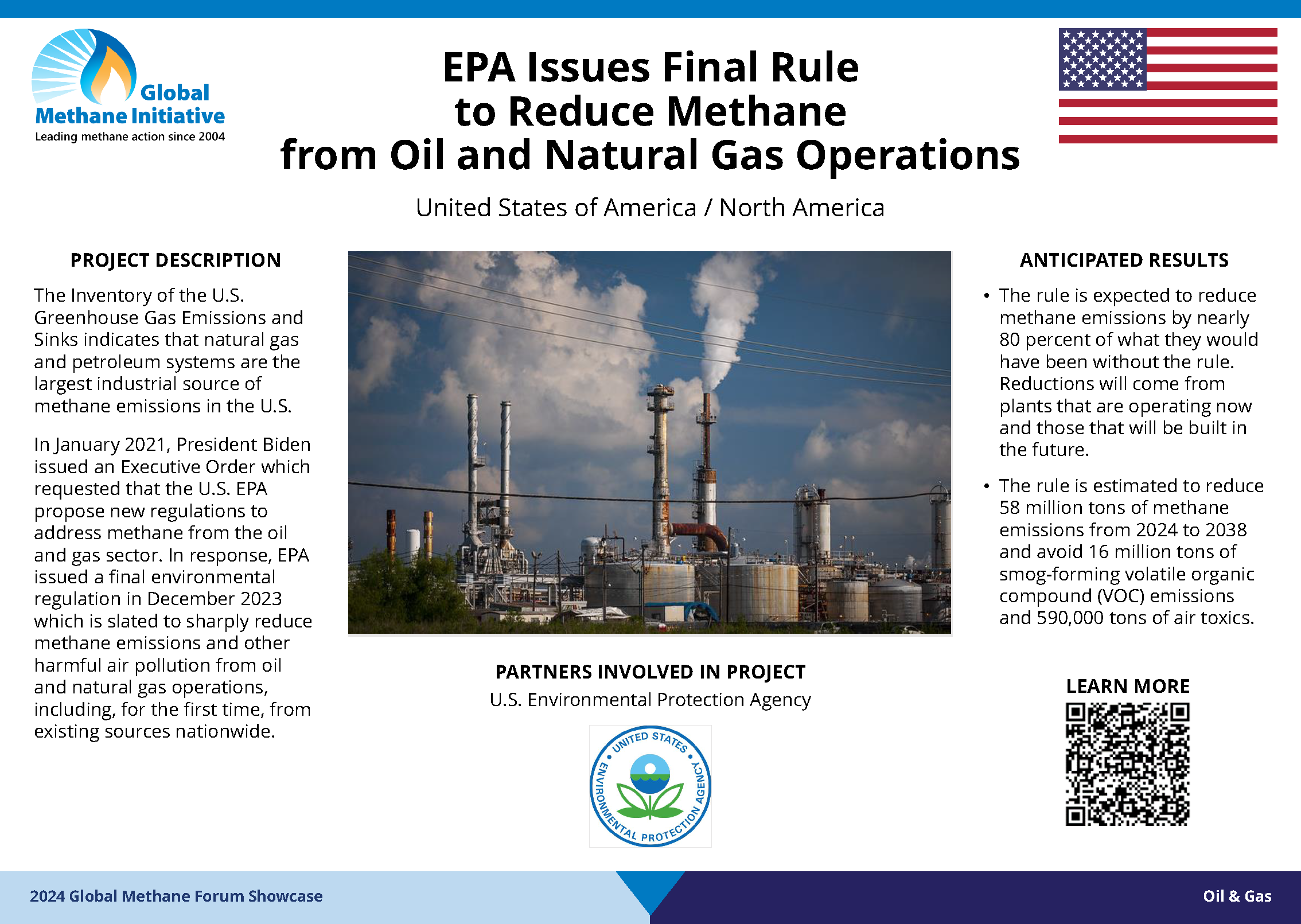
EPA Issues Final Rule to Reduce Methane from Oil and Natural Gas Operations

The Inventory of the U.S. Greenhouse Gas Emissions and Sinks indicates that natural gas and petroleum systems are the largest industrial source of methane emissions in the United States. In 2023, the U.S. Environmental Protection Agency issued a final environmental regulation that is slated to sharply reduce methane emissions and other harmful air pollution from oil and natural gas operations, including from existing sources nationwide. The rule is expected to reduce methane emissions by nearly 80% of what they would have been without the rule. It is also estimated to reduce 58 million tons of methane emissions from 2024 to 2038 and avoid 16 million tons of smog-forming volatile organic compound emissions and 590,000 tons of air toxics.

Partners

  • U.S. Environmental Protection Agency (U.S. EPA)
Download
External Link
Topic
Region
Language
Publish Date
01 Jan 2024
showcase_l_Page_01.png

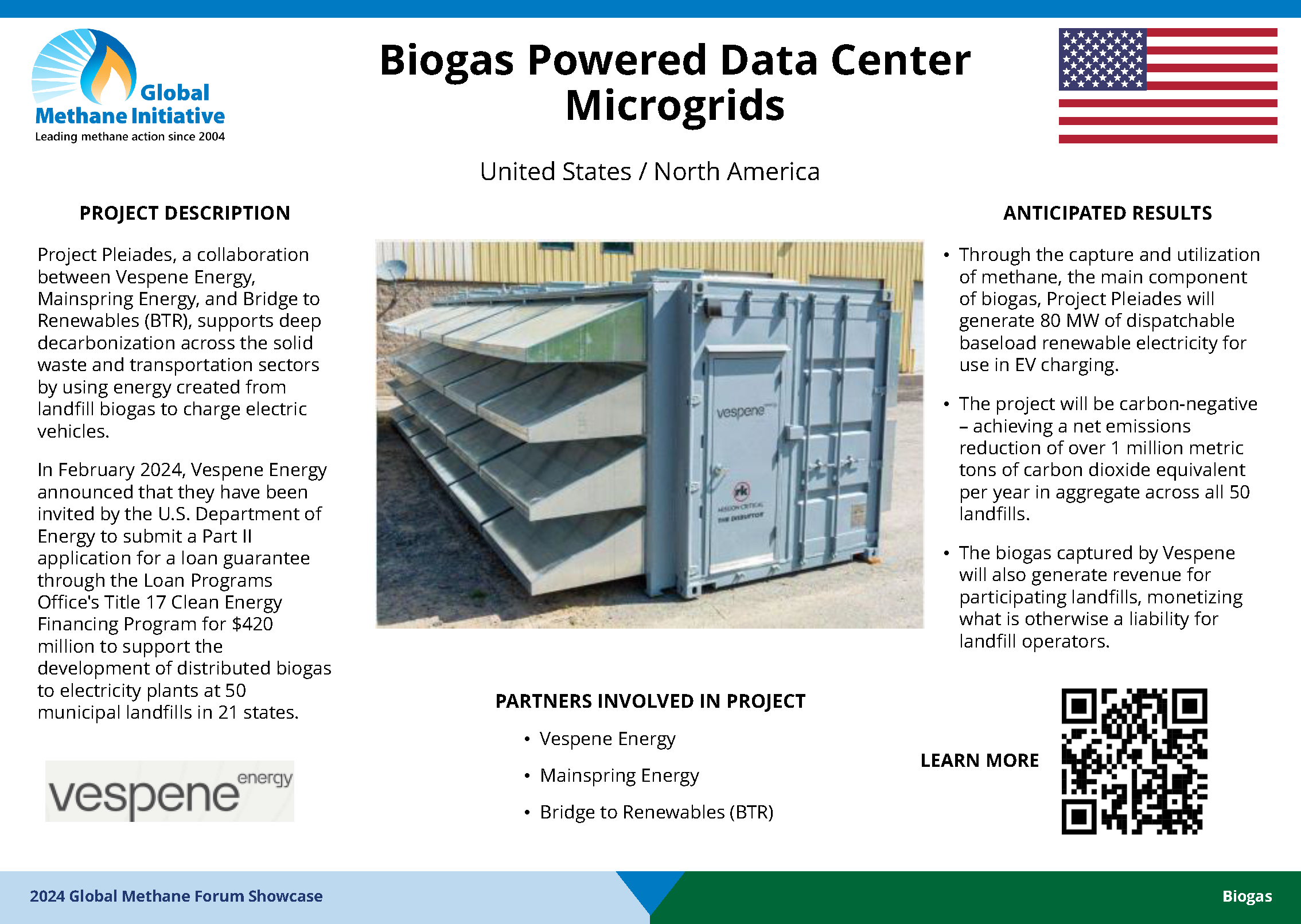
Biogas Powered Data Center Microgrids

Through the capture and utilization of methane, Project Pleiades will generate 80 MW of dispatchable baseload renewable electricity for use in EV charging, achieving a net emissions reduction of over 1 million metric tons of carbon dioxide equivalent per year in aggregate across all 50 landfills and generating revenue for participating landfills.

Partners

  • Vespene Energy
  • Mainspring Energy
  • Bridge to Renewables (BTR)
Download
Topic
Region
Language
Publish Date
01 Jan 2024
pmf_unitedStates.jpg

U.S. EPA Issues Final Rule to Sharply Reduce Methane and Other Harmful Pollution

The Inventory of the U.S. Greenhouse Gas Emissions and Sinks indicates that natural gas and petroleum systems are the largest industrial source of methane emissions in the United States. In 2023, the U.S. Environmental Protection Agency issued a final environmental regulation that is slated to sharply reduce methane emissions and other harmful air pollution from oil and natural gas operations, including from existing sources nationwide. The U.S. EPA considered nearly 1 million comments received on the two proposals before issuing a final rule, which was announced in December 2023 and subsequently published in March 2024. The rule is expected to reduce methane emissions by nearly 80% of what they would have been without the rule. It is also estimated to reduce 58 million tons of methane emissions from 2024 to 2038 and avoid 16 million tons of smog-forming volatile organic compound emissions and 590,000 tons of air toxics.

Partners

  • Global Methane Initiative (GMI)
  • U.S. Environmental Protection Agency (U.S. EPA)
External Link
Topic
Region
Language
Publish Date
01 Jan 2024
Subscribe to United States