thumb-CMM Emission Estimation Tool.png

CMM Emission Estimation Tool

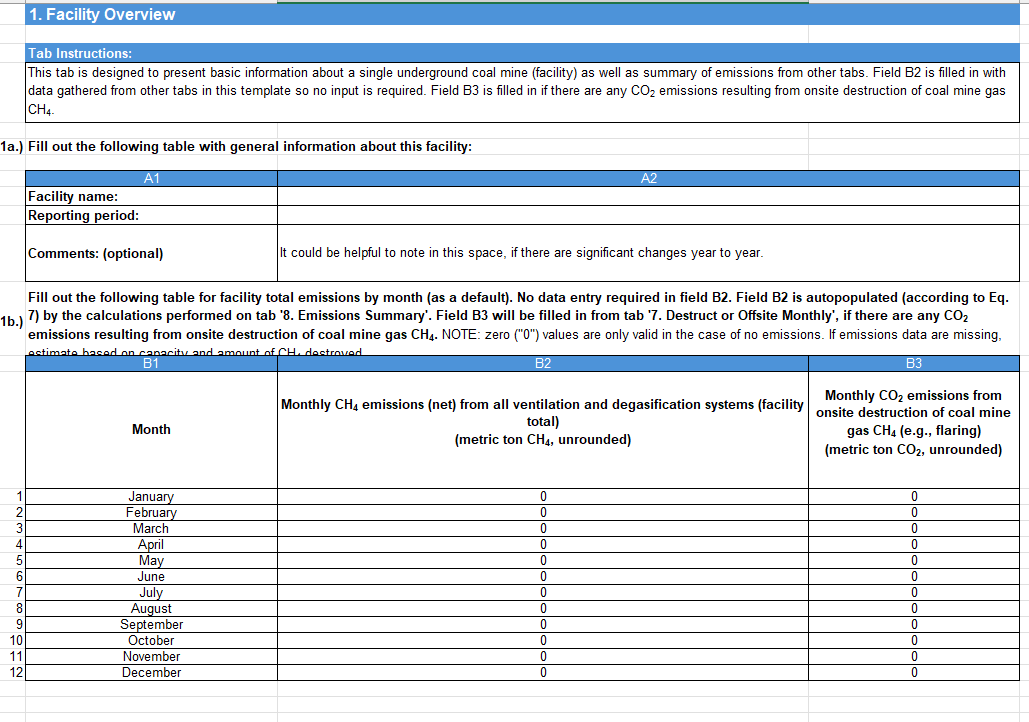
The U.S. Environmental Protection Agency, in support of GMI, collaborated with the United Nations Economic Commission for Europe to develop a tool to gather information and estimate annual methane emissions from underground coal mines. The Excel-based template simplifies collection of measurement data and provides equations that calculate total annual emissions for a single facility (i.e., underground coal mine). This template is intended to help companies better understand emissions from individual coal mines to identify mitigation options. It can also help governments refine their national-level emissions reporting to the Intergovernmental Panel on Climate Change (IPCC), i.e., by providing a mechanism to support a Tier 3 approach for National Greenhouse Gas Inventories. The template can be modified as appropriate; for example, changing from monthly data collection to a different frequency. It provides space to record additional information, such as from remote sensing campaigns.

May 2025: Version 1.2 updated instructions and column headings for clarity. Specifically, the edits clarified instructions for tabs 3 and 4 to state that methane calculated is liberated (rather than emitted) through the mine’s ventilation and degasification systems. The resulting methane liberated values are then used in the cumulative mass balance equation (equation 7) on tab 8 to calculate total methane emitted by the facility. Additionally, some column headings in tabs 6, 7, and 8 were changed to indicate that methane utilized on site should be included in the appropriate tables along with methane destroyed. Finally, an entry for pump stations was added to the drop-down list of utilization methods in A3 of tab 6.

Download
Topic
Language
Publish Date
01 May 2025
thumb-Methane Mitigation from Municipal Wastewater Treatment Plants.png

Methane Mitigation from Municipal Wastewater Treatment Plants

This fact sheet provides an overview of methane emissions generated in both wastewater collection systems and at wastewater treatment plants (WWTP). Topics include wastewater collection systems, conventional activated sludge (CAS) treatment systems, aerobic/aerated lagoon treatment systems, and anaerobic lagoon treatment systems. Biosolids management and opportunities for methane mitigation and use are also described.

Download
Topic
Language
Publish Date
01 Jan 2023
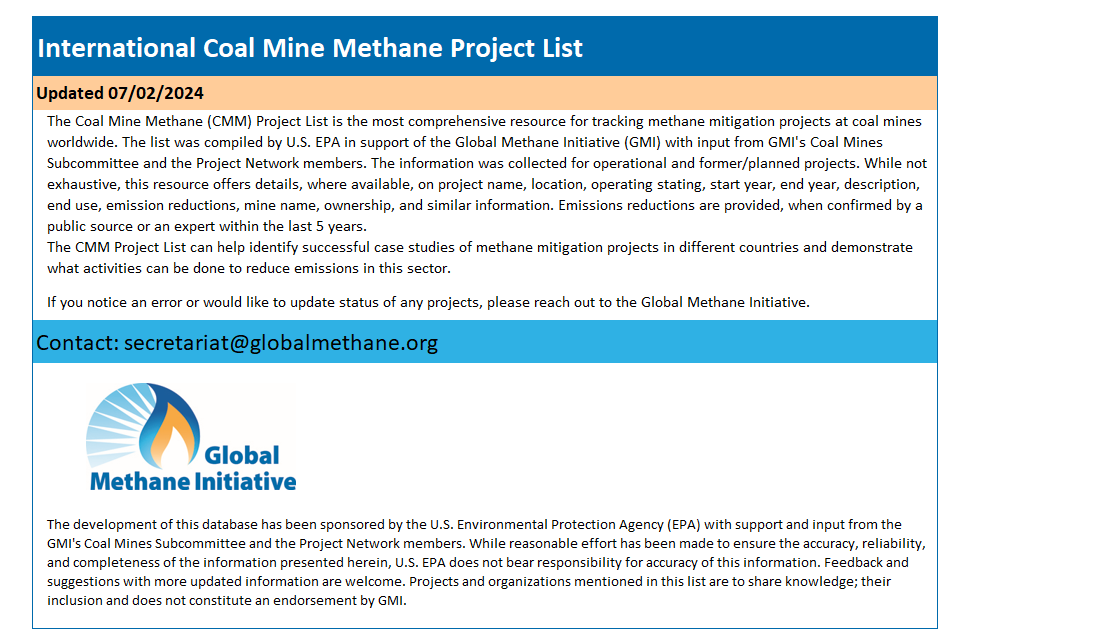
thumb-International Coal Mine Methane Project List.png

International Coal Mine Methane Project List

This Excel document provides comprehensive information on approximately 500 coal mine methane recovery and utilization projects at coal mines worldwide, including projects that are operating, in development, or planned.

Download
Topic
Language
Publish Date
01 Jan 2024
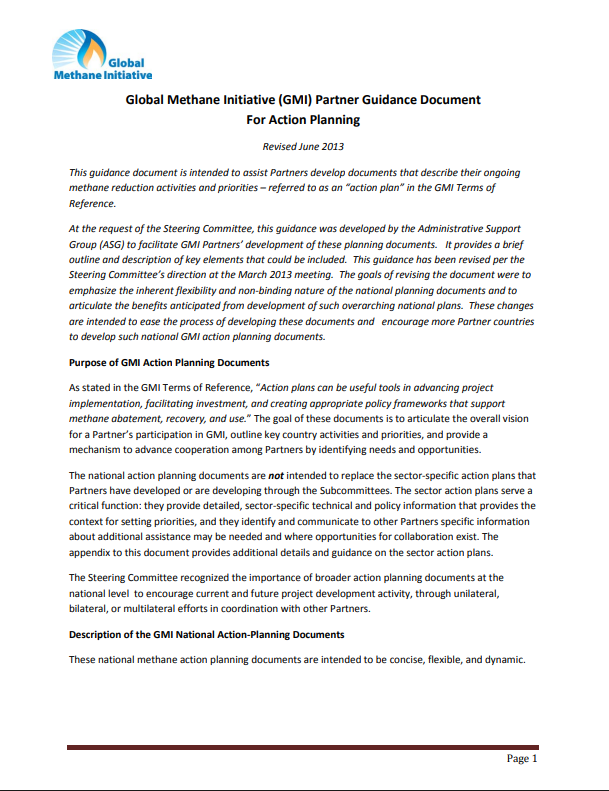
thumb_Global Methane Initiative Partner Guidance Document for Action Planning.png

Global Methane Initiative Partner Guidance Document for Action Planning

This is a brief guidance document with guiding questions to aid policymakers in documenting their methane reduction actions and priorities.

Download
Language
Publish Date
01 Jun 2013
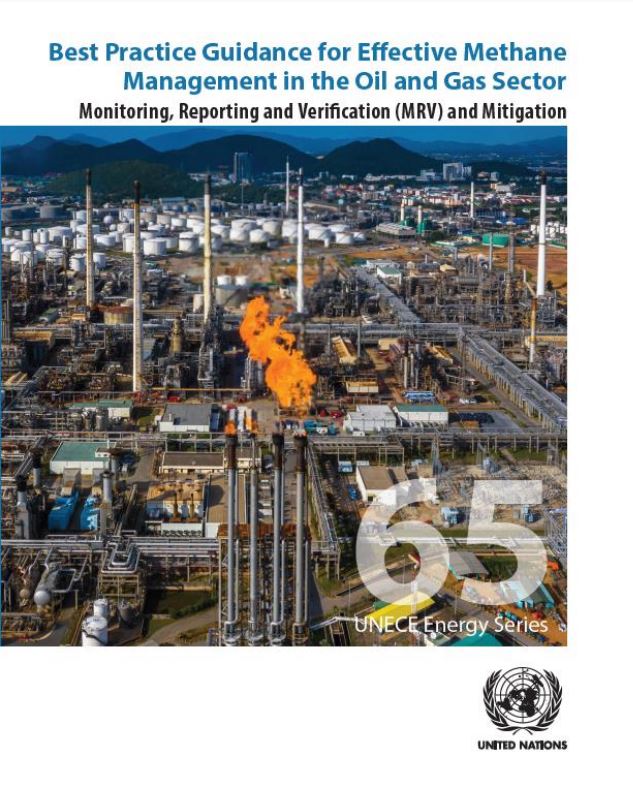
thumb Best Practices Oil and Gas Cover.jpeg

Best Practice Guidance for Effective Methane Management in the Oil and Gas Sector: Monitoring, Reporting and Verification (MRV) and Mitigation

This document provides best practice guidance for methane management within the oil and gas sector and is intended to be a resource for facility owners, operators and government policymakers.

The purpose of this document is to provide information about cost-effective measures for detecting and mitigating methane emissions along the full oil and gas value chain at the company- and national-level. Guidance for developing and implementing practices for monitoring, reporting and verifying (MRV) methane emissions is also provided.

Specific topics covered in the document include:

  1. How to improve the quantification and reliability of methane emissions data by incorporating field and country specific data;
  2. Best practices for improving and streamlining company-level reporting of methane emissions data;
  3. Various options for government policymakers to develop policies, regulations and economic instruments focused on reducing methane emissions from the oil and gas sector; and
  4. Contributions of international initiatives to mitigate methane emissions focusing on the Paris Agreement.

The report (see the link below) includes two annexes. Annex 1 provides information on emission sources, typical mitigation techniques, applicable emission detection and quantification equipment, and quantification methodologies. Annex 2 provides a brief overview of commercially available methane emissions detection and quantification technologies.

Several complementary case studies focus on experiences of oil and gas companies with methane emissions inventory, regulatory approaches to methane management, and successful public-private partnerships. Case studies are downloadable below.

Download
Topic
Language
Publish Date
01 Jan 2019
Picture1.jpg

SMART Plus

The Simplified Methane Assessment and Reporting Tool, or SMART Plus tool, is an innovative, easy-to-use tool that helps improve the accuracy of estimated methane emissions (and other pollutants such as carbon dioxide) from oil & gas operations, both at the facility level and at the national level. Learn more about the Smart Plus Tool.

Download
Topic
Language
Publish Date
12 Jun 2025
Screenshot 2025-06-12 220200.jpg

Development and Implementation of a Leak Detection and Repair (LDAR) Program to Mitigate Methane Emissions in the Oil and Gas Sector 1

This course explains the concept, objectives, systematic approach, challenges and benefits of a non-regulatory leak detection and repair (LDAR) program for managing methane emissions from equipment leaks at oil and natural gas facilities. In addition, it provides specific guidance on designing, implementing, and managing the LDAR program.

Download
Topic
Language
Publish Date
12 Jun 2025
Subscribe to English