showcase_l_Page_21.png

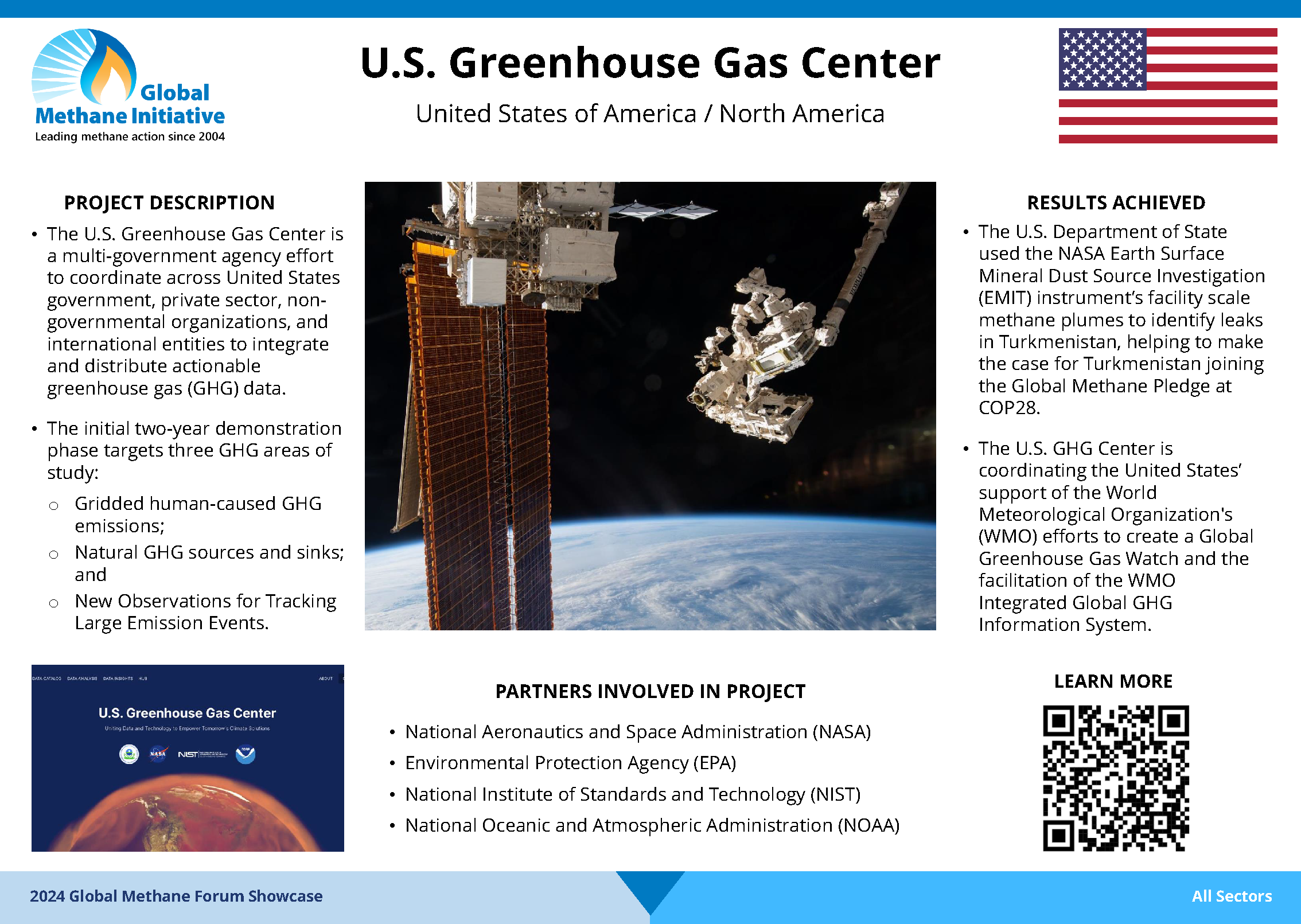
U.S. Greenhouse Gas Center

The U.S. Greenhouse Gas Center is a multi-government agency effort to coordinate across the United States government, private sector, non-governmental organizations, and international entities to integrate and distribute actionable greenhouse gas (GHG) data. The initial 2-year demonstration phase targets three GHG areas of study: gridded human-caused GHG emissions; natural GHG sources and sinks; and new observations for tracking large emission events. The Center has already helped make the case for Turkmenistan to join the Global Methane Pledge and is coordinating U.S. support of the World Meteorological Organization's efforts to create a Global Greenhouse Gas Watch.

Partners

  • National Aeronautics and Space Administration (NASA)
  • U.S. Environmental Protection Agency (U.S. EPA)
  • National Institute of Standards and Technology
  • National oceanic and Atmospheric Administration
Download
Topic
Region
Language
Publish Date
01 Jan 2023
showcase_p_Page_04.png

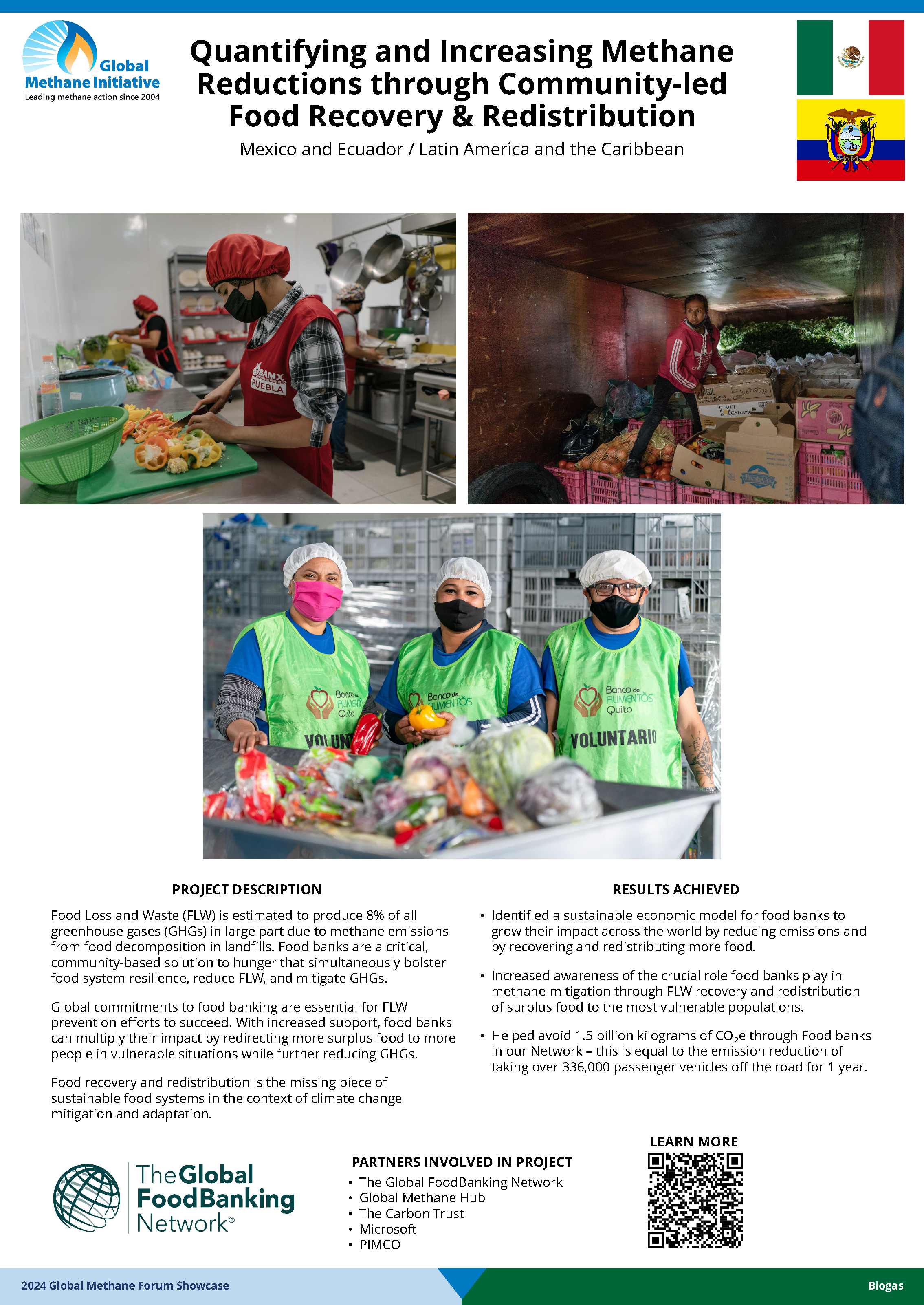
Quantifying and Increasing Methane Reductions through Community-led Food Recovery & Redistribution

Global commitments to food banking are essential for Food Loss and Waste prevention efforts to succeed. With increased support, food banks can multiply their impact on GHG emissions by redirecting more surplus food to more people in vulnerable situations. The project identifies a sustainable economic model for food banks to grow their impact across the world by reducing emissions and by recovering and redistributing more food. Additionally, the project helped avoid 1.5 billion kilograms of CO2e through food banks within the Global FoodBanking Network, equal to the emission reduction of taking 336,000 passenger vehicles off the road for one year.

Partners

  • The Global FoodBanking Network
  • Global Methane Hub
  • The Carbon Trust
  • Microsoft
  • PIMCO
Download
Topic
Region
Language
Publish Date
01 Jan 2023
showcase_p_Page_06.png

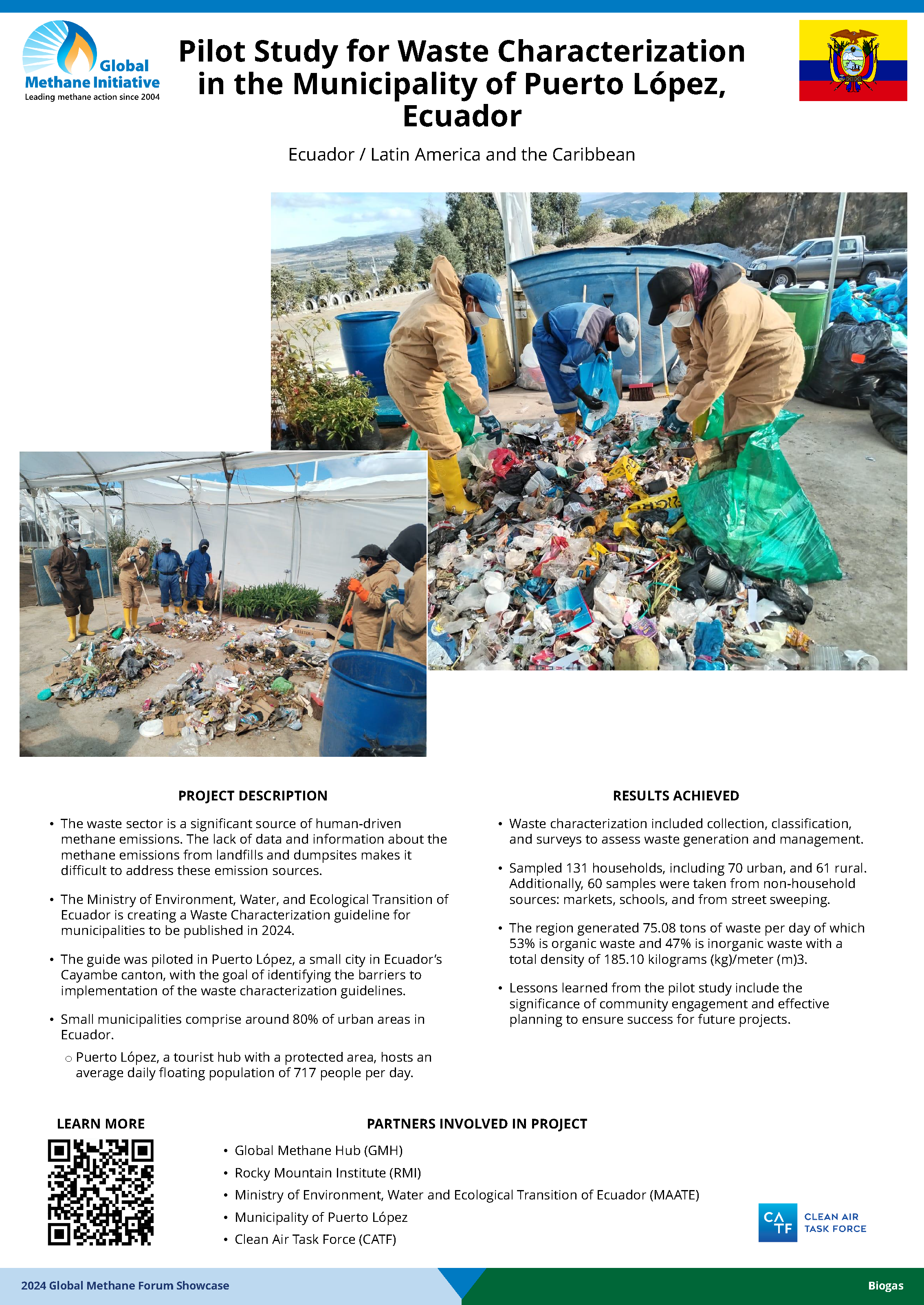
Pilot Study for Waste Characterization in the Municipality of Puerto López, Ecuador

The project aims to develop and publish a waste characterization guideline for municipalities. The guideline was piloted with the goal of identifying barriers to implementation of the waste characterization guideline. The guidelines include collection, classification, and surveys to assess waster generation and management. Lessons learned from the pilot study include the significance of community engagement and effective planning to ensure success for future projects.

Partners

  • Clean Air Task Force
  • Global Methane Hub
  • Rocky Mountain Institute
  • Ministry of Environment, Water and Ecological Transition of Ecuador
  • Municipality of Puerto López
Download
Topic
Region
Language
Publish Date
01 Jan 2023
5412.png

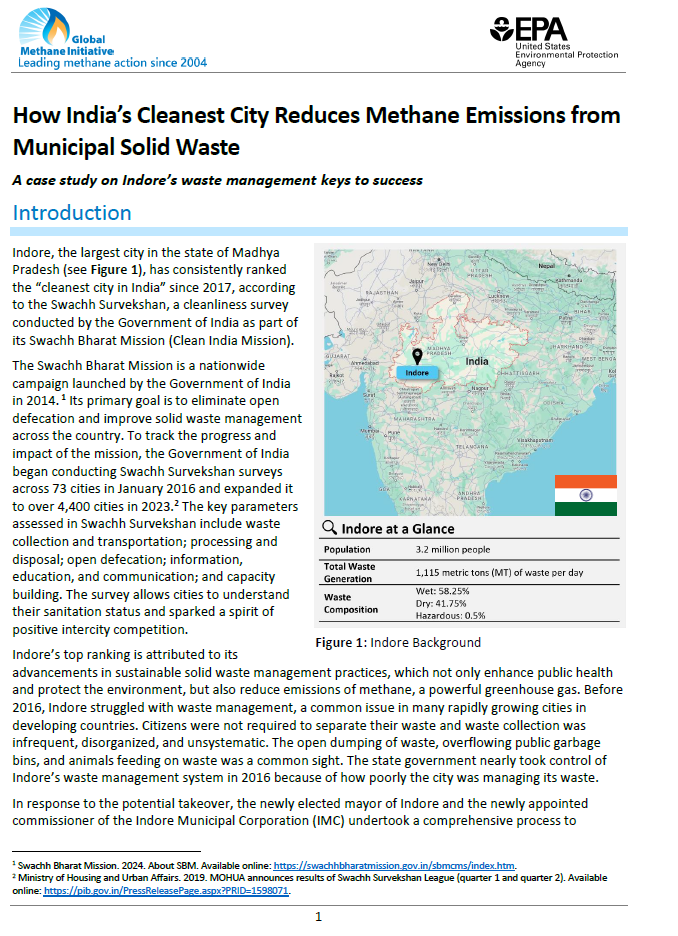
How India’s Cleanest City Reduces Methane Emissions from Municipal Solid Waste

A case study on Indore’s waste management keys to success: Indore, the largest city in the state of Madhya Pradesh, India, has consistently ranked the “cleanest city in India” since 2017. In October 2023, the U.S. Environmental Protection Agency, on behalf of the Global Methane Initiative, conducted a study tour of Indore that brought other waste management officials to learn about Indore’s improved waste management. This case study provides an overview of the factors that contributed to the successful transformation of Indore’s waste management system, including leadership buy-in, public engagement and participation, pilot testing, infrastructure upgrades, and innovative financing. It can serve as a model for cities around the world to improve solid waste management and reduce methane emissions and other climate pollutants.

Partners

  • Global Methane Initiative (GMI)
  • U.S. Environmental Protection Agency (U.S. EPA)
Download
Topic
Region
Language
Publish Date
01 Jan 2023
showcase_l_Page_13.png

GESat: A Satellite System for Reliable Inventory Validation of >50kg/CH4/hour Methane Emissions

The European Commission awarded Absolut Sensing a contract to purchase methane data as part of the Copernicus Contributing Missions Programme. Absolut Sensing anticipates that the programme will reduce industrial methane emissions in Europe and Europe-imported methane emissions by 178 million tons CO2e/year. Data from ground measurement campaigns have validated the sensor technology for quantification of facility scale emissions and it is anticipated that the program will contribute to a 20% decrease in industrial methane emissions by 2030.

Partners

  • Absolut Sensing
  • European Commission
  • European Space Agency
  • Centre National d'Etudes Spatiales
  • Kayrros
  • TotalEnergies
Download
Topic
Region
Language
Publish Date
01 Jan 2023
showcase_l_Page_04.png

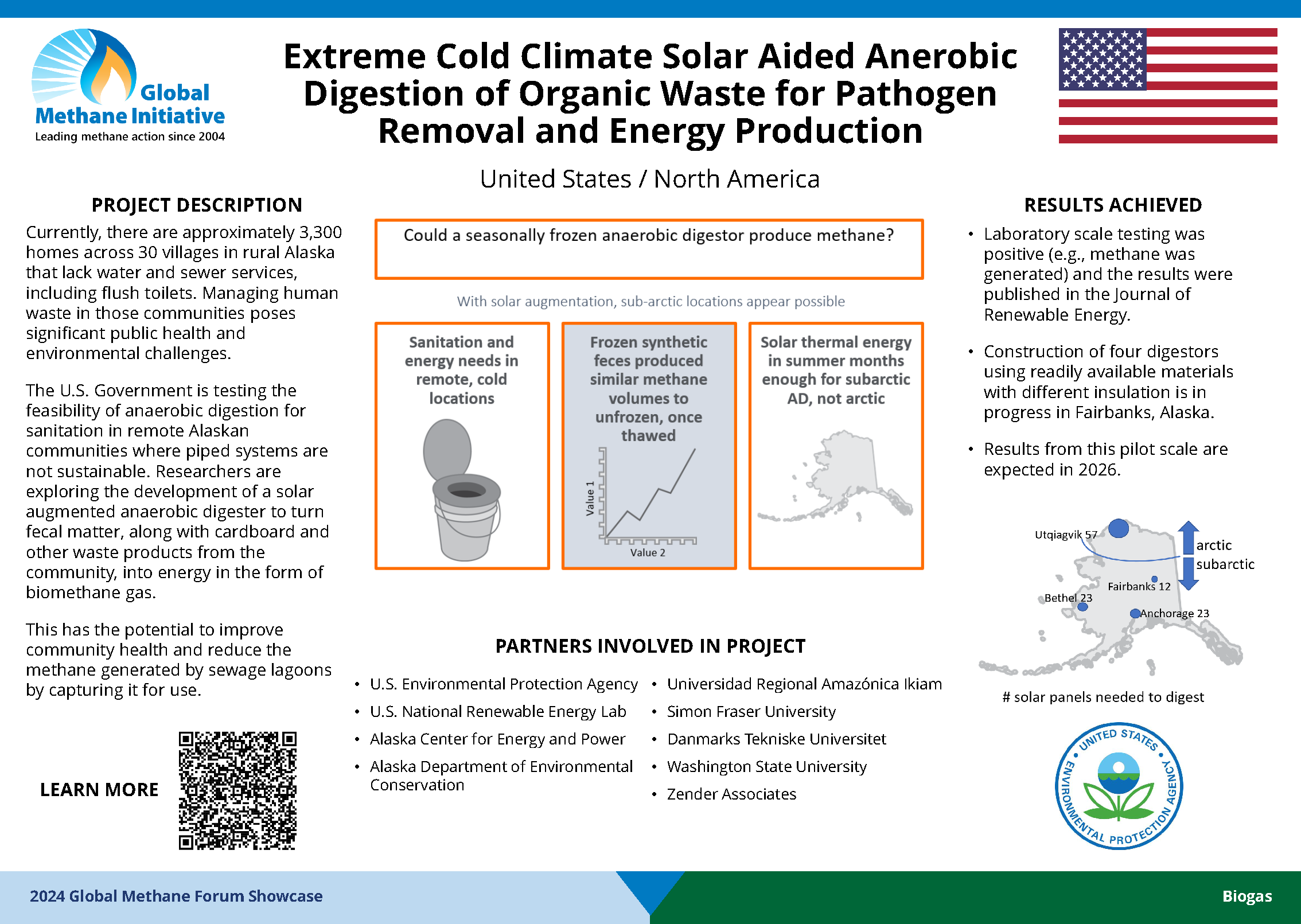
Extreme Cold Climate Solar Aided Anerobic Digestion of Organic Waste for Pathogen Removal and Energy Production

The United States Government is testing the feasibility of anaerobic digestion for sanitation in remote Alaskan Communities where piped systems are not sustainable. Researchers are exploring the development of a solar augmented anaerobic digester to turn fecal matter, along with cardboard and other waste products from the community, into energy in the form of biomethane gas. Four digesters are being constructed using different insulation and the results from this pilot are expected in 2026.

Partners

  • U.S. Environmental Protection Agency (U.S. EPA)
  • U.S. National Renewable Energy Lab
  • Alaska Center for Energy and Power
  • Alaska Department of Environmental Conservation
  • Universidad Regional Amazonica Ikiam
  • Simon Fraser University
  • Danmarks Tekniske Univ
Download
Topic
Region
Language
Publish Date
01 Jan 2023
showcase_l_Page_03.png

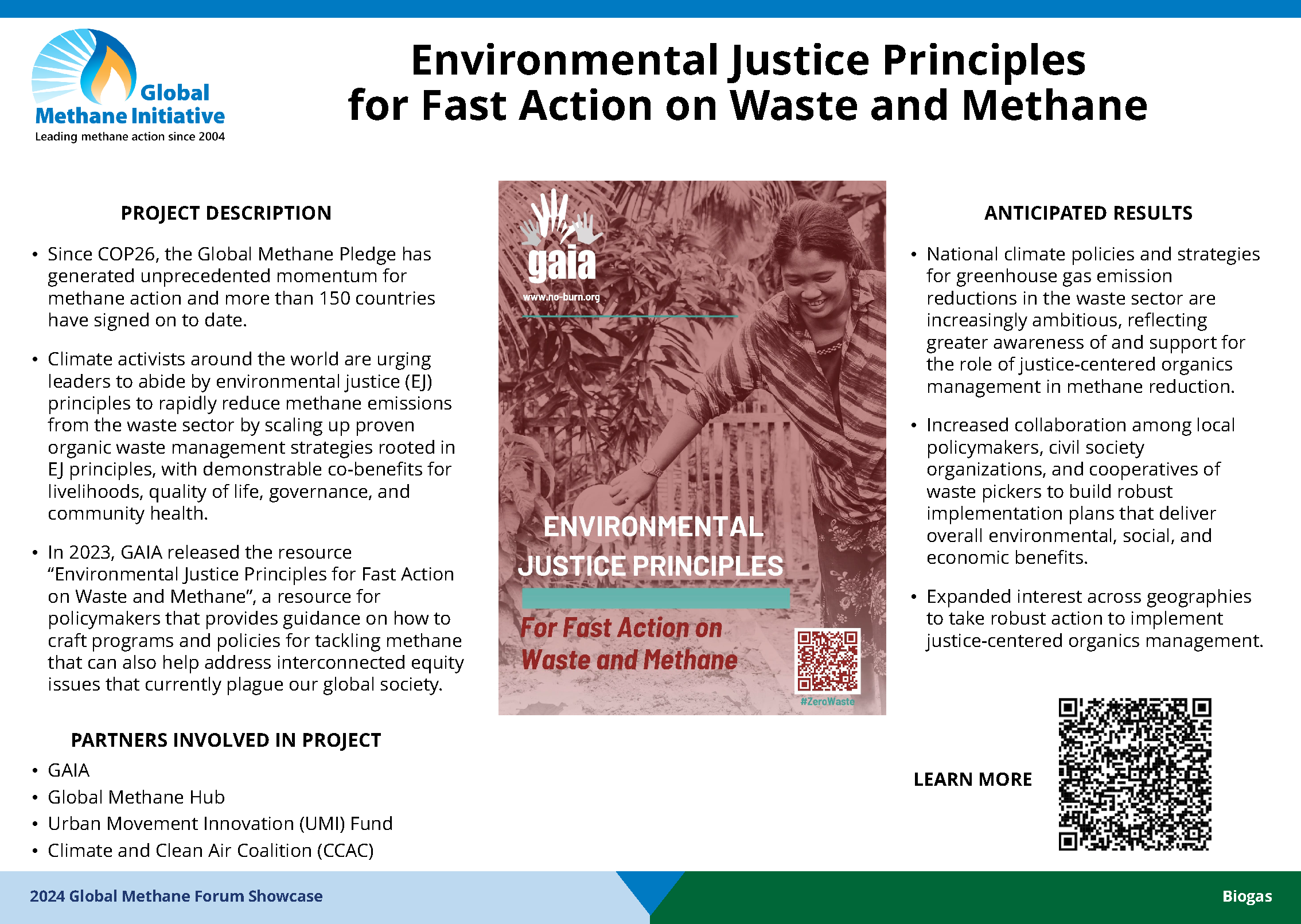
Environmental Justice Principles for Fast Action on Waste and Methane

In 2023, the Global Alliance for Incinerator Alternatives (GAIA) released a resource for policymakers, "Environmental Justice Principles for Fast Action on Waste and Methane", that provides guidance on how to programs and policies focused on methane that also address interconnected equity problems. The resource aims to increase awareness, collaboration, and expanded interest in justice-centered organics management in methane reduction.

Partners

  • Global Alliance for Incinerator Alternatives (GAIA)
  • Global Methane Hub
  • Urban Movement Innovation Fund
  • Climate & Clean Air Coalition (CCAC)
Download
Topic
Region
Language
Publish Date
01 Jan 2023
showcase_l_Page_02.png

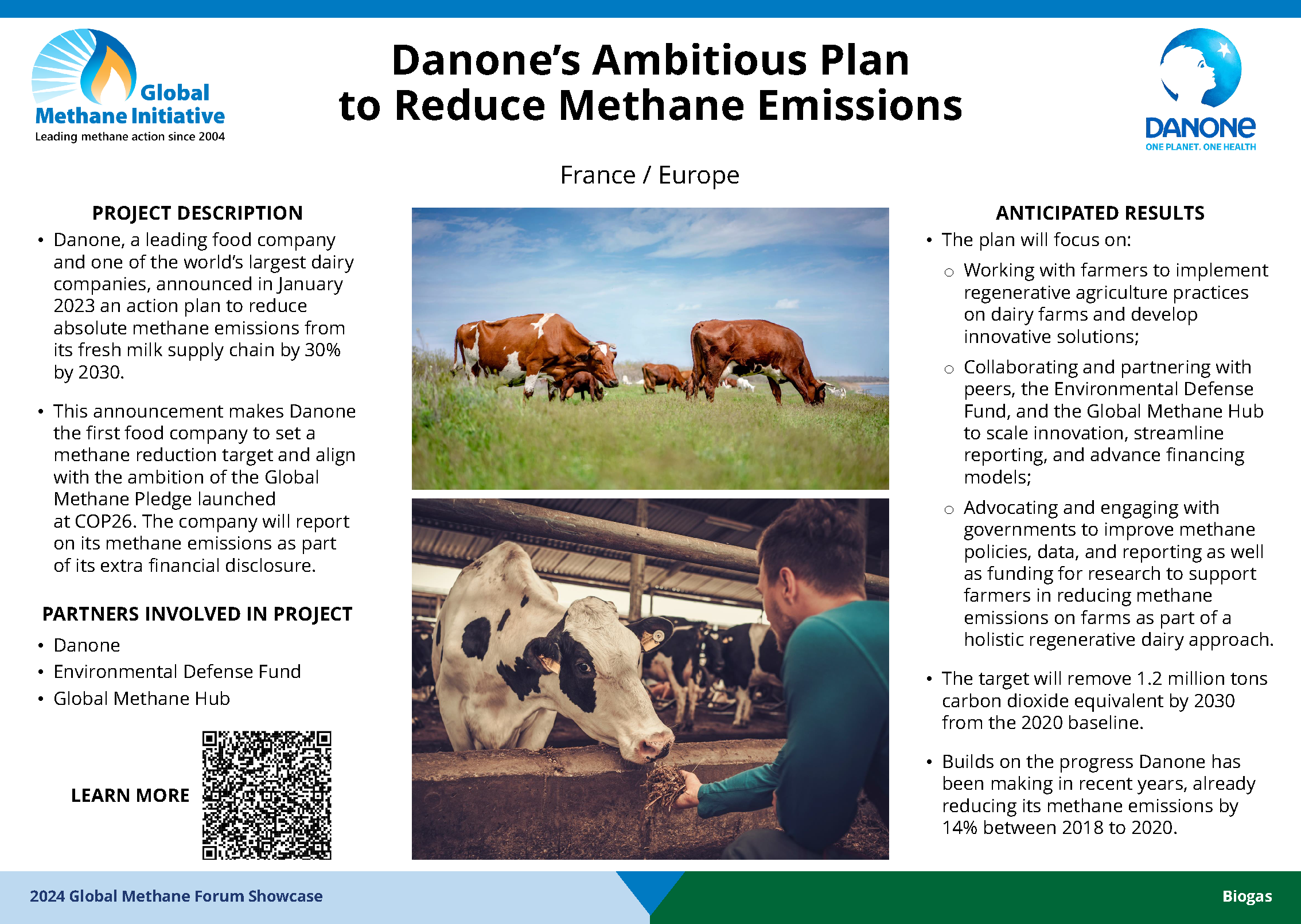
Danone's Ambitious Plan to Reduce Methane Emissions

In January 2023, Danone, one of the world's largest dairy companies announced an action plan to reduce absolute methane emissions from its fresh milk supply by 30% by 2030. The plan focuses on implementing regenerative agriculture practices through local stakeholders, partnering with other organizations to advance effectiveness and replicability, and engaging with local governments to encourage and improve policies regarding methane emissions.

Partners

  • Danone
  • Environmental Defense Fund
  • Global Methane Hub
Download
Topic
Region
Language
Publish Date
01 Jan 2023
showcase_l_Page_12.png

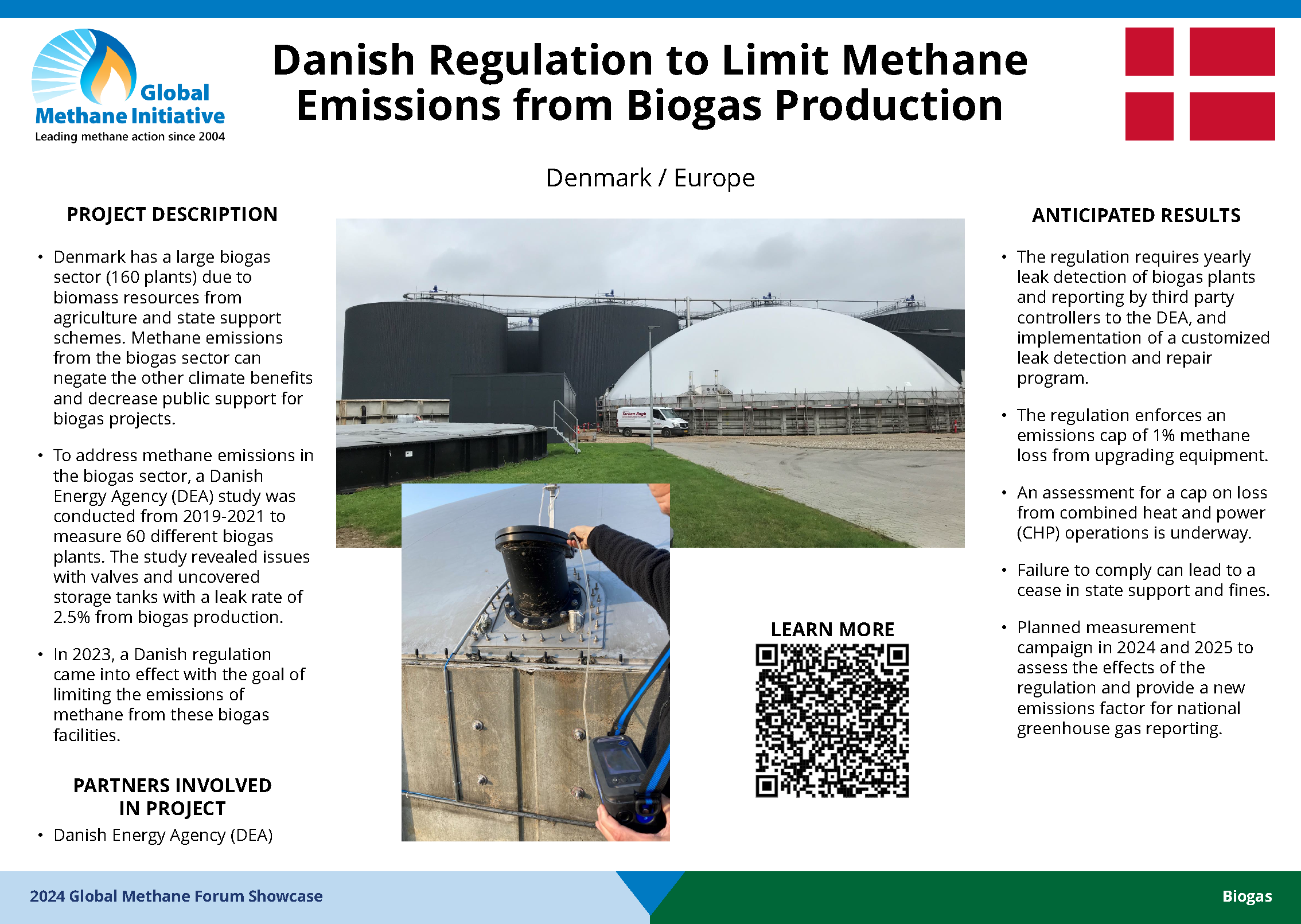
Danish Regulation to Limit Methane Emissions from Biogas Production

A Danish Energy Agency study was conducted from 2019-2021 to measure methane emissions in 60 biogas plants. The study revealed a leak rate of 2.5% from biogas production. In 2023, a Danish regulation was implemented with the goal of limiting emissions of methane from biogas plants. The regulation requires annual leak detection, reporting, and implementation of a customized leak detection and repair program. It also enforces an emissions cap of 1% methane loss from upgrading equipment. Measurement campaigns in 2024 and 2025 are planned to assess the effects of the regulation and provide a new emissions factor for national greenhouse gas reporting.

Partners

  • Danish Energy Agency
Download
Topic
Region
Language
Publish Date
01 Jan 2023
showcase_l_Page_11.png

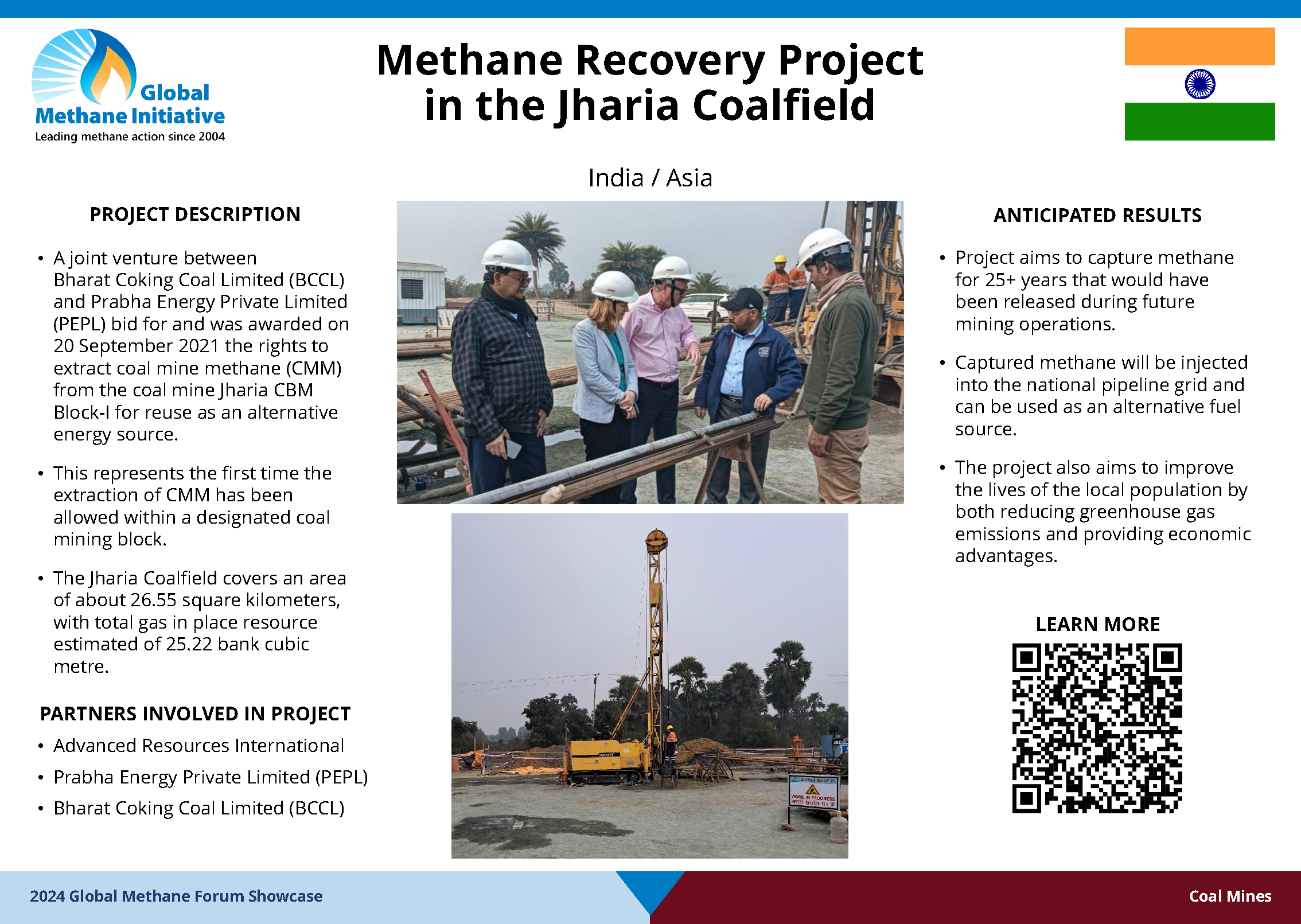
Methane Recovery Project in the Jharia Coalfield

A joint venture bid was awarded for the rights to extract coal mine methane from the coal mine Jharia CBM Block-I for reuse as an alternative source. The project aims to capture methane for 25+ years. The methane will then be injected into the national pipeline grid and can be used as an alternative energy source. Lives of the local population should be improved by both reducing greenhouse gas emissions and providing economic advantages.

Partners

  • Advanced Resources International
  • Prabha Energy Private Limited
  • Bharat Coking Coal Limited
Download
Topic
Region
Language
Publish Date
01 Jan 2024
Subscribe to English