showcase_l_Page_17.png

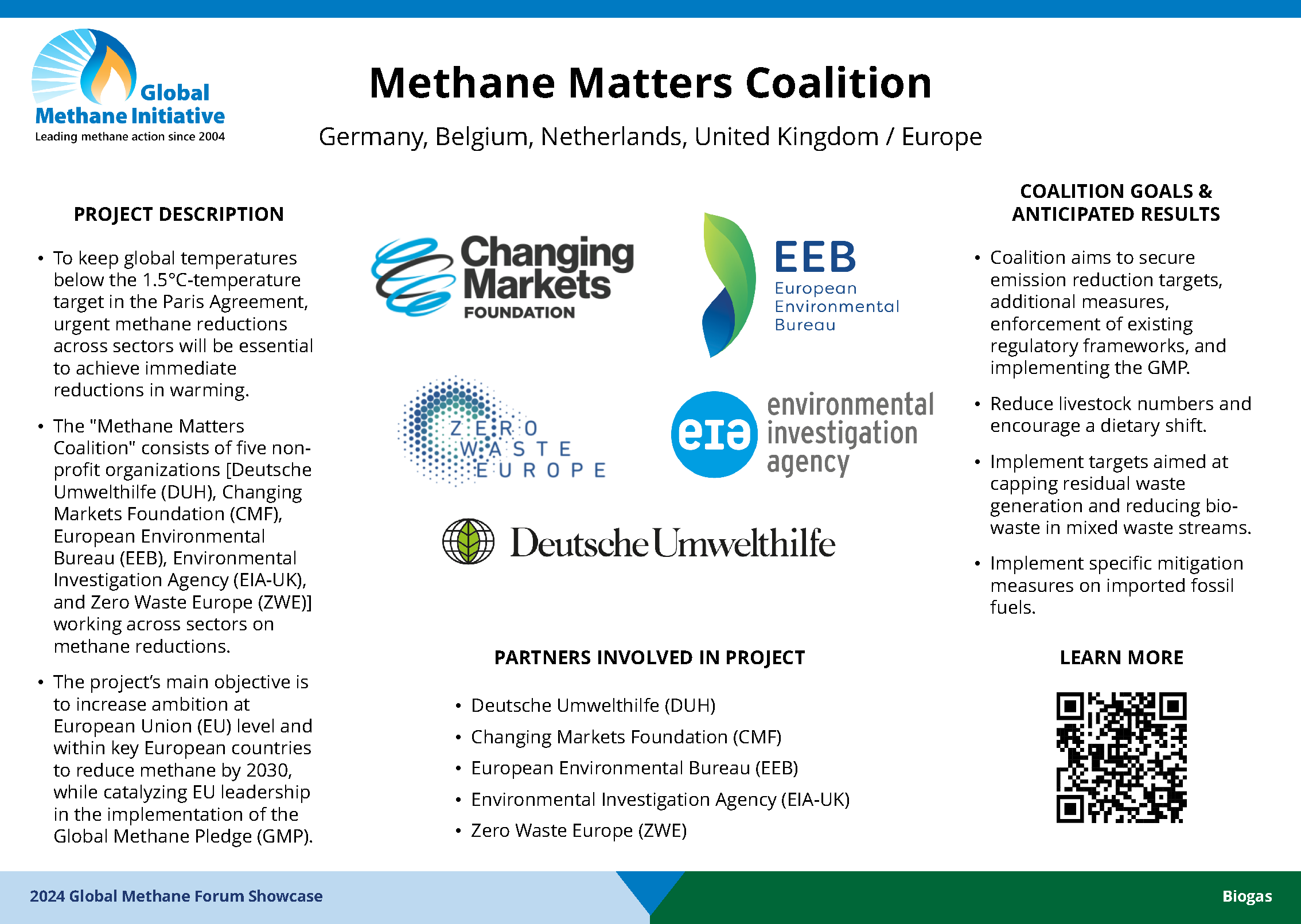
Methane Matters Coalition

The Methane Matters Coalition consists of five non-profit organizations working across sectors on methane reductions. The main objective is to increase ambition at the European Union (EU) level and within European countries to reduce methane by 2030 while catalyzing EU leadership in the implementation of the Global Methane Pledge. The coalition aims to secure emission reduction targets, enforce existing regulatory frameworks, and implement targets focused on capping residual waste generation and reducing bio-waste in mixed waste streams. Reduction of livestock numbers to encourage a dietary shift and implementing mitigation measure on imported fossil fuels is also anticipated.

Partners

  • Deutsche Umwelthilfe
  • Changing Markets Foundation
  • European Environmental Bureau
  • Environmental Investigation Agency
  • Zero Waste Europe
Download
Topic
Region
Language
Publish Date
01 Jan 2024
showcase_l_Page_22.png

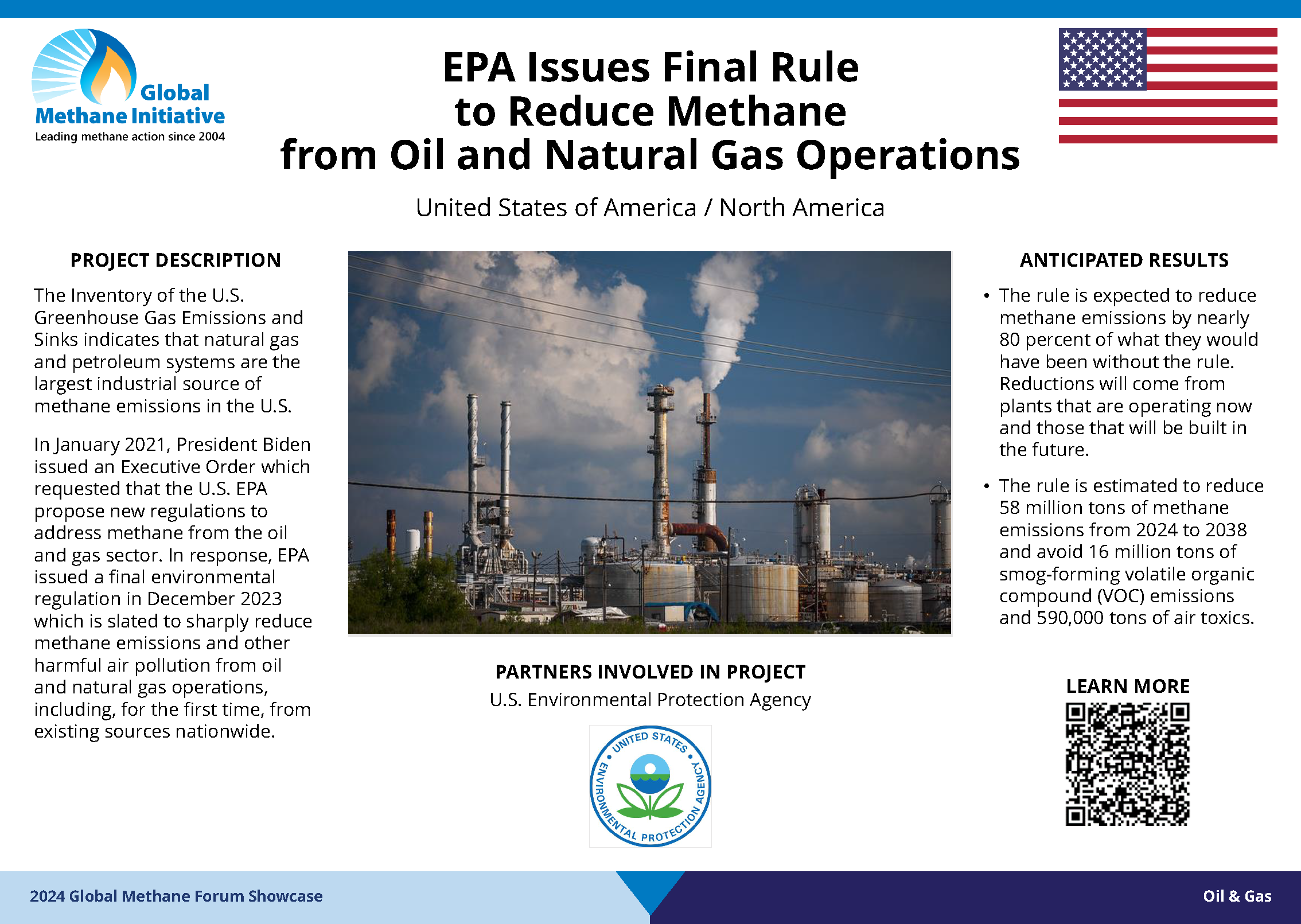
EPA Issues Final Rule to Reduce Methane from Oil and Natural Gas Operations

The Inventory of the U.S. Greenhouse Gas Emissions and Sinks indicates that natural gas and petroleum systems are the largest industrial source of methane emissions in the United States. In 2023, the U.S. Environmental Protection Agency issued a final environmental regulation that is slated to sharply reduce methane emissions and other harmful air pollution from oil and natural gas operations, including from existing sources nationwide. The rule is expected to reduce methane emissions by nearly 80% of what they would have been without the rule. It is also estimated to reduce 58 million tons of methane emissions from 2024 to 2038 and avoid 16 million tons of smog-forming volatile organic compound emissions and 590,000 tons of air toxics.

Partners

  • U.S. Environmental Protection Agency (U.S. EPA)
Download
External Link
Topic
Region
Language
Publish Date
01 Jan 2024
showcase_l_Page_01.png

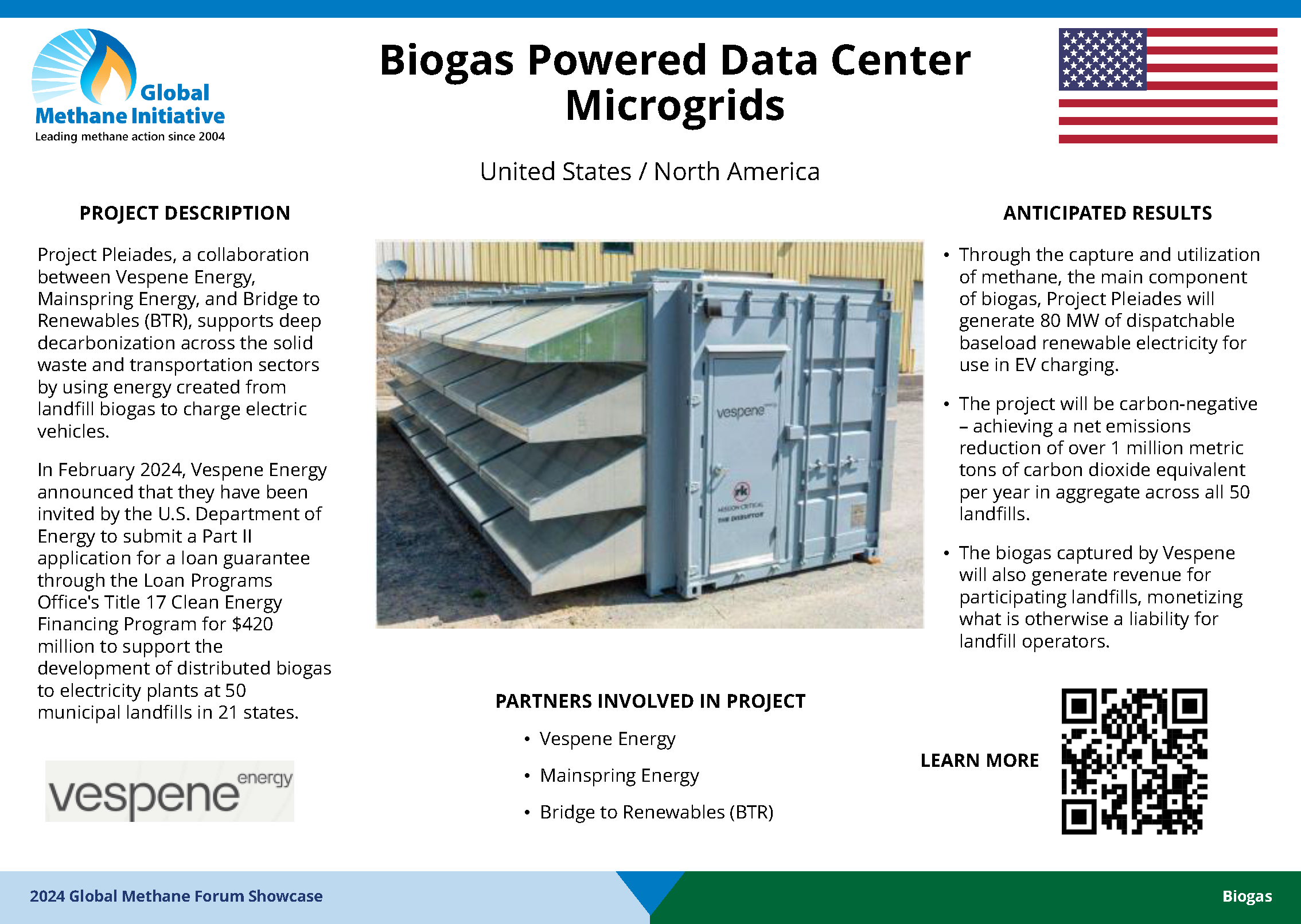
Biogas Powered Data Center Microgrids

Through the capture and utilization of methane, Project Pleiades will generate 80 MW of dispatchable baseload renewable electricity for use in EV charging, achieving a net emissions reduction of over 1 million metric tons of carbon dioxide equivalent per year in aggregate across all 50 landfills and generating revenue for participating landfills.

Partners

  • Vespene Energy
  • Mainspring Energy
  • Bridge to Renewables (BTR)
Download
Topic
Region
Language
Publish Date
01 Jan 2024
pmf_unitedStates.jpg

U.S. EPA Issues Final Rule to Sharply Reduce Methane and Other Harmful Pollution

The Inventory of the U.S. Greenhouse Gas Emissions and Sinks indicates that natural gas and petroleum systems are the largest industrial source of methane emissions in the United States. In 2023, the U.S. Environmental Protection Agency issued a final environmental regulation that is slated to sharply reduce methane emissions and other harmful air pollution from oil and natural gas operations, including from existing sources nationwide. The U.S. EPA considered nearly 1 million comments received on the two proposals before issuing a final rule, which was announced in December 2023 and subsequently published in March 2024. The rule is expected to reduce methane emissions by nearly 80% of what they would have been without the rule. It is also estimated to reduce 58 million tons of methane emissions from 2024 to 2038 and avoid 16 million tons of smog-forming volatile organic compound emissions and 590,000 tons of air toxics.

Partners

  • Global Methane Initiative (GMI)
  • U.S. Environmental Protection Agency (U.S. EPA)
External Link
Topic
Region
Language
Publish Date
01 Jan 2024
tile-methane-emmissions-from-og.jpg

Methane Emissions from the Oil and Gas Industry

This training provides an overview of the oil and natural gas industry, from the main types of deposits and wells to the different segments within the sector. This training also discusses some of the key methane emission sources in the oil and gas industry, available technologies to reduce emissions, and the positive outcomes of capturing and using methane. The training was developed by the U.S. Environmental Protection Agency (U.S. EPA) in support of voluntary activities to reduce methane emissions under the U.S. EPA’s Natural Gas STAR Program and the Global Methane Initiative (GMI).

View the Methane Emissions from the Oil and Gas Industry Course.

Course Topics

BACKGROUND ON METHANE

  • What is methane?
  • Where does methane come from?
  • Which sectors are emitting the most methane in the United States?
  • Why is it important to reduce methane emissions?

OVERVIEW OF THE OIL AND NATURAL GAS INDUSTRY

  • What are the main types of oil and natural gas reservoirs?
  • What is an oil and gas field?
  • Where are the oil and gas systems in the U.S.?
  • What are the basic types of oil and natural gas wells?
  • How is the supply chain of the oil and natural gas industry organized?

METHANE EMISSION SOURCES FROM THE OIL AND GAS INDUSTRY

  • How is methane released from oil and gas operations?
  • What are the top emission sources?
  • What are some of the options for mitigating methane emissions?
  • What are the positive outcomes of capturing and using methane?
  • What methane mitigation technologies are available?
Topic
Language
Publish Date
07 Jan 2025
thumb-2007-expo.png

2007 Methane to Markets Partnership Expo

30 October - 1 November 2007 | Beijing, China


We would like to thank all of the Methane to Markets Partnership Expo sponsors, speakers, delegates, and attendees for joining us in Beijing. With participation from more than 700 attendees from 34 countries, the Partnership Expo has made history as the largest gathering in the world to advance methane recovery and use projects. We look forward to building on the Partnership Expo's success and momentum in the months ahead.

Download
Topic
Language
Publish Date
30 Oct 2007
thumb-2010-expo.png

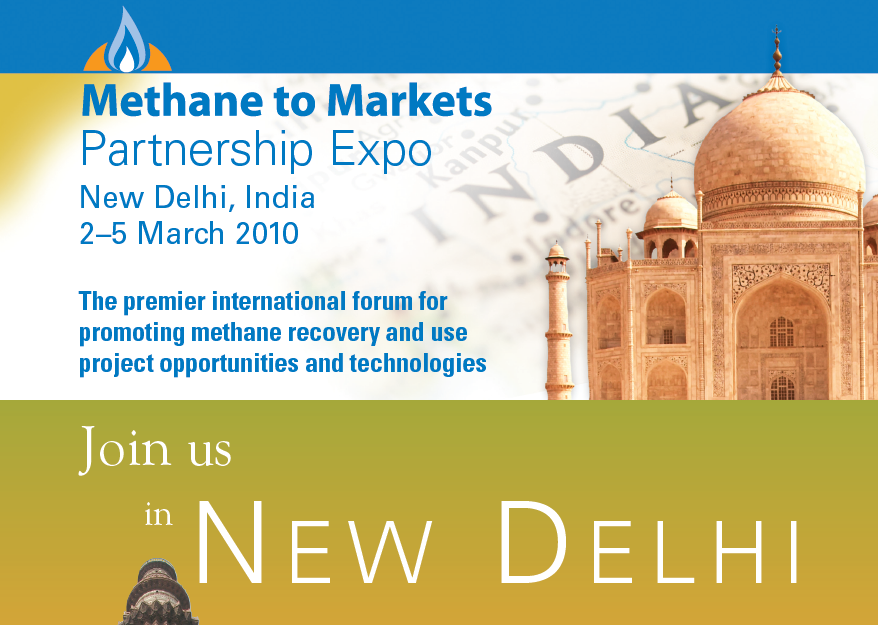
2010 Methane to Markets Partnership Expo

The World's Largest Forum for Methane Projects, Technology, Financing and Policy
2-5 March 2010 | New Delhi, India


The Methane to Markets Partnership Expo is the premier international forum for promoting methane recovery and use project opportunities and technologies. The first Expo was held in the 2007 in Beijing, China and included more than 750 participants from 34 countries.

The second Partnership Expo was held in India, an emerging market with the world's second largest population and one of the fastest growing economies. The country has methane capture-and-use projects in agriculture, coal mines, landfills, and the oil and gas sector - and with rapid growth, increased urbanization, and rising energy consumption, opportunities in these four Methane to Markets sectors are quickly expanding.

The Expo's Comprehensive Program Featured:

  • Four sector-specific conference tracks: Key methane capture and use technologies and policy issues as well as key barriers to project development and how to overcome them.
  • Methane Marketplace: Methane recovery and use projects ripe for immediate financing or implementation, as well as technology providers showcasing the latest products and services.
  • Partnership working meetings: Government and industry discussions on how Methane to Markets can effectively promote methane capture and use projects and activities around the world.

Who Attended?

  • Project Developers and Financiers: Identified and explored project opportunities with government and industry partners. The Expo showcased international financing and projects seeking development partners.
  • Policymakers, Project Developers, and Government Representatives: High-level national delegations participated in policy discussions. Helped develop next steps for the Partnership and guided advancement of country-based policies and projects.
  • Manufacturers and Vendors: Participated in an international marketplace with a methane focus. Demonstrated and marketed the latest methane recovery and use technologies and services in large exhibit areas.
  • Industry Representatives: Interacted and discussed projects with technology vendors and developers. Learned about options for implementing methane capture and re-use projects.
Download
Topic
Language
Publish Date
02 Mar 2010
thumb-2013-expo.png

2013 Methane Expo

12-15 March 2013 | Vancouver, Canda


Methane Expo 2013 drew over 450 attendees representing 44 countries from around the world, including delegates from GMI’s Partner governments, representatives from the private sector, non-governmental organizations, and academia. Thank you to Canada, this year’s host, and all the supporters and exhibitors who contributed their time and resources to make this year’s Expo a success.

The Expo agenda included high-level plenary sessions headlined by Canada’s Environment Minister, the Honourable Peter Kent; Acting GMI Steering Committee Chair Ms. Janet McCabe, U.S. Environmental Protection Agency (EPA); and British Columbia’s Minister of Environment, the Honourable Terry Lake.

Other Expo highlights included programming from all five subcommittees, and more than 90 project opportunities and success story posters that showcased the real, on the ground accomplishments of GMI. Peppered though the municipal solid waste (MSW) posters were photos from Tim Bouldry, who captures images of people living nearby landfills. Another popular session was on international methane financing with speakers from the International Development Bank, the World Bank, the Asian Development Bank, and SENES Consulting.

A well-attended municipal leaders’ forum with representatives from Colombia, Canada and Sweden explored different ways to overcome common sustainability issues under municipal jurisdiction. Finally, the Climate and Clean Air Coalition to Reduce Short-Lived Climate Pollutants (CCAC) and the Center for Clean Air Policy (CCAP) hosted side meetings.

The Steering group of the CCAC MSW initiative provided an opportunity for cities from around the world to come together to develop action plans to mitigate methane and black carbon from the municipal solid waste sector, and consider solutions like organics management and methane capture from landfills.

At the CCAP MSW event, representatives from Colombia, Chile and Dominican Republic presented the results of the development of integrated solid waste management Nationally Appropriate Mitigation Actions (NAMA) supported by Canada through its $1.2 billion Fast-Start Financing commitment.

Download
Topic
Language
Publish Date
12 Mar 2013
thumb-2016-gmf.png

2016 Global Methane Forum

28-30 March 2016 | Washington, D.C.


The Global Methane Initiative (GMI) and the Climate and Clean Air Coalition (CCAC) were pleased to welcome more than 500 attendees from 62 countries to Washington, DC for the Global Methane Forum and CCAC Working Group meetings. Methane experts and policy-makers from around the world gathered to discuss options for methane reduction and abatement activities.

This unique opportunity granted access to:

  • High-level plenary sessions on cross-cutting issues such as project financing and policy.
  • Technical sessions on biogas (agricultural sources, municipal solid waste, municipal wastewater systems), coal mines, and oil and natural gas systems.
  • Joint GMI Subcommittee – CCAC Initiative level discussions on policy and projects.
  • Opportunities for networking with methane experts in the public and private sectors from around the world.

During the 2016 Global Methane Forum, GMI Partners reaffirmed their commitment to the Initiative via the GMI Partners Communique, a consensus statement on GMI’s accomplishments over the last 10 years, as well as reasons to continue GMI’s autonomy for another 5 years.

Download
Topic
Language
Publish Date
16 Apr 2018
thumb-2018-gmf.png

2018 Global Methane Forum

16-18 April 2018 | Toronto, Canada


Global Methane Initiative Communiqué

As the 2018 Global Methane Forum concludes, we congratulate all Partners and participants for a very successful conference focused on collaborative solutions to address methane emissions across key sectors of the economy. The GMI would like to extend a special thanks to the Climate and Clean Air Coalition (CCAC), who were key partners in this event. Building on the success of the joint 2016 Global Methane Forum, we are proud to have provided a unique opportunity in Toronto for policy-makers, technical experts, scientists, and non-governmental organizations dedicated to the reduction of methane, to discuss options to reduce emissions in all key methane-emitting sectors. 

It is important that we continue this international dialogue and collaboration. Mitigating methane has significant environmental, energy, economic, and health benefits. Methane is a potent greenhouse gas, considered responsible for nearly one-third of current warming, and a significant air pollutant that contributes to the formation of ground-level ozone.

Because methane has a shorter lifespan in the atmosphere than other greenhouse gases, global actions to reduce methane emissions have a faster impact in slowing warming. Reducing methane, in conjunction with other short-lived climate pollutants and CO 2, increases the probability of limiting warming to less than 2°C.

Methane is also an important precursor to ground-level ozone, a key component of smog, itself linked to serious health issues and negative impacts on crop production, with direct impacts on climate change. Methane is expected to drive levels of ground-level ozone upwards over the next decade.

Methane is also the primary component of natural gas, which makes methane a valuable energy resource; but when methane is emitted, it creates serious safety hazards and further contributes to local air pollution. Reducing our methane emissions, especially by capturing and using it, thus provides multiple benefits to local and national economies and by providing cleaner and more affordable energy.

Through our joint technical activities as part of the ongoing work of the GMI, we will continue to raise awareness of the importance of addressing methane, both to contribute to our collective actions to address climate change and air pollution, as well as of the opportunities for recovery of this beneficial energy resource. Our GMI Partners and Project Network members are already working collaboratively through awareness-raising efforts, sharing technical expertise, and promoting technology deployment.

These activities are collectively leading to tangible methane reductions worldwide. Building on this success, we believe more can be done – to incentivize scientific and technological innovations on monitoring, measuring and mitigating methane, as well as facilitating access to financing and investment resources that will allow us to collectively take the next steps.

The GMI Steering Committee believes that 2019 should be dedicated as a year of methane awareness and action among our partners. We will be developing a detailed plan with an announcement to come later this year that will provide opportunities for each Partner to contribute in a meaningful and impactful way to address methane in key sectors.

We invite our partners in the United Nations Economic Commission for Europe (UNECE) and the CCAC to join us in this collective effort.

We look forward to working collaboratively on this important effort to reduce methane emissions.

Together we can make a difference!
 

Topic
Language
Publish Date
16 Apr 2018
Subscribe to English