showcase_l_Page_07.png

Weibei Pipeline Project for Associated Gas Recovery and Use

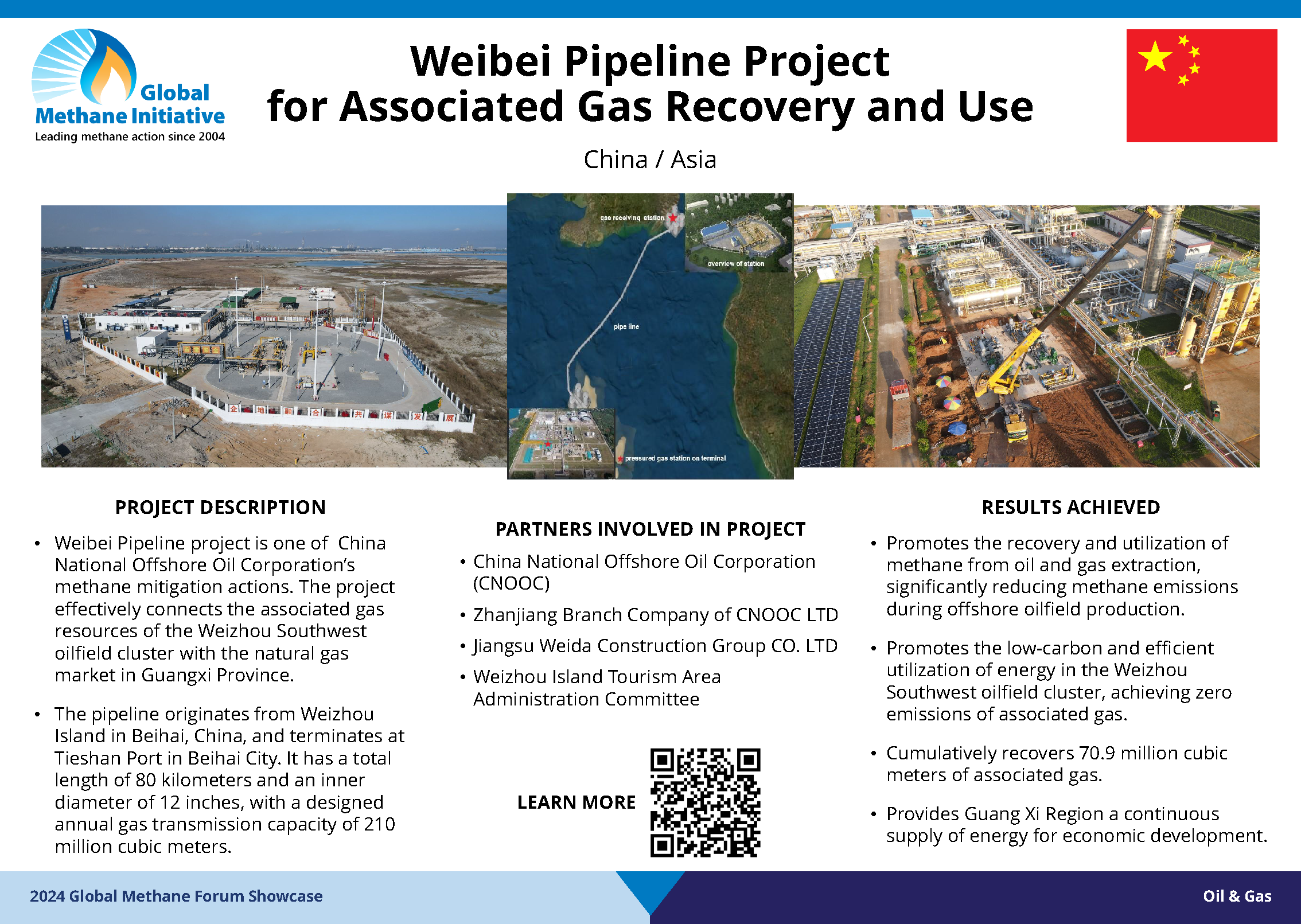
The Weibei Pipeline project effectively connects the associated gas resources of the Weizhou Southwest oilfield cluster with the natural gas market in Guangxi Province. The project promotes the recovery and utilization of methane from oil and gas extraction, significantly reducing methane emissions during offshore oilfield production. Additionally, it promotes the low-carbon and efficient utilization of energy, recovers 70.9 million cubic meters of associated gas, and provides the Guang Xi Region a continuous supply of energy for economic development.

Partners

  • China National Offshore Oil Corporation (CNOOC)
  • Zhanjiang Branch Company of CNOOC LTD
  • Jiangsu Weida Construction Group CO. LTD
  • Weizhou Island Tourism Area Administration Committee
Download
Topic
Region
Language
Publish Date
01 Jan 2022
showcase_p_Page_02.png

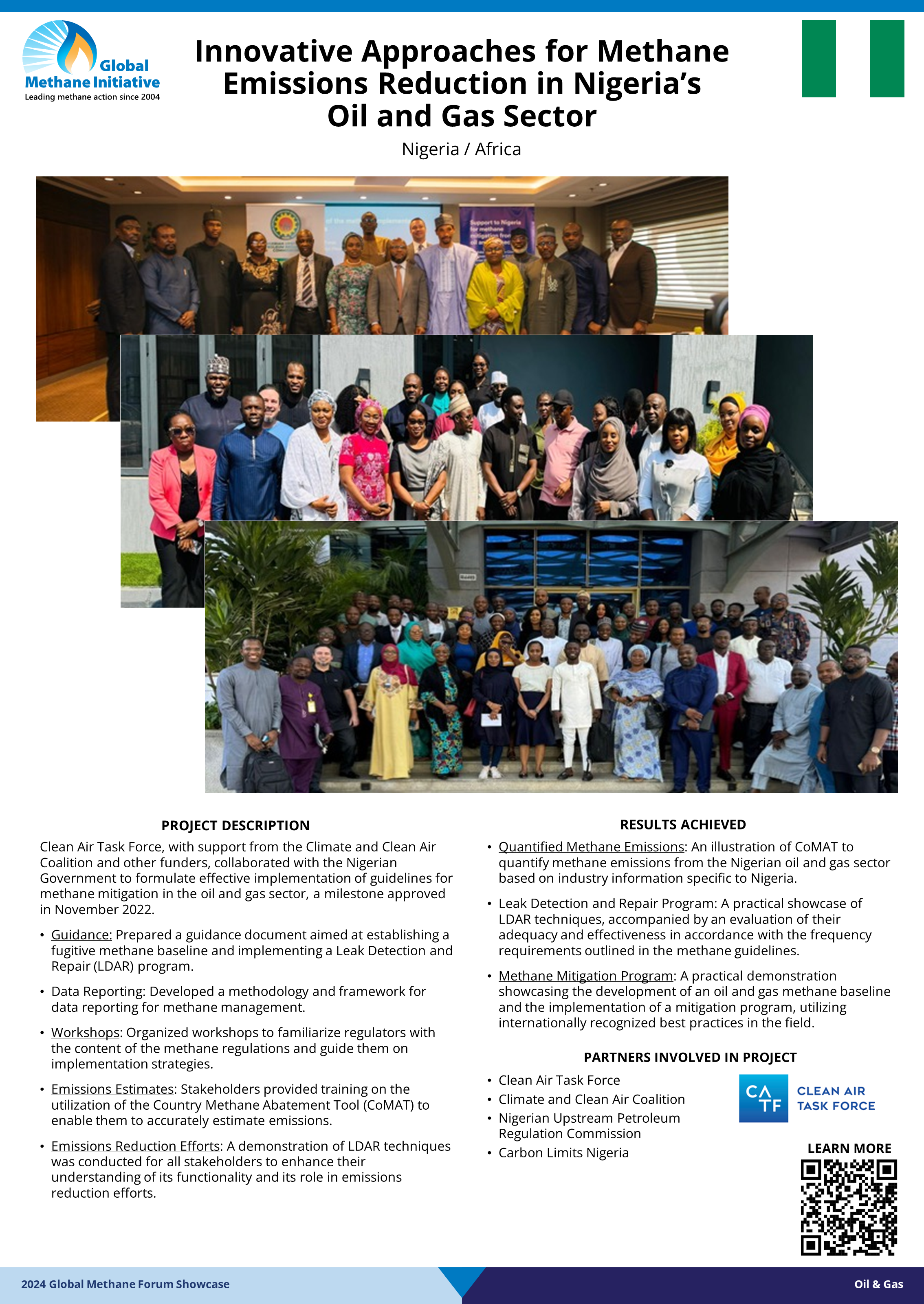
Innovative Approaches for Methane Emissions Reduction in Nigeria's Oil and Gas Sector

The Clean Air Task Force collaborated with the Nigerian Government to formulate effective implementation of guidelines for methane mitigation in the oil and gas sector. The topics covered by the guidelines include data reporting, workshops, emissions estimates, and emissions reduction efforts. The project quantified methane emissions and demonstrated a practical showcase of the Leak Detection and Repair Program as well as the Methane Mitigation Program.

Partners

  • Clean Air Task Force
  • Climate & Clean Air Coalition (CCAC)
  • Nigerian Upstream Petroleum Regulation Commission
  • Carbon Limits Nigeria
Download
Topic
Region
Language
Publish Date
01 Jan 2022
showcase_l_Page_14.png

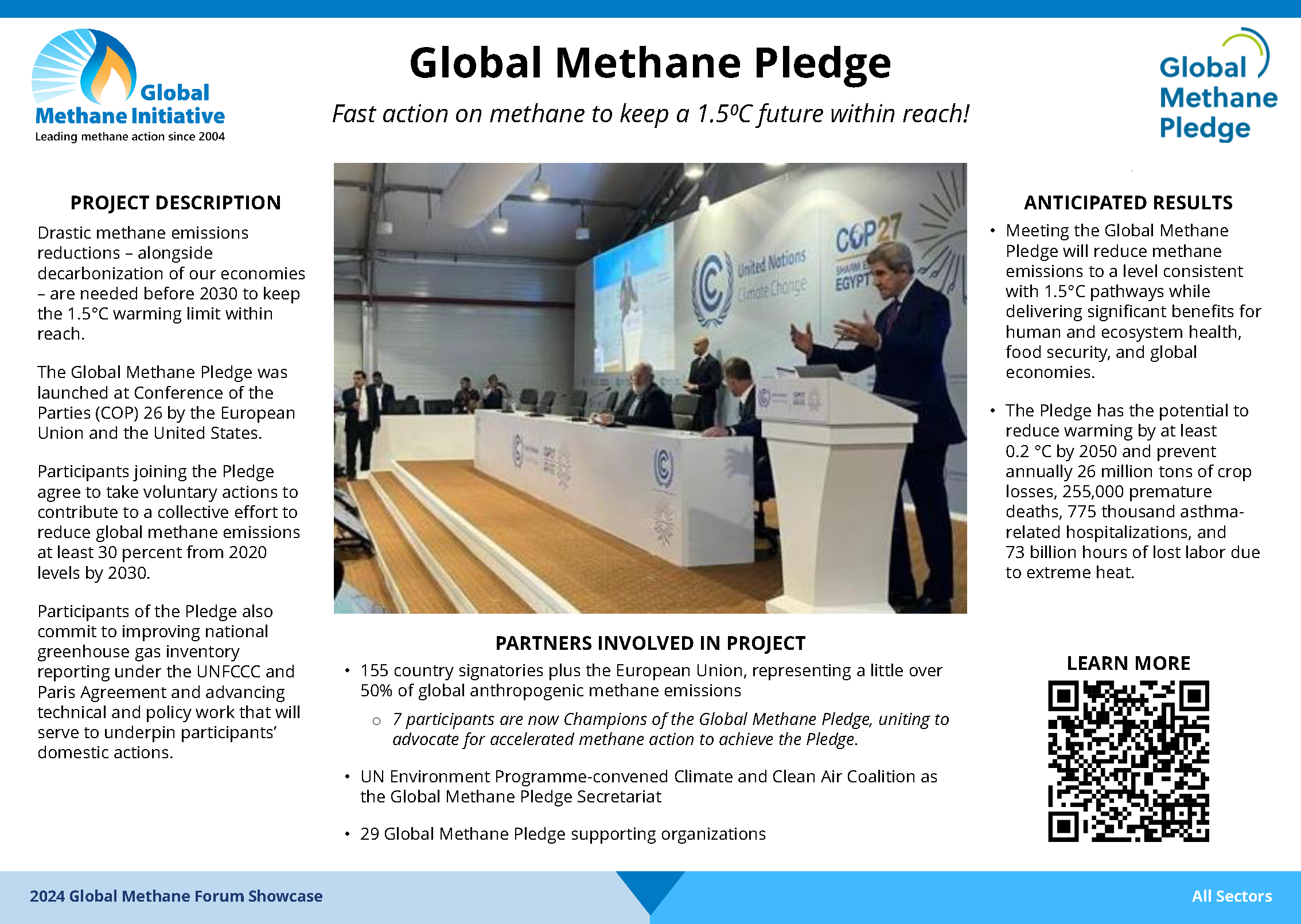
Global Methane Pledge

The Global Methane Pledge was launched in 2021 by the European Union and the United States. The Pledge is represented by 155 countries (as of March 2024). Meeting the Global Methane Pledge will reduce methane emissions to a level consistent with 1.5˚C pathways while delivering significant benefits for human and ecosystem health, food security, and global economies. The Pledge has the potential to reduce warming by 0.2˚C by 2050 and to prevent numerous losses of food, human life, and labor.

Partners

  • U.S. Environmental Protection Agency (U.S. EPA)
  • 155 country signatories plus the European Union
  • UN Environment Programme (UNEP)
  • Climate & Clean Air Coalition (CCAC)
  • 29 Global Methane Pledge supporting organizations
Download
Topic
Region
Language
Publish Date
01 Jan 2022
showcase_l_Page_06.png

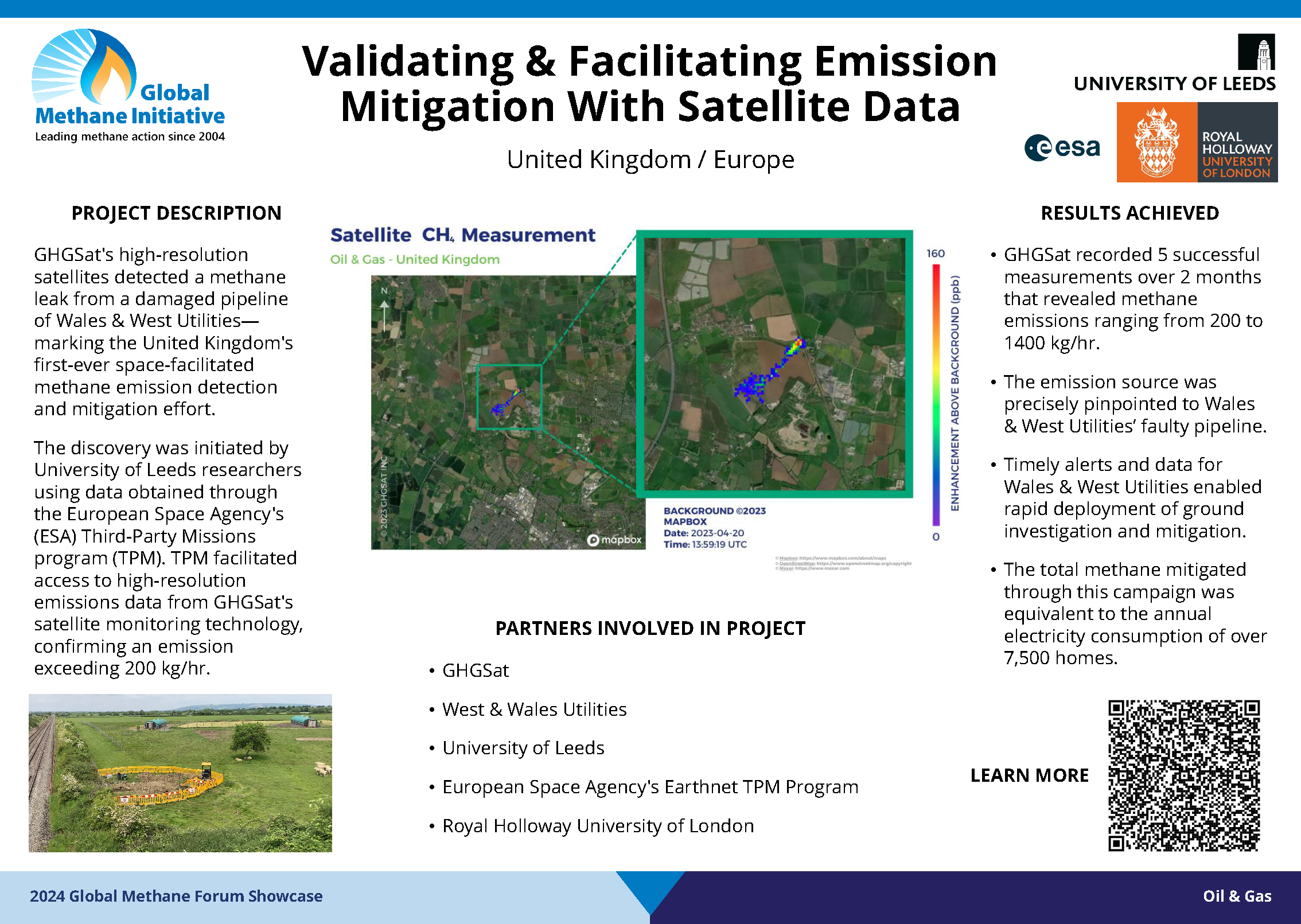
Validating & Facilitating Emission Mitigation With Satellite Data

GHGSat's high-resolution satellites detected a methane leak from a damaged pipeline marking the United Kingdom's first-ever space-facilitated methane emission detection and mitigation effort. GHGSat recorded 5 successful measurements over 2 months that revealed the emission source was precisely pinpointed to a faulty pipeline. The total methane mitigated through this campaign was equivalent to the annual electricity consumption of over 7,500 homes.

Partners

  • GHGSat
  • West & Wales Utilities
  • University of Leeds
  • European Space Agency's Earthnet TPM Program
  • Royal Holloway University of London
Download
Topic
Region
Language
Publish Date
01 Jan 2023
showcase_l_Page_21.png

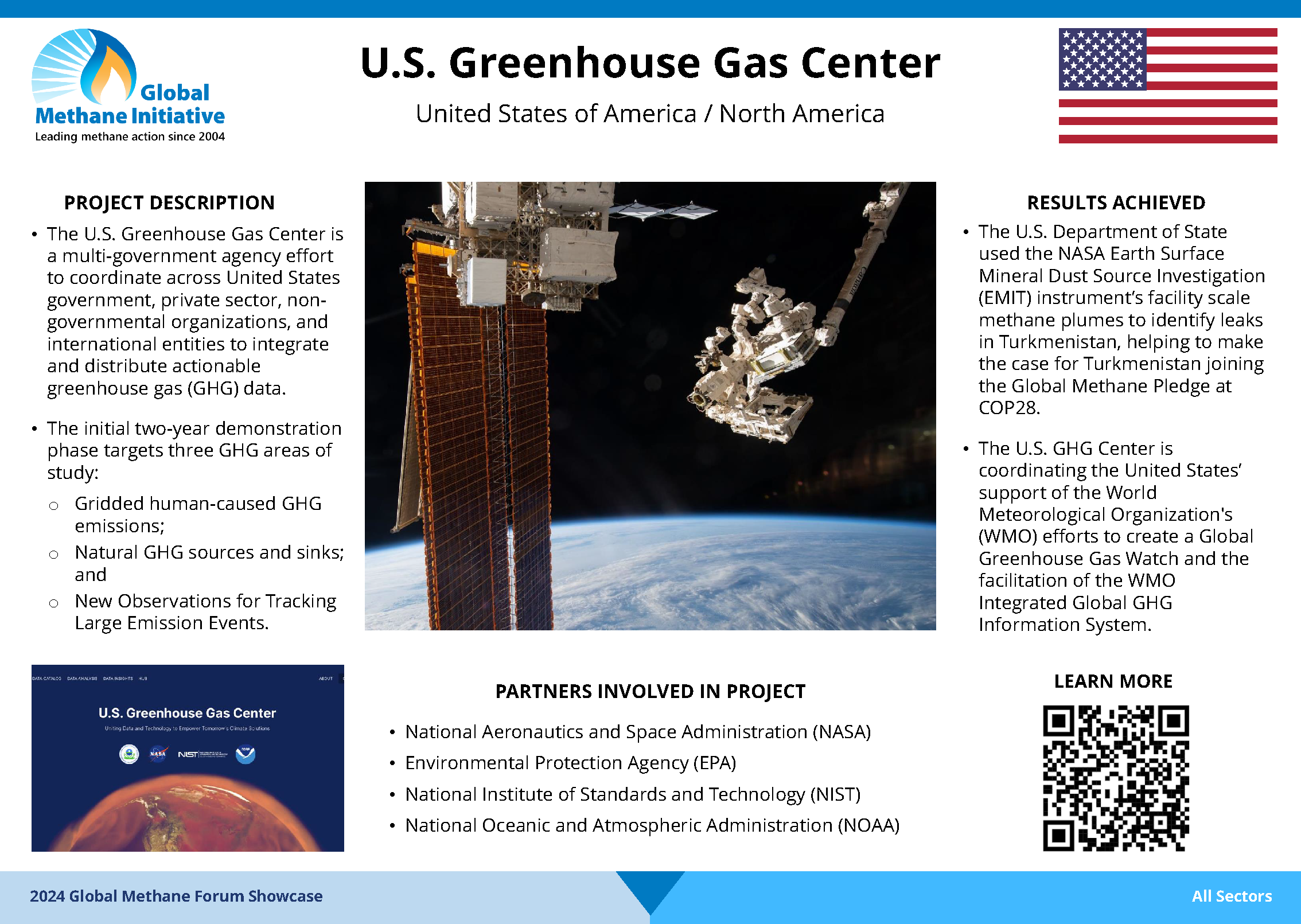
U.S. Greenhouse Gas Center

The U.S. Greenhouse Gas Center is a multi-government agency effort to coordinate across the United States government, private sector, non-governmental organizations, and international entities to integrate and distribute actionable greenhouse gas (GHG) data. The initial 2-year demonstration phase targets three GHG areas of study: gridded human-caused GHG emissions; natural GHG sources and sinks; and new observations for tracking large emission events. The Center has already helped make the case for Turkmenistan to join the Global Methane Pledge and is coordinating U.S. support of the World Meteorological Organization's efforts to create a Global Greenhouse Gas Watch.

Partners

  • National Aeronautics and Space Administration (NASA)
  • U.S. Environmental Protection Agency (U.S. EPA)
  • National Institute of Standards and Technology
  • National oceanic and Atmospheric Administration
Download
Topic
Region
Language
Publish Date
01 Jan 2023
showcase_l_Page_13.png

GESat: A Satellite System for Reliable Inventory Validation of >50kg/CH4/hour Methane Emissions

The European Commission awarded Absolut Sensing a contract to purchase methane data as part of the Copernicus Contributing Missions Programme. Absolut Sensing anticipates that the programme will reduce industrial methane emissions in Europe and Europe-imported methane emissions by 178 million tons CO2e/year. Data from ground measurement campaigns have validated the sensor technology for quantification of facility scale emissions and it is anticipated that the program will contribute to a 20% decrease in industrial methane emissions by 2030.

Partners

  • Absolut Sensing
  • European Commission
  • European Space Agency
  • Centre National d'Etudes Spatiales
  • Kayrros
  • TotalEnergies
Download
Topic
Region
Language
Publish Date
01 Jan 2023
showcase_l_Page_22.png

EPA Issues Final Rule to Reduce Methane from Oil and Natural Gas Operations

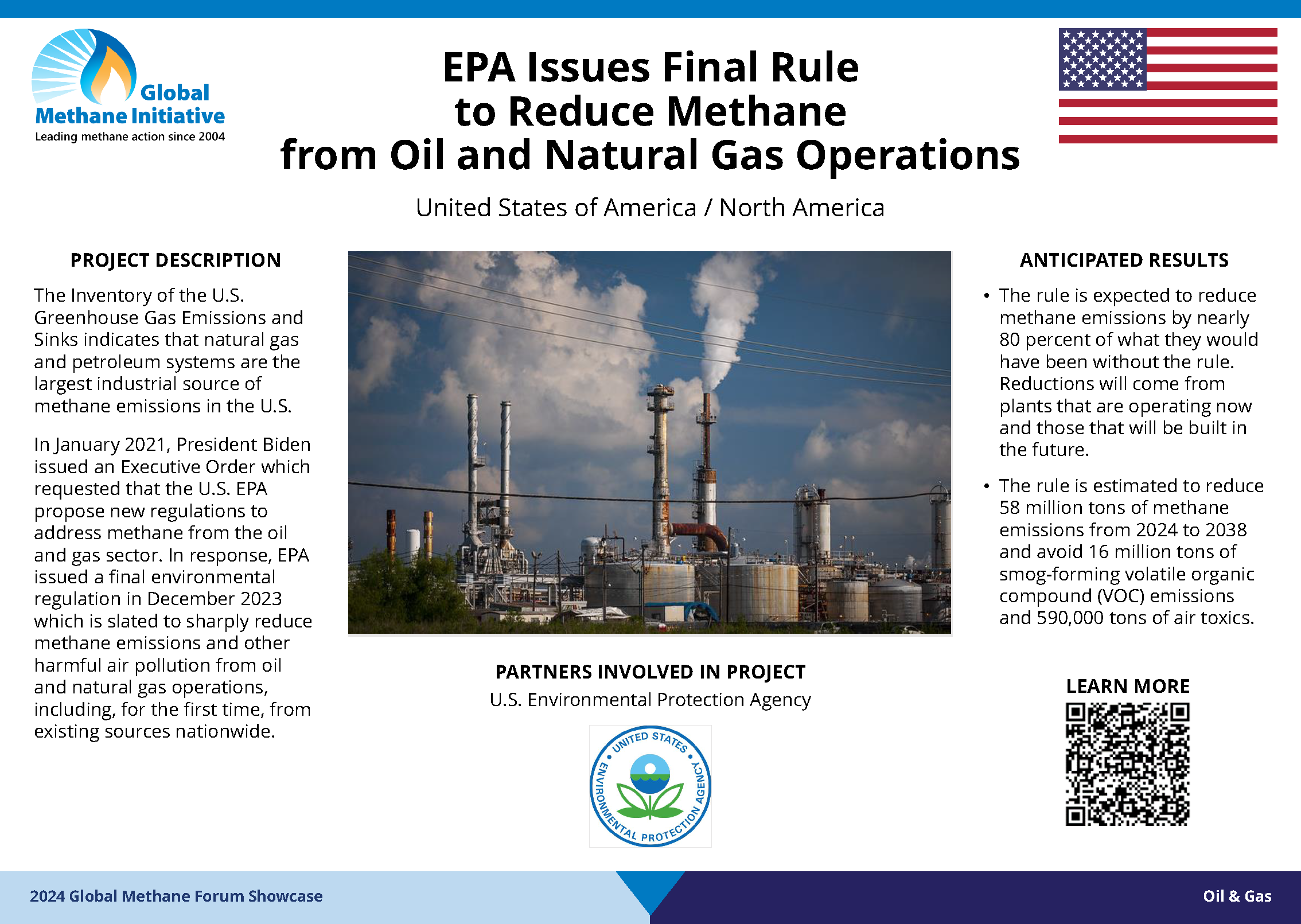
The Inventory of the U.S. Greenhouse Gas Emissions and Sinks indicates that natural gas and petroleum systems are the largest industrial source of methane emissions in the United States. In 2023, the U.S. Environmental Protection Agency issued a final environmental regulation that is slated to sharply reduce methane emissions and other harmful air pollution from oil and natural gas operations, including from existing sources nationwide. The rule is expected to reduce methane emissions by nearly 80% of what they would have been without the rule. It is also estimated to reduce 58 million tons of methane emissions from 2024 to 2038 and avoid 16 million tons of smog-forming volatile organic compound emissions and 590,000 tons of air toxics.

Partners

  • U.S. Environmental Protection Agency (U.S. EPA)
Download
External Link
Topic
Region
Language
Publish Date
01 Jan 2024
pmf_unitedStates.jpg

U.S. EPA Issues Final Rule to Sharply Reduce Methane and Other Harmful Pollution

The Inventory of the U.S. Greenhouse Gas Emissions and Sinks indicates that natural gas and petroleum systems are the largest industrial source of methane emissions in the United States. In 2023, the U.S. Environmental Protection Agency issued a final environmental regulation that is slated to sharply reduce methane emissions and other harmful air pollution from oil and natural gas operations, including from existing sources nationwide. The U.S. EPA considered nearly 1 million comments received on the two proposals before issuing a final rule, which was announced in December 2023 and subsequently published in March 2024. The rule is expected to reduce methane emissions by nearly 80% of what they would have been without the rule. It is also estimated to reduce 58 million tons of methane emissions from 2024 to 2038 and avoid 16 million tons of smog-forming volatile organic compound emissions and 590,000 tons of air toxics.

Partners

  • Global Methane Initiative (GMI)
  • U.S. Environmental Protection Agency (U.S. EPA)
External Link
Topic
Region
Language
Publish Date
01 Jan 2024
tile-methane-emmissions-from-og.jpg

Methane Emissions from the Oil and Gas Industry

This training provides an overview of the oil and natural gas industry, from the main types of deposits and wells to the different segments within the sector. This training also discusses some of the key methane emission sources in the oil and gas industry, available technologies to reduce emissions, and the positive outcomes of capturing and using methane. The training was developed by the U.S. Environmental Protection Agency (U.S. EPA) in support of voluntary activities to reduce methane emissions under the U.S. EPA’s Natural Gas STAR Program and the Global Methane Initiative (GMI).

View the Methane Emissions from the Oil and Gas Industry Course.

Course Topics

BACKGROUND ON METHANE

  • What is methane?
  • Where does methane come from?
  • Which sectors are emitting the most methane in the United States?
  • Why is it important to reduce methane emissions?

OVERVIEW OF THE OIL AND NATURAL GAS INDUSTRY

  • What are the main types of oil and natural gas reservoirs?
  • What is an oil and gas field?
  • Where are the oil and gas systems in the U.S.?
  • What are the basic types of oil and natural gas wells?
  • How is the supply chain of the oil and natural gas industry organized?

METHANE EMISSION SOURCES FROM THE OIL AND GAS INDUSTRY

  • How is methane released from oil and gas operations?
  • What are the top emission sources?
  • What are some of the options for mitigating methane emissions?
  • What are the positive outcomes of capturing and using methane?
  • What methane mitigation technologies are available?
Topic
Language
Publish Date
07 Jan 2025
thumb-tile-ldar-training.jpg

Developing and Implementing a Leak Detection and Repair (LDAR) Program to Mitigate Methane Emissions from the Oil and Gas Sector

This training, prepared by the U.S. Environmental Protection Agency (EPA) in support of GMI, explains the concept, objectives, systematic approach, challenges and benefits of a non-regulatory leak detection and repair (LDAR) program for managing methane emissions from equipment leaks at oil and natural gas facilities. In addition, it provides specific guidance on designing, implementing, and managing the LDAR program.

Course Modules

This course is divided into five self-directed modules. You can return to a module at any time to access the material.

Who can benefit from this training?

  • Company Management will understand the essential elements of an LDAR program and its merits.
  • LDAR Management Team will understand how to develop and manage an LDAR program and evaluate its effectiveness.
  • LDAR Surveyors will understand key LDAR program objectives and be familiar with procedures and best practices for conducting LDAR surveys, communicating the results, and verifying leak repairs.
  • Facility Operations and Maintenance Team will understand the systematic approach of an LDAR survey at a facility and the team’s related responsibilities.
  • Environmental Personnel will understand the type of emissions and emissions reduction data available from an LDAR program, as well as how to develop an emissions baseline.
  • Policymakers will develop a better understanding of the goals, systematic processes, challenges, and benefits of an LDAR program.


Disclaimer:

This course is not intended to address applicable national, state, Tribal, or local LDAR regulations. Prior to developing a non-regulatory LDAR program, please ensure you understand any relevant LDAR regulations that may apply in your jurisdiction.

Topic
Language
Publish Date
09 Jan 2025
Subscribe to Oil & Gas