Introduction > 1: Understand the Context > 2: Engage Stakeholders > 3: Establish Baseline > 4: Set Goals > 5: Develop Policies and Programs > 6: Implement Policies and Programs > 7: Evaluate, Report, and Adapt > Case Studies
Step 6: Implement Policies and Programs
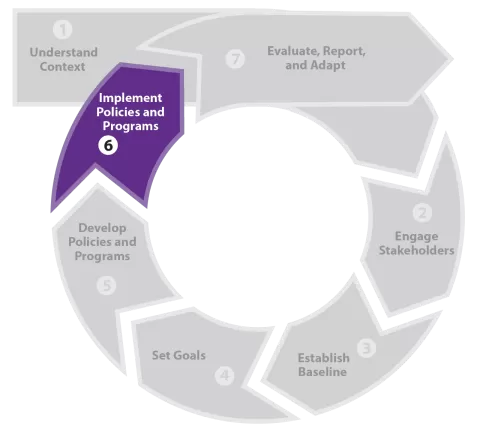
In the implementation phase, the policies and programs designed under Step 5, Develop Policies and Programs, are put into effect by or in coordination with the appropriate sector-focused government agencies and key stakeholders. Policy and program implementation relies heavily on stakeholder relationships and institutional arrangements established in prior steps, and continued engagement between government and stakeholders.
Best Practice Activities for this Step
Prepare a detailed implementation plan
The plan should identify any necessary actions by policymakers, government entities, and other stakeholders impacted by the policy or program. Use stakeholder maps created in Step 2, Engage Stakeholders, to outline the types of participants (not specific persons) and roles in the government or by external partners.
- For example, for each strategy, one agency may lead implementation and establish an administrator role to provide ongoing oversight and data collection. An industry representative may be required to certify ongoing monitoring and reporting.
Consider a communications plan
A communications plan that is developed along with the implementation plan will complement and streamline the implementation process to clarify roles and the process for continuing communications with stakeholders.
Consider financing sources
Considerations should include government budgets, taxes or fees, international banks, market opportunities required to implement the selected options.
Establish formal agreements or regulatory frameworks to implement and execute the policies and programs
Depending upon the specific policy, this could include developing an enabling action, such as a government directive, a commitment to an international agreement, or a declaration, that creates the legal and administrative conditions required to execute the specific policy or regulatory actions.
Engage stakeholders throughout the implementation process
Engaging stakeholders satisfy the following:
- Reiterates policy purpose and co-benefits to industry and local communities
- Encourages voluntary measures with influential messaging
- Trains, encourages, and otherwise empowers stakeholders to successfully execute their part of the policy implementation
- Enables a communication feedback loop. This could be for stakeholders and ministries responsible for meeting targets and policymakers who can establish complementary policies, direct resources, or seek external capacity building support.
For example, oil and gas sector strategies may involve technical outreach to a relatively small number of private sector operators. Biogas sector strategies may involve a large number of stakeholders or community members.
Plan for funding and technical support
Policy implementers from the government or private sector may require additional staffing or support from other government agencies, stakeholder experts, non-governmental organizations (NGO) or others for activities at various stages of implementation. The type of funding or technical support needed should be specific to the source, sector, and strategy.
- For example, a coal mine operator may need technical training to properly implement pre-mine drainage at an active coal mine. On the other hand, a subnational government entity or NGO may need technical support to develop outreach materials for rural farmers to educate, empower, and encourage them to participate in Climate Smart Agriculture practices. To address financial needs, governments may offer funding, which could be in the form of loans or subsidies, for example to construct a methane digestor. If there is multilateral bank funding, the funds are processed through a national government entity.
Track data to ensure policy compliance and achievement of goals
Transparency requirements include tracking progress on implementing emission reduction policies and measures. Refer to this step's Key Resources list for methods and tools and seek international capacity building support as needed.
Key Resources Related to this Step
General Resources
Climate Toolbox
Nationally Determined Contributions (NDC) Partnership 2023. The Climate Toolbox includes more than 700 resources and tools to support government officials, implementing partners, and other parties in NDC planning and implementation.
Operationalizing Article 6.2 of the Paris Agreement: Achieving ambitious climate action through cooperative approaches
United Nationals Development Program, Learning for Nature 2023. This is a self-paced training course with information on how to implement actions to achieve climate action goals.
Climate Policy Implementation Tracking Framework
World Resources Institute 2014. This resource is a framework for national governments to develop and implement climate policy and has a similar structure to this Framework.
Oil & Gas Resources
Driving Down Methane Leaks from the Oil and Gas Industry - A Regulatory Roadmap and Toolkit
International Energy Agency 2021. This report aims to provide a complete “getting started” guide for policymakers looking to develop new regulations to tackle oil and gas methane emissions within their jurisdictions. This guide consists of two companion pieces: a Regulatory Roadmap and a Regulatory Toolkit.
Methane Abatement for Oil & Gas – A Handbook for Policymakers
U.S. Department of Commerce Commercial Law Development Program
2023. A practical resource for decision-makers on the policy and strategy behind encouraging methane abatement from the oil and gas sector, this guide helps legislators, ministries, regulators, and National Oil Company officials adopt and enforce rules that will rapidly and effectively reduce methane emissions from the oil and gas sector. Also available in Russian, Vietnamese, Spanish, Portuguese (Brazil), Portuguese (Portugal), Turkmen, Arabic, Malay, Bahasa Indonesia, and French.
Natural Gas STAR Program
U.S. Environmental Protection Agency 2023. This voluntary program provides a framework for oil and gas company partners to implement methane reduction technologies and practices.
Financing Solutions to Reduce Natural Gas Flaring and Methane Emissions
World Bank 2022.
Coal Resources
Conducting Pre-Feasibility Studies for Coal Mine Methane Projects Training
GMI
2022. This training course introduces coal mine methane project developers, third parties, mining company personnel, and government officials to principles for assessing the potential of projects to capture and use coal mine methane.
Coal Mine Methane (CMM) Finance Guide
U.S. Environmental Protection Agency
2019. This resource summarizes the market potential of coal mine methane, project economics, financing, and risk mitigation.
Coalbed Methane Outreach Program
U.S. Environmental Protection Agency
2023. This is voluntary program provides resources to support coal mine methane project development, overcome institutional, technical, regulatory, and financial barriers to implementation, and communicate the benefits of coal mine methane recovery.
Managing Coal Mine Closure – Achieving a Just Transition for All
World Bank
2018. This document offers lessons learned from closing coal mines and steps governments can take to minimize the social and economic impacts associated with closures.
Coal Mine Methane (CMM) Emissions Estimation Tool
GMI
The CMM Emission Estimation Tool helps national governments estimate annual methane emissions from underground coal mines in their countries, providing a step-by-step, systematic, and easy-to-follow process for collecting the data needed to estimate facility-specific methane emissions, including descriptions of the equations and calculations used. This spreadsheet-based resource is designed to help countries develop more accurate national emissions estimates by aggregating facility-level emissions.
Trainings on Prefeasibility Studies on CMM and AMM (+Translations)
GMI
These trainings help users learn best practices in conducting prefeasibility studies, which evaluate CMM or AMM resources.
Biogas Resources
Global Methane Initiative (GMI) Financial Readiness Framework for Organic Waste Management
GMI and EPA
2024. This resource provides high-level, step-by-step practical guidance to help stakeholders understand the process for financing organic waste management projects, mitigating potential investment risks, and improving the bankability of projects .
Case Studies
|
Image

|
Japan Reduces Methane from Landfills The Ministry of the Environment of Japan conducted a survey on the generation and disposal of municipal solid waste to ensure compliance with their new standards on waste management to reduce methane emissions. They published the results in 2020. The data are critical to evaluate the impacts and effectiveness of the standards managing and reducing waste. Read about Japan |
|
Image

|
Trinidad and Tobago, an Oil and Gas Producer, Strengthens Capacity for Emissions Transparency To improve the transparency of their country's emissions, Trinidad and Tobago identified key stakeholders and outlined their responsibilities. For example, the Ministry of Planning and Development is required to review proposals on institutional arrangements for implementing climate transparency activities. Read about Trinidad and Tobago |