Introduction > 1: Understand the Context > 2: Engage Stakeholders > 3: Establish Baseline > 4: Set Goals > 5: Develop Policies and Programs > 6: Implement Policies and Programs > 7: Evaluate, Report, and Adapt > Case Studies
Step 4: Set Goals
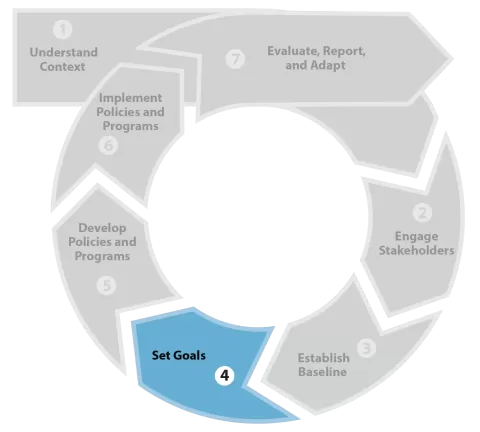
A valuable part of the methane policymaking process involves establishing specific goals or commitments to limit methane emissions from specific source sector to a specified annual amount by a specified date. Goals may be quantitative (e.g., reducing a specified annual amount of emissions by a certain date), or qualitative (e.g., conducting stakeholder workshops and meetings). Whichever types of goals are chosen, it is important for them to be realistic with a clearly defined parameters and time frame for achievement. Quantitative goals should be compared against the emissions baseline projected under Step 3, Establish Baseline, and can inform the strategies and actions identified in Step 5, Develop Policies and Programs.
- Iterations of the Steps: Often in the policymaking process, there may be some iteration between steps. For example, there may be some interaction and iterations between Step 4, Set Goals and Step 5, Develop Policies and Programs. Goals are typically based on some preliminary analysis of the collective potential of policies that could be adopted. Then after goals are set, policy options are analyzed more closely, and benefit-cost estimates may be refined before policies are selected.
Best Practice Activities for this Step
Consider priorities, previous goals, and existing programs
Consider existing policies and planning documents at the national (e.g., Nationally Determined Contributions (NDC) and methane action plans) and subnational levels (e.g., state or provincial pollution control regulations). Explore the potential to adapt existing policies and targets to achieve higher levels of emission reductions. During this step, country policymakers should ensure that any new goal is in alignment with, or more stringent than, previous goals, such as those established in their NDC.
Consider the technical feasibility and quantify emission-reduction potential of broad policies and programs
This can ensure the goal is realistic and achievable. This best practice is further discussed in Step 5, Develop Policies and Programs.
Set the parameters of the goal
This involves defining the geographical territory and identifying sectors and sources of methane emissions.
Determine the format of the reduction goal
This may include the following:
- Base year emissions goals, which reduce or limit the increase of emissions by a certain quantity relative to the base year (e.g., reduce methane emissions 40 percent from 1990 levels by 2030)
- Fixed level goals, which reduce or limit the increase of emissions to an absolute emissions level by a certain target year (e.g., reach net zero methane emissions by 2030)
- Base year intensity goals, which reduce the emissions intensity — the emissions per unit of another variable, such as the Gross Domestic Product by a certain quantity relative to a base year (e.g., reduce methane by 40 percent from the 1990 base year intensity by 2030)
- Baseline scenario goals, which reduce emissions by a certain quantity relative to projected emissions in a business-as-usual scenario — in the absence of methane reduction activities (e.g., reduce methane by 40 percent from baseline scenario emissions in 2030)
- Set a time frame to achieve the goal. For example, a goal can specify the achievement of emission reductions by a single target year (e.g., by 2025 or over a certain target period such as from 2021 to 2025)
- Communicate with stakeholders. Solicit feedback, secure buy-in, and ensure that goals are attainable (e.g., if industrial sources can comply with them in the timeframe proposed) (refer to Step 2, Engage Stakeholders, and the Communication Core Principle)
- Document final goals to prepare for future evaluation and reporting. For example, such as under the Enhanced Transparency Framework
Establish criteria and indicators to track progress in meeting the goal
There are different types of indicators to track progress for policy implementation, including activity indicators (e.g., permitting, procurement, licensing), effect indicators (e.g., GHG effects, air or water pollution effects, public health effects), input indicators (e.g., policy or program financing), and key performance indicators (e.g., number of anaerobic digesters installed).
Set a time frame to achieve the goal
For example, a goal can specify the achievement of emission reductions by a single target year (e.g., by 2025 or over a certain target period such as from 2021 to 2025).
Communicate with stakeholders
Solicit feedback, secure buy-in, and ensure that goals are attainable (e.g., if industrial sources can comply with them in the timeframe proposed) (refer to Step 2, Engage Stakeholders, and the Communication Core Principle).
Document final goals to prepare for future evaluation and reporting
For example, such as under the Enhanced Transparency Framework.
Key Resources Related to this Step
General Resources
Mitigation Goal Standard: An Accounting and Reporting Standard for National and Subnational Greenhouse Gas Reduction Goals
World Resources Institute 2014. This resource outlines a step-by-step process for designing GHG mitigation goals.
Oil & Gas Resources
A Technical, Economic and Environmental Analysis of Beneficial Use of Stranded Associated Gas in Kazakhstan
GMI 2023. This study provides a range of practical mitigation options and recommendations for stranded associated gas, which can help inform goal development in this sector.
Guidelines for Methane Target Setting
Gas Infrastructure Europe 2020. This resource offers a step-by-step process for setting methane reduction targets in the oil and gas sector.
Driving Down Methane Leaks from the Oil and Gas Industry - A Regulatory Roadmap and Toolkit
International Energy Agency 2021. This report aims to provide a complete “getting started” guide for policymakers looking to develop new regulations to tackle oil and gas methane emissions within their jurisdictions. This guide consists of two companion pieces: a Regulatory Roadmap and a Regulatory Toolkit.
Methane Abatement for Oil & Gas – A Handbook for Policymakers
U.S. Department of Commerce Commercial Law Development Program
2023. A practical resource for decision-makers on the policy and strategy behind encouraging methane abatement from the oil and gas sector, this guide helps legislators, ministries, regulators, and National Oil Company officials adopt and enforce rules that will rapidly and effectively reduce methane emissions from the oil and gas sector. Also available in Russian, Vietnamese, Spanish, Portuguese (Brazil), Portuguese (Portugal), Turkmen, Arabic, Malay, Bahasa Indonesia, and French.
Coal Resources
Conducting Pre-Feasibility Studies for Coal Mine Methane Projects Training
GMI 2022. This cost-free online training course focuses on how to conduct technical pre-feasibility studies to estimate the potential for mitigation projects at operating and closed coal mines.
Driving Down Coal Mine Methane Emissions: A Regulatory Roadmap and Toolkit
International Energy Agency 2023. Box 4 of this Toolkit provides some case studies on setting strategic targets to reduce methane from coal mining.
Coal Mine Methane (CMM) Emissions Estimation Tool
GMI
The CMM Emission Estimation Tool helps national governments estimate annual methane emissions from underground coal mines in their countries, providing a step-by-step, systematic, and easy-to-follow process for collecting the data needed to estimate facility-specific methane emissions, including descriptions of the equations and calculations used. This spreadsheet-based resource is designed to help countries develop more accurate national emissions estimates by aggregating facility-level emissions.
Biogas Resources
Pre-Feasibility Assessment on Biogas-Powered Cold Storage Potential
GMI
2024. This report assesses the potential for direct biogas-powered cold storage facilities in Maharashtra, India. Prefeasibility studies demonstrate the potential benefits of biogas and can help decisionmakers in forming methane mitigation goals.
Case Studies
|
Image

|
Albania's Landfill Methane Capture Strategy Based on their GHG inventory, Albania set a goal to begin capturing methane in 2025 and increase the amount captured linearly until they capture 10 percent of the 1.34 million m3 of methane by 2030. Additionally, they set goals to increase the amount of composted waste by 85 percent between 2009 and 2020 and an additional 3 percent annually until 2030. Read about Albania |
|
Image

|
Bangladesh National Action Planning for Short-Lived Climate Pollutants In Bangladesh, sectoral and government stakeholders engaged to propose, assess, and prioritize policies, programs, and pilot projects to reduce short-lived climate pollutants. Read about Bangladesh |
|
Image
|
Rwanda, Dominica, and Uruguay These countries included methane emissions reduction targets in their NDC. GMI's Policymaker's Handbook for Measurement, Reporting, and Verification in the Biogas Sector |
|
Image

|
Trinidad and Tobago, an Oil and Gas Producer, Strengthens Capacity for Emissions Transparency Trinidad and Tobago joined the NDC Support Programme, which focused on the implementation of an MRV system, the installation and design of a knowledge management system to support MRV, and the design and implementation of a pilot project to test it. Read about Trinidad and Tobago |