Introduction > 1: Understand the Context > 2: Engage Stakeholders > 3: Establish Baseline > 4: Set Goals > 5: Develop Policies and Programs > 6: Implement Policies and Programs > 7: Evaluate, Report, and Adapt > Case Studies
Step 5: Develop Policies and Programs
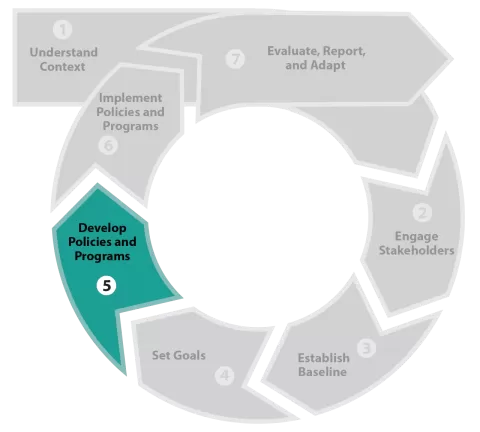
This step involves identifying, analyzing, selecting, and further developing the sector- and source-specific strategies at the national and subnational level that will reduce methane emissions. Strategies can include regulatory, voluntary, and incentive-based policies and programs, approaches, or technologies. It may be useful to evaluate policies and programs from other countries and tailor these to meet your own country-specific circumstances.
National and sectoral policies and programs are not always replicable and scalable to another country's context. It can, therefore, be helpful to re-engage with the experts and stakeholders engaged identified in Step 2, Engage Stakeholders, to ensure the most locally appropriate and beneficial strategies are identified. Policies or programs should be designed around the best available data, including accurate cost information, to improve the likelihood of successful implementation.
Best Practice Activities for this Step
Identify potential strategies to reduce methane emissions
It is helpful for potential strategies to reflect and build on national priorities and any existing methane mitigation efforts identified under Step 1, Understand the Context as well as incorporate any relevant input from key stakeholders gathered in Step 2, Engage Stakeholders. It can be useful to review policies and programs from other countries and consider how to tailor these to meet your own country-specific circumstances, if appropriate.
Develop criteria that will be used to evaluate and select mitigation strategies
Criteria can be based on implementation feasibility, cost-effectiveness, mitigation potential relative to goals set in Step 4, Set Goals, and co-benefits as they relate to country priorities determined in Step 1, Understand the Context.
Quantify methane reductions expected from the identified strategies over the goal period
Use engineering estimates, case studies, and available tools to estimate the amount of methane each strategy is likely to reduce (refer to the Key Resources section for tools and resources suggestions).
Estimate net costs to implement the policies or strategy
Net costs include the costs to stakeholders of complying with new regulations and administrative costs over time and also account for cost reductions if applicable (e.g., reduction in loss of natural gas from leak detection programs).
Quantify or assess benefits of the identified policies or strategies
For a balanced analysis, it is important to include, and quantify when feasible, the social and environmental benefits (e.g., job creation, local and macroeconomic effects, safety enhancement, local air quality improvement). It may be helpful to conduct further research on existing national or subnational methane reduction plans, programs, policies, laws, and regulations at this time to ensure that the identified strategies are complementary and not duplicative.
Analyze feasibility
Ideally this analysis should include the adoption and implementation of the identified strategies. It is helpful to document potential policy risks, barriers to adoption, technical and political barriers, and options for mitigating risks and barriers.
Select strategies using criteria and document decision-making
With the information gathered, it is often useful to evaluate the strategies against the established criteria and document the recommendations.
Key Resources Related to this Step
General Resources
Assessment of Environmental and Society Benefits of Methane Reductions (Web Tool)
Climate and Clean Air Coalition and United Nations Environment Programme
2021. This web tool quantifies the environmental and societal benefits of reducing methane emissions from all key emitting sectors. Policymakers can use this tool to establish linkages between methane reduction and other social, environmental, and economic priorities.
Methane Technical Assistance
Climate and Clean Air Coalition and United Nations Environment Programme
2023. This webpage describes the different technical assistance offerings as well as toolkits and guides on how to address methane emissions in the agriculture, fossil fuels, and waste sectors.
Methane Policies Database
International Energy Agency
2025. This database includes methane reduction policies and programs under development and implemented around the world. Users can click on the filter button, select “Methane Abatement” as a topic, and filter by country, region, sector, policy type, technology, status, jurisdiction, and source.
Oil & Gas Resources
General Resources
Designing Better Methane Mitigation Policies: The Challenge of Distributed Small Sources in the Natural Gas Sector
Arvind P. Ravikumar and Adam R. Brandt
2017. This study examines the effect of facility-related and mitigation-related uncertainties on regulation effectiveness and proposes four policy options for methane mitigation.
Rules to Prevent Methane Leakage in the Energy Sector
European Union Agency for the Cooperation of Energy Regulators
2021. This white paper by the Council of European Energy Regulators assesses the on the European Union Methane Strategy. This document is an example of how to review a proposed policy to identify gaps and opportunities for improvements.
Curtailing Methane Emissions from Fossil Fuel Operations
International Energy Agency
2021. The report quantifies the potential impact of a range of measures, including policy and regulatory action, voluntary industry initiatives and improvements in transparency of emissions data.
Reducing Methane Emissions Best Practices Guides
Methane Guiding Principles
2019. This website includes 10 best practices guides to help decision-makers develop methane mitigation plans for the oil and gas sector. Each guide includes information on quantifying emissions, mitigation strategies, and checklists to monitor progress.
Comparing Policies to Reduce Methane Emissions in the Natural Gas Sector
Resources for the Future
2017. This report compares policies aimed at reducing methane emissions from the natural gas sector in the United States in terms of economic efficiency and environmental effectiveness.
Methane Abatement for Oil & Gas – A Handbook for Policymakers
U.S. Department of Commerce Commercial Law Development Program
2023. A practical resource for decision-makers on the policy and strategy behind encouraging methane abatement from the oil and gas sector, this guide helps legislators, ministries, regulators, and National Oil Company officials adopt and enforce rules that will rapidly and effectively reduce methane emissions from the oil and gas sector. Also available in Russian, Vietnamese, Spanish, Portuguese (Brazil), Portuguese (Portugal), Turkmen, Arabic, Malay, Bahasa Indonesia, and French.
Tools And Databases:
A Technical, Economic and Environmental Analysis of Beneficial Use of Stranded Associated Gas in Kazakhstan
GMI
2023. This study provides a range of practical mitigation options and recommendations for stranded associated gas. The report includes the results of a prefeasibility assessment that can help decision-makers craft policies and programs.
Identifying and Evaluating Opportunities for Greenhouse Gas Mitigation & Operational Efficiency Improvement at Oil and Gas Facilities
GMI
2020. This document presents introductory guidance on an approach to identify, evaluate and advance opportunities to manage GHG emissions, including methane.
Best Practice Guidance for Effective Methane Management in the Oil and Gas Sector: Monitoring, Reporting and Verification and Mitigation
UNECE and GMI
2019. This document provides guidance for effective methane management practices for the oil and gas sector.
Oil and Gas Country Methane Abatement Tool
Clean Air Task Force
2023. This tool helps governments design a methane mitigation program for the oil and gas sector by leveraging existing technologies and policies or introducing new ones.
Rules to Prevent Methane Leakage in the Energy Sector
European Union Agency for the Cooperation of Energy Regulators
2021. This white paper by the Council of European Energy Regulators assesses the on the European Union Methane Strategy. This document is an example of how to review a proposed policy to identify gaps and opportunities for improvements.
Driving Down Methane Leaks from the Oil and Gas Industry - A Regulatory Roadmap and Toolkit
International Energy Agency
2021. This report aims to provide a complete “getting started” guide for policymakers looking to develop new regulations to tackle oil and gas methane emissions within their jurisdictions. This guide consists of two companion pieces: a Regulatory Roadmap and a Regulatory Toolkit.
Global Methane Tracker
International Energy Agency
2023. This interactive database provides country and regional estimates for methane emissions and abatement options.
Methane Tracker Tool
International Energy Agency
2023. This data tool provides detailed estimates on the abatement potential for each technology and policy options to tackle methane emissions in the oil and gas sector.
Reducing Methane Emissions Best Practices Guides
Methane Guiding Principles
2019. This website includes 10 best practices guides to help decision-makers develop methane mitigation plans for the oil and gas sector. Each guide includes information on quantifying emissions, mitigation strategies, and checklists to monitor progress.
Methane Mitigation Technologies Platform
U.S. Environmental Protection Agency
2023. This resource provides an overview of key methane emission sources in the oil and gas industry as well as technologies and practices that can be used to reduce methane emissions.
Coal Resources
General Resources
Legal and Regulatory Status of Abandoned Mine Methane in Selected Countries: Considerations for Decision Makers
GMI and U.S. Environmental Protection Agency
2019. This document presents case studies on the legal and regulatory status of abandoned coal mines and incentives and policies to increase the capture and utilize methane from abandoned mines.
Status of CMM Ownership and Policy Incentives in Key Countries: Considerations for Decision Makers
GMI and U.S. Environmental Protection Agency
2019. This document presents case studies on the ownership and legal status of coal mines and incentives and policies to increase the capture and utilize methane from coal mines.
Best Practice Guidance for Effective Methane Drainage and Use in Coal Mines
United Nations Economic Commission for Europe
2010. This guidance is intended to assist mine owners and operators, government regulators, and policymakers in designing and implementing safe and effective methane capture and control in underground coal mines.
Best Practice Guidance for Effective Methane Recovery and Use from Abandoned Coal Mines
United Nations Economic Commission for Europe
2010. This guidance is intended to raise awareness of abandoned mine methane opportunities and hazards among government regulators and policymakers, among other stakeholders.
Coalbed Methane Outreach Program
U.S. Environmental Protection Agency
2023. This is voluntary program provides resources to support coal mine methane project development, overcome institutional, technical, regulatory, and financial barriers to implementation, and communicate the benefits of coal mine methane recovery.
Coal Mine Methane (CMM) Finance Guide
U.S. Environmental Protection Agency
2019. This resource summarizes the market potential of coal mine methane, project economics, financing, and risk mitigation.
Coal Mine Methane (CMM) Emissions Estimation Tool
GMI
The CMM Emission Estimation Tool helps national governments estimate annual methane emissions from underground coal mines in their countries, providing a step-by-step, systematic, and easy-to-follow process for collecting the data needed to estimate facility-specific methane emissions, including descriptions of the equations and calculations used. This spreadsheet-based resource is designed to help countries develop more accurate national emissions estimates by aggregating facility-level emissions.
Trainings on Prefeasibility Studies on CMM and AMM (+Translations)
GMI
These trainings help users learn best practices in conducting prefeasibility studies, which evaluate CMM or AMM resources.
Selected Studies
Conducting Pre-Feasibility Studies for Abandoned Mine Methane Projects Training
GMI
2022. This training course introduces coal mine methane project developers, third parties, mining company personnel, and government officials to principles for assessing the feasibility of abandoned mine methane projects.
Conducting Pre-Feasibility Studies for Coal Mine Methane Projects Training
GMI
2022. This training course introduces coal mine methane project developers, third parties, mining company personnel, and government officials to principles for assessing the potential of projects to capture and use coal mine methane.
Colombia Coal Mine Methane Market Study
U.S. Environmental Protection Agency
2019. This is an example of the type of study that was conducted to understand opportunities. It provides an overview of Colombia's energy markets and identifies opportunities for coal mine methane utilization and emissions reduction projects in Colombia.
India Coal Mine Methane Market Study
U.S. Environmental Protection Agency
2019. This is an example of the type of study that could be conducted to understand opportunities. It provides an overview of India's energy markets and identifies opportunities for coal mine methane utilization and emissions reduction projects in India.
Tools And Databases
Coal Mine Methane Mitigation and Utilization Technologies and Project Profiles (also referred to as the Coal Mine Methane Technology Database)
GMI
2018. This database provides descriptions of a selection of key technologies applicable to coal mine methane recovery and use, including each technology's commercial availability.
Conducting Pre-Feasibility Studies for Abandoned Mine Methane Projects Training
GMI
2022. This training course introduces to project developers, third parties, mining company personnel, and government officials the principles for assessing the feasibility of abandoned mine methane projects.
Conducting Pre-Feasibility Studies for Coal Mine Methane Projects Training
GMI
2022. This training course introduces coal mine methane project developers, third parties, mining company personnel, and government officials to principles for assessing the potential of projects to capture and use coal mine methane.
Legal and Regulatory Status of Abandoned Mine Methane in Selected Countries: Considerations for Decision Makers
GMI and U.S. Environmental Protection Agency
2019. This document presents case studies on the legal and regulatory status of abandoned coal mines and incentives and policies to increase the capture and utilize methane from abandoned mines.
Status of CMM Ownership and Policy Incentives in Key Countries: Considerations for Decision Makers
GMI and U.S. Environmental Protection Agency
2019. This document presents case studies on the ownership and legal status of coal mines and incentives and policies to increase the capture and utilize methane from coal mines.
Best Practice Guidance for Effective Methane Drainage and Use in Coal Mines
United Nations Economic Commission for Europe
2010. This guidance is intended to assist mine owners and operators, government regulators, and policymakers in designing and implementing safe and effective methane capture and control in underground coal mines.
Coalbed Methane Outreach Program
U.S. Environmental Protection Agency
2023. This is voluntary program provides resources to support coal mine methane project development, overcome institutional, technical, regulatory, and financial barriers to implementation, and communicate the benefits of coal mine methane recovery.
Biogas Resources
General Resources
Market Opportunities for Anaerobic Digestion of Livestock and Agro-Industrial Wastes in India
GMI
2020. This is an example of the type of study that could be conducted to understand context. This study presents a detailed analysis of primary sources of methane emissions and market assessment of recent developments in biogas capture and use in India.
Five Practical Actions Towards Low-Carbon Livestock
Food and Agriculture Organization of the United Nations
2019. This resource presents five actions that may impact livestock emissions.
Best Practices for Solid Waste Management: A Guide for Decision-Makers in Developing Countries
U.S. Environmental Protection Agency
2020. This guide includes best practices for the management of solid waste in developing countries. It can help decision-makers learn the basics about reducing and recovering methane emissions from the solid waste sector.
Risk and Analysis Technical Review Checklist for Biogas Projects
U.S. Environmental Protection Agency
2023. This Risk Checklist helps project developers, government agencies, financial institutions, and other stakeholders assess the technical and financial feasibility of anaerobic digestors or other biogas projects.
Methane Mitigation: Lessons Learned from India’s Compressed Biogas (Renewable Natural Gas) Projects
GMI and U.S. Environmental Protection Agency
2024. This report presents the results of study analyzing a subset of India’s compressed biogas sector focusing on the potential role for this sector to create a market for a renewable energy resource while mitigating a significant source of methane emissions in India.
Training on Best Practices for Landfill and Organic Waste Management
GMI and U.S. Environmental Protection Agency
2024. This training series focuses on proven approaches and case studies for dumpsite closure and remediation, sanitary landfill construction, operation, and maintenance, organic waste treatment, feedstock management, greenhouse gas measurement, reporting, and verification, and useful tools and resources.
Indore’s Clean City Transformation: A Model for Sustainable Waste Management
GMI and U.S. Environmental Protection Agency
2024. This case study explores how Indore, India, transformed its waste management strategy and reduced methane emissions by implementing door-to-door source-segregated waste collection and scaling up a neighborhood-level pilot project. It highlights key initiatives, including leadership involvement, public engagement and participation, infrastructure upgrades, and innovative financing.
The Waste Methane Toolbox: Policy Solutions for a Low Methane Future
Clean Air Task Force
2025. This guide provides a clear framework for policymakers to design policies as a part of holistic strategy to build integrated solid waste management systems that manage all waste materials effectively. The guide includes a matrix of policy approaches to mitigate methane, policy development considerations, and key case studies.
Tools And Databases
Anaerobic Digestion (AD) Screening Tool
GMI
2022. The AD Screening Tool conducts pre-feasibility analyses to evaluate AD opportunities for a variety of feedstocks, including organic municipal solid waste, livestock manure, agricultural residues, and wastewater.
Biogas Wastewater Assessment Technology Tool (BioWATT)
GMI
2016. This tool allows users to assess wastewater-to-energy projects by providing biogas production estimates for wastewater-to-energy technologies, electricity potential, greenhouse gas savings, and more information.
Landfill Gas (LFG) Screening Tool
GMI
2021. This is an Excel-based tool that helps cities assess the feasibility of LFG energy projects. It provides an estimate of how much LFG a site could collect and whether the fuel supply is adequate to support a modest-sized LFG energy project.
Market Opportunities for Anaerobic Digestion of Livestock and Agro-Industrial Wastes in India
GMI
2020. This is an example of the type of study that could be conducted to understand context. This study presents a detailed analysis of primary sources of methane emissions and market assessment of recent developments in biogas capture and use in India.
OrganEcs
GMI
2021. This tool estimates the costs and financial returns associated with organic waste management projects, including anaerobic digestion and composting projects.
Pre-Feasibility Assessment on Biogas-Powered Cold Storage Potential
GMI
2024. This report assesses the potential for direct biogas-powered cold storage facilities in Maharashtra, India. Prefeasibility studies demonstrate the potential benefits of biogas and can help decisionmakers develop policies and programs.
Solid Waste Emissions Estimation Tool (SWEET)
GMI
2023. This Excel-based tool quantifies emissions of methane, black carbon, and other pollutants from sources in the municipal solid waste sector.
Five Practical Actions Towards Low-Carbon Livestock
Food and Agriculture Organization of the United Nations
2019. This resource presents five actions that may impact livestock emissions.
Biogas Toolkit
U.S. Environmental Protection Agency
2023. This toolkit compiles information from AgSTAR, Landfill Methane Outreach Program, and GMI as a knowledge hub for biogas project stakeholders. The toolkit covers the agriculture, solid waste, and wastewater sectors and a variety of topics and project phases.
Case Studies
|
Image

|
Bangladesh National Action Planning for Short-Lived Climate Pollutants In Bangladesh, sectoral and government stakeholders engaged to propose, assess, and prioritize policies, programs, and pilot projects to reduce short-lived climate pollutants. Read about Bangladesh |
|
Image

|
Identifying Coal Mine Methane (CMM) Mitigation Options in Colombia In Colombia, government officials identified coal mining as a major source of methane emissions and economic productivity and, thus, designed a methane reduction strategy with a focus on coal mine methane as an energy source. Read about Colombia |
|
Image
|
Kazakhstan, Roshchanka et al. This paper demonstrates how policymakers could assess and implement policies to promote coal mine methane capture and utilization, using Kazakhstan as a case study. A Strategic Approach to Selecting Policy Mechanisms for Addressing Coal Mine Methane Emissions: A Case Study on Kazakhstan |
|
Image

|
Trinidad and Tobago, an Oil and Gas Producer, Strengthens Capacity for Emissions Transparency Trinidad and Tobago joined the NDC Support Programme, which focused on the implementation of an MRV system, the installation and design of a knowledge management system to support MRV, and the design and implementation of a pilot project to test it. Read about Trinidad and Tobago |