Introduction > 1: Understand the Context > 2: Engage Stakeholders > 3: Establish Baseline > 4: Set Goals > 5: Develop Policies and Programs > 6: Implement Policies and Programs > 7: Evaluate, Report, and Adapt > Case Studies
Step 1: Understand the Context
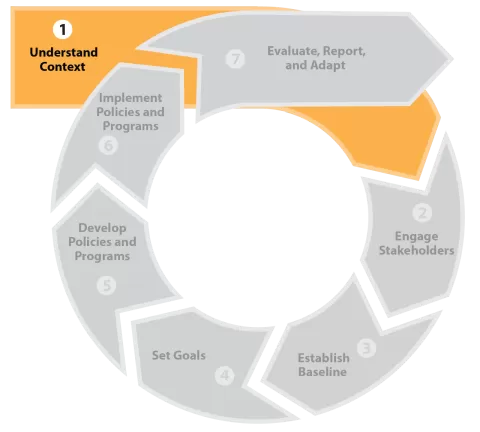
The initial step is to “Understand the Context.” The key outcome of this step is a big-picture understanding of both the context for action and the national priorities for methane reduction strategies.
Recommended activities include examining the country's total annual methane emissions and trends, key sources of methane, national and subnational priorities related to the methane producing sectors, and the current policy and regulatory landscape.
Best Practice Activities for this Step
Identify national anthropogenic methane emissions sources
This can determine areas of focus to achieve large-scale reductions. Key national documents to review may include country-specific:
- National Greenhouse Gas Inventory developed by national energy and environmental ministries
- National Communications submitted to the United Nations Framework Convention on Climate Changed (UNFCCC)
- Biennial Report, or Biennial Update Report to the UNFCCC
- Nationally Determined Contributions
- Biennial Transparency Report (2024 or later1)
1 Countries are transitioning how they track and report their mitigation strategies and estimating policy impacts. Developed countries submitted their last Biennial Reports in 2022 and developing countries will submit their last Biennial Update Reports in 2024. The first Biennial Transparency Reports under the Enhanced Transparency Framework (ETF) are required after 2024.
Examine existing national and subnational commitments and related efforts
Understanding commitments and efforts aimed at reducing methane emissions can reduce knowledge gaps and identify potential opportunities to accelerate reductions. This may include exploring the following:
- National targets and commitments to reduce methane, such as in Nationally Determined Contributions or through the Global Methane Pledge
- Existing methane reduction policies, programs, and projects
- Partnerships with organizations such as the Global Methane Initiative or the Climate and Clean Air Coalition
Review existing social, environmental, and economic priorities in national strategies or action plans (e.g., National Development Plans)
By understanding these priorities, policymakers can develop policies and programs that not only reduce methane, but also generate social, environmental, or economic co-benefits.
Identify priorities, key issues to be addressed, or desired outcomes
Based on a review of the available information and materials, make a preliminary assessment of sector(s) and issue(s) to be brought to stakeholders and addressed, as specifically as possible.
Key Resources Related to this Step
General Resources
Global Methane Initiative Partner Guidance Document for Action Planning
GMI
2013. This is a brief guidance document with guiding questions to aid policymakers in documenting their methane reduction actions and priorities.
Methane Roadmap Action Programme Template and Workbook
Climate and Clean Air Coalition
2023. The template and workbook are designed to provide general guidance on the content and structure for a National Methane Roadmap.
Global Methane Assessment (Summary for Decision Makers)
Climate and Clean Air Coalition (CCAC) and United Nations Environment Programme
2021. This is the executive summary for the CCAC Global Methane Assessment, which gives a broad overview of why and how to reduce methane emissions.
Strengthening Nationally Determined Contributions to Catalyze Actions that Reduce Short-Lived Climate Pollutants (SLCP)
World Resources Institute
2018. This paper presents options for how targets, policies, and actions on SLCPs can be incorporated into NDCs to help reach climate goals, which may be helpful for policymakers to identify gaps in current NDCs.
Tools and Databases
Global Methane Tracker
International Energy Agency
2025. This interactive database provides country and regional estimates for methane emissions and abatement options.
Methane Policies Database, under the Methane Tracker
International Energy Agency
2025. This database provides information about country - specific methane policies and regulations in place.
Non - CO2 Greenhouse Gas (GHG) Data Tool
U.S. Environmental Protection Agency
2019. This data tool includes methane emissions data by country from 1990 - 2050.
Oil & Gas Resources
Oil and Gas Sector Webpage
GMI
This webpage provides resources that can help countries understand national and subnational efforts and opportunities for reducing methane emissions from the oil and gas sector.
Global Venting and Flaring Regulations
Global Gas Flaring Reduction Partnership
2022. This interactive map includes a review of regulatory frameworks governing gas flaring and venting in 21 oil-producing countries.
Driving Down Methane Leaks from the Oil and Gas Industry - A Regulatory Roadmap and Toolkit
International Energy Agency
2021. This report aims to provide a complete “getting started” guide for policymakers looking to develop new regulations to tackle oil and gas methane emissions within their jurisdictions. This guide consists of two companion pieces: a Regulatory Roadmap and a Regulatory Toolkit.
Methane Emissions from Oil and Gas Operations
International Energy Agency
2022. This database tracks oil and gas methane and provides detailed country-by-country estimates of emissions, which could be helpful in understanding context.
Gap Assessment Tool
Methane Guiding Principles
2019. To address emissions in the natural gas supply chain, this tool allows organizations to carry out an assessment of existing methane abatement measures to understand where gaps exist.
The Imperative of Cutting Methane from Fossil Fuels- An assessment of the benefits for the climate and health
United Nations Environment Programme
2023. This report highlights actions reduce methane emissions from fossil fuel production and use and their co-benefits for public health.
Methane Abatement for Oil & Gas – A Handbook for Policymakers
U.S. Department of Commerce Commercial Law Development Program
2023. A practical resource for decision-makers on the policy and strategy behind encouraging methane abatement from the oil and gas sector, this guide helps legislators, ministries, regulators, and National Oil Company officials adopt and enforce rules that will rapidly and effectively reduce methane emissions from the oil and gas sector. Also available in Russian, Vietnamese, Spanish, Portuguese (Brazil), Portuguese (Portugal), Turkmen, Arabic, Malay, Bahasa Indonesia, and French.
Methane Mitigation Technologies Platform
U.S. Environmental Protection Agency
This Platform provides information on key methane emissions sources in the oil and gas industry, as well as measurement methodologies, technologies, and common industry practices to reduce methane.; It may be useful to countries and companies looking to reduce methane emissions in the oil & gas sector.
Videos About Methane Emissions from the Oil and Gas Industry
U.S. Environmental Protection Agency
This series of videos provides an overview of the oil and natural gas industry, from the main types of deposits and wells to the different segments within the sector. The videos also discuss some of the key methane emission sources in the oil and gas industry, available technologies to reduce emissions, and the positive outcomes of capturing and using methane.
Coal Resources
Actions for Scaling Up Mitigation of Methane Emissions from Coal Mines
GMI
2024. This document provides a list of concrete ideas for actions that could scale up projects on the capture and use of methane at coal mines, developed by the GMI Coal Mines Subcommittee and the UN Economic Commission for Europe Group of Experts on Coal Mine Methane and Just Transition.
Addressing Top Barriers to Development of Coal Mine Methane Projects: Concrete Ideas from Expert Brainstorming
GMI
2024. This document summarizes concrete ideas to overcoming barriers to coal mine methane project development, developed by the GMI Coal Mines Subcommittee and the UN Economic Commission for Europe Group of Experts on Coal Mine Methane and Just Transition.
Coal Mine Methane Country Profiles
GMI
2020. This report series characterizes the coal and coal mine methane sectors of 37 countries.
Coal Mines Sector Webpage
GMI
This webpage provides resources that can help countries understand national and subnational efforts and opportunities for reducing methane emissions from the coal sector.
International Coal Mine Methane Projects Database
GMI
2021. This Excel document has information on over 200 coal mine methane recovery and utilization projects operating, under development, or planned around the world.
Coal Mine Methane (CMM) Emissions Estimation Tool
GMI
The CMM Emission Estimation Tool helps national governments estimate annual methane emissions from underground coal mines in their countries, providing a step-by-step, systematic, and easy-to-follow process for collecting the data needed to estimate facility-specific methane emissions, including descriptions of the equations and calculations used. This spreadsheet-based resource is designed to help countries develop more accurate national emissions estimates by aggregating facility-level emissions.
Trainings on Prefeasibility Studies on CMM and AMM (+Translations)
GMI
These trainings help users learn best practices in conducting prefeasibility studies, which evaluate CMM or AMM resources.
Training CMM Basics (+Translations)
GMI
The CMM Basics training helps users understand emissions sources and mitigation options from coal mining.
Biogas Resources
Biogas Sector Webpage
GMI
This webpage provides resources that can help countries understand national and subnational efforts and opportunities for reducing methane emissions from the agriculture, municipal solid waste and wastewater sectors.
Fact Sheet on Methane Mitigation from Municipal Wastewater Treatment Plants
GMI
2023. This fact sheet provides an overview of methane emissions generated from wastewater collection systems and at wastewater treatment plants (WWTPs) as well as opportunities and challenges for methane abatement, capture, and use at WWTPs.
Case Studies
|
Image

|
Bangladesh National Action Planning for Short-Lived Climate Pollutants In Bangladesh, policymakers reviewed existing policies, legislation, and relevant information from development programs that related to short-lived climate pollutants. The review helped country decision-makers understand the extent of methane emission reduction activities to date to inform the development of new strategies. Read about Bangladesh |
|
Image

|
Identifying Coal Mine Methane (CMM) Mitigation Options in Colombia In Colombia, government officials identified coal mining as a major source of methane emissions and economic productivity and, thus, designed a methane reduction strategy with a focus on coal mine methane as an energy source. Read about Colombia |