Introduction > 1: Understand the Context > 2: Engage Stakeholders > 3: Establish Baseline > 4: Set Goals > 5: Develop Policies and Programs > 6: Implement Policies and Programs > 7: Evaluate, Report, and Adapt > Case Studies
Step 2: Engage Stakeholders
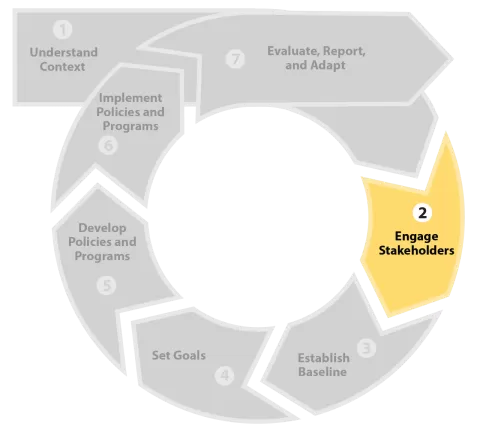
Stakeholders are individuals and organizations that may be affected by, or influence, a given effort. Meaningful engagement with key stakeholders early in the policy making process and a recognition that policy making is not a linear process is critical to the long-term success of methane mitigation strategies. Stakeholder engagement includes one or more of the following processes, as appropriate:
- Soliciting input on policy ideas, feasibility, costs, and impacts
- Listening to industry perspectives and local community concerns
- Collecting and clarifying technical information and data needed for subsequent analyses, program design, and transparency reporting
- Determining roles and responsibilities for ongoing transparency activities
- Informing stakeholders on policy proposals or new rules
Stakeholders from industry and communities can contribute to the design, implementation, evaluation, and adaptation of methane mitigation policies and programs. Whether the stakeholder is a dairy farmer or coal mine operator, they can be a key partner in the subsequent Framework steps. For example, 30 stakeholders are involved in Colombia's coal mine methane industry, including mining companies, equipment manufacturers, project developers, and more (refer to the Colombia Coal Mine Methane Example). Identifying and mapping the roles and responsibilities of all stakeholders involved are important steps to effective engagement.
Best Practice Activities for this Step
Identify key stakeholders and document stakeholder roles and responsibilities
Key stakeholders may include:
- National or subnational government bodies responsible for developing GHG emissions inventories or climate or methane-specific mitigation plans
- Finance institutions, ministries, or treasuries
- Private companies
- Academic institutions with technical expertise on methane mitigation
- Non-governmental organizations representing a variety of interests (e.g., environmental protection, economic development, public health)
- Impacted communities, including marginalized populations (e.g., minority and low-income populations or indigenous peoples) that are often excluded from decision-making processes
Select the appropriate type of stakeholder engagement and determine the desired outcomes of engagement
Types of engagement may include:
- Consulting, which involves soliciting input, feedback, or advice from stakeholders before developing policies or programs
- Actively involving, which involves actively engaging with stakeholders throughout the policy or program development process
- Informing, which involves communicating to stakeholders after the policy or program development process
Engage with identified stakeholders
This process can identify concerns, barriers, technical assistance and capacity building needs, and opportunities for improving existing methane policies and programs or developing new ones. To effectively engage, policymakers may consider:
- Selecting communication means and media appropriate for the type of engagement and desired outcomes. These may include public meetings, in-person workshops or roundtable discussions, stakeholder input surveys, websites, reports, factsheets, white papers, or case studies (refer to the Communication Core Principle)
- Documenting stakeholder input and engagement outcomes (e.g., through a memorandum of understanding, database, report) to better integrate them into the decision-making process
- Planning for follow-up engagement, as needed
Key Resources Related to this Step
General Resources
Enhancing Climate Action Through Stakeholder Engagement at the Country Level
Climate Investment Funds
2020. This report evaluates the impact of certain stakeholder engagement strategies in nine separate countries.
Sustainability Guidance Note: Designing and Ensuring Meaningful Stakeholder Engagement on GCF-Financed Projects
Green Climate Fund
2022. This document provides initial steps for developing a stakeholder engagement strategy from project inception to implementation.
Stakeholder Engagement Handbook
United Nations Environment Programme
2018. This Handbook aims to guide stakeholders by introducing the currently applied rules, mechanisms, and practices for stakeholder engagement in UNEP's work.
Coal Mine Methane (CMM) Emissions Estimation Tool
GMI
The CMM Emission Estimation Tool helps national governments estimate annual methane emissions from underground coal mines in their countries, providing a step-by-step, systematic, and easy-to-follow process for collecting the data needed to estimate facility-specific methane emissions, including descriptions of the equations and calculations used. This spreadsheet-based resource is designed to help countries develop more accurate national emissions estimates by aggregating facility-level emissions.
Oil & Gas Resources
Driving Down Methane Leaks from the Oil and Gas Industry - A Regulatory Roadmap and Toolkit
International Energy Agency
2021. This report aims to provide a complete “getting started” guide for policymakers looking to develop new regulations to tackle oil and gas methane emissions within their jurisdictions. This guide consists of two companion pieces: a Regulatory Roadmap and a Regulatory Toolkit.
Methane Abatement for Oil & Gas – A Handbook for Policymakers
U.S. Department of Commerce Commercial Law Development Program
2023. A practical resource for decision-makers on the policy and strategy behind encouraging methane abatement from the oil and gas sector, this guide helps legislators, ministries, regulators, and National Oil Company officials adopt and enforce rules that will rapidly and effectively reduce methane emissions from the oil and gas sector. Also available in Russian, Vietnamese, Spanish, Portuguese (Brazil), Portuguese (Portugal), Turkmen, Arabic, Malay, Bahasa Indonesia, and French.
Case Studies
|
Image

|
Bangladesh National Action Planning for Short-Lived Climate Pollutants In Bangladesh, sectoral and government stakeholders engaged to propose, assess, and prioritize policies, programs, and pilot projects to reduce short-lived climate pollutants. Read about Bangladesh |
|
Image

|
Identifying Coal Mine Methane (CMM) Mitigation Options in Colombia In Colombia, government officials identified coal mining as a major source of methane emissions and economic productivity and, thus, designed a methane reduction strategy with a focus on coal mine methane as an energy source. Read about Colombia |