Introduction > 1: Understand the Context > 2: Engage Stakeholders > 3: Establish Baseline > 4: Set Goals > 5: Develop Policies and Programs > 6: Implement Policies and Programs > 7: Evaluate, Report, and Adapt > Case Studies
Step 7: Evaluate, Report, and Adapt
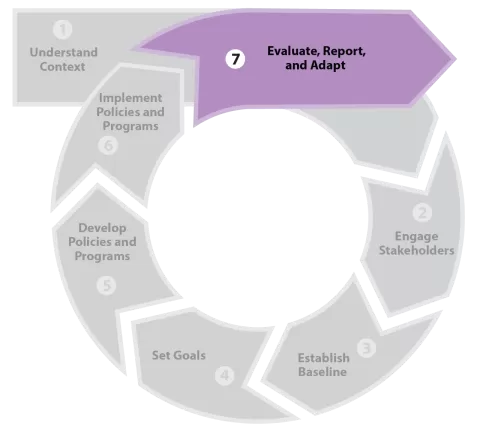
The final step of the Framework involves the measurement, reporting, and verification (MRV) of emissions reductions from the implemented policies and programs. This involves comparing the emissions baseline, established under Step 3, Establish Baseline, with the reported emissions reductions from the policies and programs implemented under Step 6, Implement Policies and Programs. This step is critical for tracking progress toward the goals established in Step 4, Set Goals. Activities under this step may also include communication of emissions reductions and broader impacts of the strategy and transparency reporting under the Paris Agreement.
Best Practice Activities for this Step
Determine status of policy implementation
The status should be based on tracking over time of key implementation milestones and indicators by responsible government authority or stakeholders, such as data reported by projects implemented or incentivized by the policy. Incorporate and document assumptions about the relative progress and effectiveness of implementation.
Calculate emissions reductions for the most recent data years
If the implementation is ongoing, update the emissions projections through the target year for the sources within the goal boundary. This and the following best practices rely on the data and methodological foundation developed in Step 3, Establish Baseline and Step 4, Set Goals. Policies that implement or incentivize emission reduction projects can require emission reduction data to be reported by projects, which policymakers can use to calculate the overall emission reductions of the policy.
- For example, a policy to promote the use of anaerobic digesters to reduce methane emissions from livestock waste could include a requirement for digester projects to monitor and report emission reductions relative to the project baseline emissions. If project-level emissions data are unavailable, policymakers could also use their country's GHG inventory to track sector-specific emission reductions. For example, for a policy intended to divert organic waste from landfills, the data sources used to develop the GHG inventory could be used to track reductions in waste entering landfills.
Assess emission reductions annually during the goal period
Calculate changes in emissions that occurred as a result of policies or programs and assess whether the strategies were effective in changing emission levels. This can help policymakers determine if strategies are on track or need adjustments.
Gather input from key stakeholders
This could include opportunities for improving on implementation challenges or unintended consequences that may occur throughout the process (refer to Step 2, Engage Stakeholders for best practices and resources for soliciting stakeholder input).
Identify adjustments to policies and program(s)
Modify as needed based on emissions assessments and feedback from stakeholders. This may include modifying implementation approaches to remove barriers, updating rules to have wider applicability, strengthening industry data reporting requirements, or increasing the stringency of targets.
Verify emissions reductions
This could be done internally by a person in the organization not involved in the process of planning, implementing, and reporting on the progress towards a mitigation goal or target. It could also be done by a third-party from an independent, accredited verification body (e.g., Verified Carbon Standards).
Report progress towards goals and targets to appropriate programs as required
Inform stakeholder partners about policy updates or new rules. Recognizing meaningful stakeholder contributions to progress can bolster support for continued policies and enhance stakeholder relationships.
- For example, this could include following the guidelines of the UNFCCC Enhanced Transparency Framework
Key Resources Related to this Step
General Resources
MRV Resource Center
GMI
2022. This website provides information and tools to support the measurement, reporting, and verification (MRV) of methane emissions and emissions reductions from the biogas (i.e., agriculture, municipal solid waste, and wastewater), oil and gas, and coal mines sectors.
Waste Characterization Handbook: Understanding Municipal Waste Streams to Develop Data-Driven Methane Mitigation Strategies
GMI
2024. This handbook and accompanying Excel tool help decision-makers and solid waste professionals plan and conduct studies to understand the composition of waste streams. A waste characterization study, also helpful for baseline emissions estimates, can also be used to re-evaluate the success of waste diversion strategies.
Mitigation Goal Standard: An Accounting and Reporting Standard for National and Subnational Greenhouse Gas Reduction Goals
World Resources Institute
2014. This Standard is intended to provide guidance for assessing and publicly reporting progress toward meeting an emissions reduction goal.
MRV 101: Understanding Measurement, Reporting, and Verification of Climate Change Mitigation
World Resources Institute
2016. This working paper defines MRV of GHG emissions, of mitigation actions, and of support and provides national decision-makers with information to understand each type and how and when they are used.
Policy and Action Standard: An Accounting and Reporting Standard for Estimating the Greenhouse Gas Effects of Policies and Actions
World Resources Institute
2014. This Standard provides a protocol for estimating and reporting emissions reductions resulting from policies and actions.
Oil & Gas Resources
Best Practice Guidance for Effective Methane Management in the Oil and Gas Sector: Monitoring, Reporting and Verification (MRV) and Mitigation
GMI and United Nations Economic Commission for Europe
2019. This document provides guidance for effectively strategizing and implementing practices for MRV methane emissions from the oil and gas sector.
Driving Down Methane Leaks from the Oil and Gas Industry - A Regulatory Roadmap and Toolkit
International Energy Agency
2021. This report aims to provide a complete “getting started” guide for policymakers looking to develop new regulations to tackle oil and gas methane emissions within their jurisdictions. This guide consists of two companion pieces: a Regulatory Roadmap and a Regulatory Toolkit.
Methane Flaring Toolkit
Methane Guiding Principles
2023. This toolkit helps decision-makers assess, measure, and monitor methane emission from gas flares during oil and gas operations.
Templates and Guidance Documents
Oil and Gas Methane Partnership 2.0.
2023. These documents provide technical guidance on quantifying methane emissions from various oil and gas processes and equipment.
Methane Abatement for Oil & Gas – A Handbook for Policymakers
U.S. Department of Commerce Commercial Law Development Program
2023. A practical resource for decision-makers on the policy and strategy behind encouraging methane abatement from the oil and gas sector, this guide helps legislators, ministries, regulators, and National Oil Company officials adopt and enforce rules that will rapidly and effectively reduce methane emissions from the oil and gas sector. Also available in Russian, Vietnamese, Spanish, Portuguese (Brazil), Portuguese (Portugal), Turkmen, Arabic, Malay, Bahasa Indonesia, and French.
Leak Detection and Repair Training
GMI
This self-paced online training series provides an overview of Leak Detection and Repair (LDAR) programs, widely recognized as an effective mechanism to reduce a significant source of methane emissions from oil and gas operations. It is intended to help oil and gas companies reduce methane emissions from equipment leaks.
Coal Resources
Best Practice Guidance for Effective Management of Coal Mine Methane at National Level: Monitoring, Reporting, Verification and Mitigation
GMI and United Nations Economic Commission for Europe
2022. Detailed technical MRV and mitigation guidance document on designing national systems to quantify and ultimately mitigate coal mine methane emissions.
Coal Mine Methane (CMM) Emissions Estimation Tool
GMI
The CMM Emission Estimation Tool helps national governments estimate annual methane emissions from underground coal mines in their countries, providing a step-by-step, systematic, and easy-to-follow process for collecting the data needed to estimate facility-specific methane emissions, including descriptions of the equations and calculations used. This spreadsheet-based resource is designed to help countries develop more accurate national emissions estimates by aggregating facility-level emissions.
Biogas Resources
MRV Webinar Series: The Role and Importance of MRV for Biogas Projects
GMI
2022. This webinar series includes discussions on the basics of MRV and best practices, tools, and resources to support MRV for biogas projects.
Policymaker's Handbook for Measurement, Reporting, and Verification in the Biogas Sector
GMI
2022. This handbook for government policymakers offers best practices for project-level MRV in the biogas sector and using MRV to support national-level biogas mitigation objectives.
Case Studies
|
Image

|
Japan Reduces Methane from Landfills The Ministry of the Environment of Japan conducted a survey on the generation and disposal of municipal solid waste to ensure compliance with their new standards on waste management to reduce methane emissions. They published the results in 2020. The data are critical to evaluate the impacts and effectiveness of the standards managing and reducing waste. Read about Japan |
|
Image

|
Trinidad and Tobago, an Oil and Gas Producer, Strengthens Capacity for Emissions Transparency Trinidad and Tobago joined the NDC Support Programme, which focused on the implementation of an MRV system, the installation and design of a knowledge management system to support MRV, and the design and implementation of a pilot project to test it. Read about Trinidad and Tobago |