Introduction > 1: Understand the Context > 2: Engage Stakeholders > 3: Establish Baseline > 4: Set Goals > 5: Develop Policies and Programs > 6: Implement Policies and Programs > 7: Evaluate, Report, and Adapt > Case Studies
Step 3: Establish Baseline
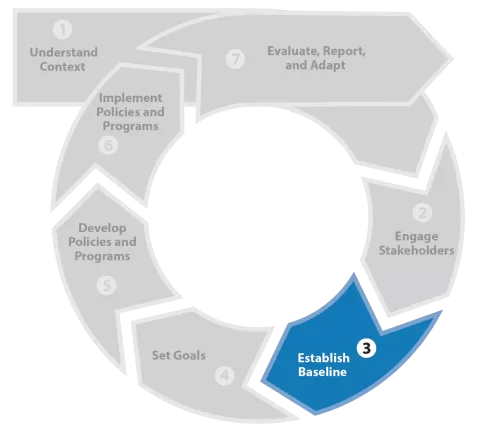
To set effective methane mitigation goals (as laid out in Step 4, Set Goals), and then track and report progress towards them, policymakers first estimate and project baseline emissions. While the GHG inventory is useful for understanding the current emissions (as discussed in Step 1, Understand the Context), an emissions baseline represents a projection of future emissions in a business-as-usual case in the absence of any additional policy intervention. The emissions baseline should take into account the fact that there may already be existing laws and policies that would impact future emissions. It should also take into account future changes in emissions due to population and economic growth. In other words, the emissions baseline is a projection of what the emissions would be if no further policy actions are taken to reduce them.
Policymakers can use baseline estimates as a benchmark for assessing the emissions impacts that could occur under alternative policy scenarios. For example, an emissions baseline could include projections of business-as-usual methane emissions for the next 10-20 years. As policymakers implement methane reduction policies (as discussed in Step 6, Implement Policies and Programs), they can compare the emission reductions achieved by the policy against projected baseline emissions that would have occurred if that policy intervention had not been implemented.
Establishing a baseline can be data intensive and time-consuming, especially for some methane sources that are highly disperse and difficult to measure (e.g., fugitive methane from oil and gas operations). A baseline relies on GHG inventory data and methods, in addition to other data and information necessary for projecting emissions, such as data on demographic and economic trends. The purpose of baseline development is not to re-create the GHG inventory. Rather it is to use the inventory and other information about trends in emissions to understand what the emissions would be if the emission reduction policy were not implemented.
- Common Limitations of Available Data: For some sources of methane, data availability may be very limited. For most sources of methane, emissions are associated with dispersed and highly variable activities (e.g., livestock enteric fermentation, organic waste decomposition) or gas leakage (e.g., methane from coal seams, gas leakage from pipelines) are not measured directly. The IPCC Guidelines for National GHG Inventories, provides rigorous methodologies for estimating emissions, including guidance on addressing data gaps.
- GHG Baselines and Inventories: GHG baselines and inventories are related, but separate concepts. Inventories are analyses of past emissions. Baselines are forward looking projections of emissions in the absence of interventions to reduce them. They are often referred to as "business-as-usual” emissions. GHG inventories can serve as the starting point of developing a baseline, but baselines require additional considerations, such as the impacts of other (non-GHG) policies and demographic trends on emissions.
Best Practice Activities for this Step
Review core concepts and components of setting baseline scenarios and emissions
Various entities, including the Global Methane Initiative (GMI) offer technical methodologies and detailed sector-specific guidance to execute this step. Refer to the Key Resources under this step below.
Collect readily available methane emissions data and identify data gaps and limitations
The types of data needed include:
- Activity data, the level of an activity that affects GHG emissions (e.g., number of head of livestock)
- Emission factors, the quantity of GHGs that is emitted per unit of GHG-producing activity (e.g., 50 kg of methane per livestock head)
Policymakers can start by reviewing their national GHG inventory. For some methane-producing sources, a country may have gaps in data availability and capacity to account for emissions. As a part of this process, policymakers may engage with the national inventory coordinator or sector lead about data and methodological issues (refer to the Communcation and Transparency Core Principles and Step 1, Understand the Context). Other potential data sources are listed under the Key Resources section of this step.
Estimate and project baseline emissions
The International Panel on Climate Change's (IPCC) general equation for estimating GHG emissions is Activity Data x Emission Factor = GHG Emissions. Policymakers should review their national GHG inventory to understand how sector-level emissions have been calculated. Other sources of information for calculating emissions include the IPCC Guidelines for National Greenhouse Gas Inventories, which includes default emission factors (see Key Resources, below). These calculations should utilize data on demographic trends as well as factor in current policies that could impact emissions (as described in the following best practice). In this step, policymakers attempt to project what the emissions would be in the future without any additional policy intervention.
Factor in current or future law, practices, and technologies that could affect projected baseline emissions estimates
For example, as part of its baseline assessment processes, Bangladesh developed emission scenarios for 2030 from existing quantitative data and relevant qualitative information they compiled from development programs, policies, and legislation (refer to the Bangladesh Country Example).
Key Resources Related to this Step
General Resources
Overview And Methods For Developing Baselines:
Greenhouse Gas Emissions Forecasting: Learning from International Best Practices
Environment and Climate Change Canada
2008. This report discusses Canada and the United States as case studies for GHG emissions forecasting.
What is a Baseline?
GHG Management Institute
2022. This technical article explains the core concepts and multiple components of a baseline scenario and baseline emissions.
IPCC Guidelines for National Greenhouse Gas Inventories
Intergovernmental Panel on Climate Change
2006. This document provides methodologies and default emission factors for calculating emissions from multiple sectors.
Options and Guidance for the Development of Baselines
Partnership for Market Readiness
2013. This detailed resource provides background and technical support for baseline development for countries considering mitigation actions, including market-based mechanisms.
The Nuts and Bolts of Baseline Setting: Why, What and How?
Partnership for Market Readiness
2012. This document provides an overview of baseline setting for GHG crediting mechanisms.
Mitigation Goal Standard: An Accounting and Reporting Standard for National and Subnational Greenhouse Gas Reduction Goals
World Resources Institute
2014. This technical resource provides a detailed methodology for estimating the base year or baseline scenario emissions and developing emissions projections and calculating the allowable emissions in the target year(s).
Available Data Sources:
Data Portal
Carbon Mapper
2023. This data portal provides facility-scale data on methane emissions—captured from Carbon Mapper's satellite and airborne monitoring technology—to increase the transparency and understanding of methane emissions.
Global Methane Tracker
International Energy Agency
2025. This interactive database provides country and regional estimates for methane emissions and abatement options.
Non-CO2 Greenhouse Gas (GHG) Data Tool
U.S. Environmental Protection Agency
2022. This data tool includes methane emissions data by country from 1990-2050.
Oil & Gas Resources
Driving Down Methane Leaks from the Oil and Gas Industry - A Regulatory Roadmap and Toolkit
International Energy Agency
2021. This report aims to provide a complete “getting started” guide for policymakers looking to develop new regulations to tackle oil and gas methane emissions within their jurisdictions. This guide consists of two companion pieces: a Regulatory Roadmap and a Regulatory Toolkit.
Methane Emissions from Oil and Gas Operations
International Energy Agency
2022. This database tracks oil and gas methane and provides detailed country-by-country estimates of emissions, which could be helpful in establishing baseline.
Methane Abatement for Oil & Gas – A Handbook for Policymakers
U.S. Department of Commerce Commercial Law Development Program
2023. A practical resource for decision-makers on the policy and strategy behind encouraging methane abatement from the oil and gas sector, this guide helps legislators, ministries, regulators, and National Oil Company officials adopt and enforce rules that will rapidly and effectively reduce methane emissions from the oil and gas sector. Also available in Russian, Vietnamese, Spanish, Portuguese (Brazil), Portuguese (Portugal), Turkmen, Arabic, Malay, Bahasa Indonesia, and French.
The Simplified Methane Assessment and Reporting Tool Plus (or "SMART Plus")
U.S. Environmental Protection Agency
The Simplified Methane Assessment and Reporting Tool Plus (or "SMART Plus") helps stakeholders refine and improve GHG emissions estimates from oil & gas facilities. The tool estimates methane, carbon dioxide, nitrous oxide, carbon monoxide, non-methane volatile organic compounds, nitrogen oxides, and sulfur dioxide.
Leak Detection and Repair Training
GMI
This self-paced online training series provides an overview of Leak Detection and Repair (LDAR) programs, widely recognized as an effective mechanism to reduce a significant source of methane emissions from oil and gas operations. It is intended to help oil and gas companies reduce methane emissions from equipment leaks.
Coal Resources
Coal Mine Methane Country Profiles
GMI
2020. This report series describes the baseline coal mine methane emissions from operating and abandoned mines in 37 countries.
Driving Down Coal Mine Methane Emissions: A Regulatory Roadmap and Toolkit
International Energy Agency
2023. Step 3 of this document discusses how to establish a baseline for coal mine methane.
Coal Mine Methane (CMM) Emissions Estimation Tool
GMI
The CMM Emission Estimation Tool helps national governments estimate annual methane emissions from underground coal mines in their countries, providing a step-by-step, systematic, and easy-to-follow process for collecting the data needed to estimate facility-specific methane emissions, including descriptions of the equations and calculations used. This spreadsheet-based resource is designed to help countries develop more accurate national emissions estimates by aggregating facility-level emissions.
Biogas Resources
Policy Maker's Handbook for Measurement, Reporting, and Verification in the Biogas Sector
GMI
2022. This handbook offers guidance and tools for establishing a business-as-usual emissions baseline in the biogas sector, which encompasses the agriculture, municipal solid waste, and wastewater sectors.
Solid Waste Emissions Estimation Tool (SWEET)
GMI
2023. Excel-based tool that quantifies emissions of methane, black carbon, and other pollutants from sources in the municipal solid waste sector.
Waste Characterization Handbook: Understanding Municipal Waste Streams to Develop Data-Driven Methane Mitigation Strategies
GMI
2024. This handbook and accompanying Excel tool help decision-makers and solid waste professionals plan and conduct studies to understand the composition of waste streams. Waste characterization helps to improve baseline methane emissions estimates.
Waste Wise Cities Tool
UN-Habitat
2021. This document provides readers with a step-by-step guide for collecting data on municipal solid waste generated, collected, and managed in controlled facilities and quantifying greenhouse gas emissions and air pollution from waste.
Case Studies
|
Image

|
Albania's Landfill Methane Capture Strategy Albania conducted a GHG inventory and, in their business-as-usual scenario, assumed that methane capture technologies would not be installed until 2030 and that the amount of waste produced annually would remain the same. Read about Albania |
|
Image

|
Bangladesh National Action Planning for Short-Lived Climate Pollutants In Bangladesh, sectoral and government stakeholders engaged to propose, assess, and prioritize policies, programs, and pilot projects to reduce short-lived climate pollutants. Read about Bangladesh |
|
Image

|
Trinidad and Tobago, an Oil and Gas Producer, Strengthens Capacity for Emissions Transparency Trinidad and Tobago joined the NDC Support Programme, which focused on the implementation of an MRV system, the installation and design of a knowledge management system to support MRV, and the design and implementation of a pilot project to test it. Read about Trinidad and Tobago |