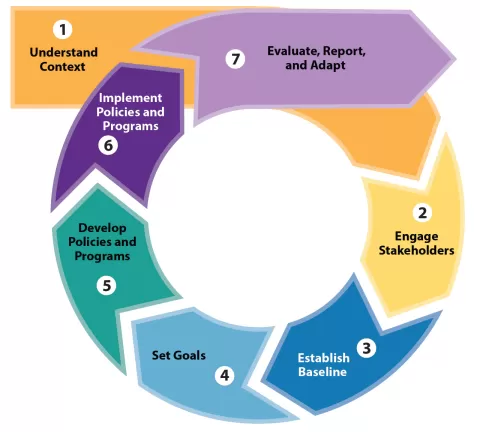
Introduction > 1: Understand the Context > 2: Engage Stakeholders > 3: Establish Baseline > 4: Set Goals > 5: Develop Policies and Programs > 6: Implement Policies and Programs > 7: Evaluate, Report, and Adapt > Case Studies > United States
Image
Understand the Context
- Oil and natural gas operations are the largest industrial source of methane emissions in the United States.
- On January 20, 2021, the President of the United States issued an Executive Order outlining actions to mitigate the effects of climate change.
- This order directed the U.S. EPA to propose new regulations for methane and volatile organic compound emissions from new and existing operations in the oil & natural gas sector, including the exploration and production, processing, transmission and storage segments. EPA previously had regulated greenhouse gases, in the form of methane limitations, in a 2016 regulation.
Engage Stakeholders
- The U.S. EPA engaged stakeholders during three key periods in 2021 and 2022 as the Agency was developing proposed regulations and seeking public comments:
- In Spring 2021, as a prelude to the rulemaking process, the U.S. EPA conducted outreach to hear the perspectives of state and local air agencies, Tribal Nations, industry, communities and the public. Outreach included virtual public listening sessions, webinars, and technical workshops with state co-regulators, key stakeholders and the public to hear concerns and to learn from what states were doing to regulate methane and volatile organic compounds (VOC) emissions. It also included a workshop about innovative technologies that could be used to detect methane emissions from oil and natural gas operations.
- In November 2021, the U.S. EPA announced its proposed regulation. The Agency again conducted outreach to share information with members of communities with environmental justice concerns, small businesses, and Tribes. The Agency conducted this through webinars in which key staff walked through the proposed requirements and answered questions. Agency staff also provided overviews for state, local and Tribal air agencies, in addition to attending industry meetings.
- Separately, the U.S. EPA provided the public formal opportunities, as required under the federal Clean Air Act, to provide their views on the proposal and the Regulatory Impact Analysis. This included a written comment period and a three-day virtual public hearing. In January 2022, the U.S. EPA extended the written public comment period on the proposal to allow for greater input on the 2021 proposal. The 2021 proposed rule received over 470,000 public comments.
- The U.S. EPA conducted similar webinar-based outreach and a formal public comment period that included an additional virtual public hearing on a supplemental proposal, which the Agency announced in December 2022. The supplemental proposal received over 515,000 additional public comments.
- Ultimately, the U.S. EPA considered nearly 1 million comments received on the two proposals before issuing a final rule, which was announced in December 2023 and subsequently published in March 2024.
Develop Policies and Programs
Develop, Propose, and Issue Final Requirements
- Following requirements of the U.S. Clean Air Act, and considering the feedback it received during pre-proposal outreach, the U.S. EPA evaluated a range of available methane mitigation technologies and practices to determine the “best system of emission reduction” that has been adequately demonstrated to control emissions for each type of source included in the regulation, considering cost-effectiveness and other factors.
- In November 2021, the U.S. EPA announced a proposal that would:
- Update and strengthen methane standards for new sources
- Establish standards for then-unregulated new sources
- Establish first Emission Guidelines for states to set requirements to regulate existing sources
- Encourage the development and deployment of cost-effective technologies to further reduce pollution from oil and natural gas sources.
- The U.S. EPA repeated this process in 2022, when it developed a supplemental proposal that considered public comments and that made the proposed standards more comprehensive. The supplemental proposal also included a proposed Super Emitter Program to leverage third-party expertise to find large methane leaks and releases, known as “super emitters."
- Following requirements of the Clean Air Act, and after considering public comment on the initial and supplemental proposals, the U.S. EPA announced a final rule on December 2, 2023.
- On March 8, 2024, the rule was published in the Federal Register. the official daily U.S. publication for rules, proposed rules, and notices of Federal agencies and organizations, as well as executive orders and other presidential documents.
Analyze the Impacts
- For each of the proposed regulations, and for the final rule, U.S. EPA conducted a regulatory impact analysis to assess the potential costs and benefits of implementing the proposed requirements relative to a baseline scenario without the regulatory action. As part of this analysis, the Agency established an emissions baseline using data from EPA's Greenhouse Gas Inventory and other sources.
- For the final rule, the regulatory impact analysis assessed the impacts for 15 years (from 2024, when the rule takes effect, through 2038). The regulatory impact analysis considered requirements that would result in quantifiable compliance costs or emissions reductions associated with the rule.
- The final rule is expected to reduce methane emissions by nearly 80 percent from the sources covered compared to emissions without the rule. It will reduce an estimated 58 million tons of methane emissions from 2024 to 2038, equivalent to over 200 million homes’ energy use for one year. In addition, the rule will avoid 16 million tons of smog-forming VOC emissions and 590,000 tons of air toxics.
Implement Policies and Programs
- The final rule sets out specific implementation schedules for new and existing sources.
- New sources must comply with the requirements as of the effective date of the final rule, May 7, 2024, or upon startup for sources that are constructed in the future. However, there are some later compliance dates for specific emission sources, such as flaring of associated gas, process controllers, and pumps.
- Each state is required to adopt and submit a plan for reducing emissions from existing sources to the U.S. EPA by March 9, 2026, which is 24 months from the rule's publication date. The final rule generally requires that state plans require compliance by no later than 36 months after the plans are due to the U.S. EPA.
- The U.S. EPA’s Office of Enforcement and Compliance Assurance works with EPA’s regional offices, and partners with state and tribal governments, and other federal agencies to ensure compliance with this and other environmental regulations. The Agency will also play a strong oversight role in the super emitter program to ensure a high degree of integrity, transparency and accountability.
Evaluate, Report, and Adapt
Petitions for Review of the Final Rule
- In May 2024, U.S. EPA notified petitioners that it is granting reconsideration on two narrow aspects of the final rule in response to petitions from industry. Through the reconsideration process, the Agency will issue a proposal and take public comment
- In June 2024, U.S. EPA issued minor technical corrections to its final rule.
- As required under the Clean Air Act, U.S. EPA will continue to carefully review petitions for reconsideration and evaluate issues raised, as appropriate, if a party raising an objection to the rule can demonstrate that it was impracticable to raise such objection within the public comment period or if the grounds for such objection arose after the period ended.
Clean Air Act Required Reviews
- Separate from the petitions process, the Clean Air Act also requires U.S. EPA to periodically review and, if appropriate, “revise such standards” following the procedures under the Act.
Relevant Framework Steps
- Step 1, Understand the Context
- Step 2, Engage Stakeholders
- Step 5, Develop Policies and Programs
- Step 6, Implement Policies and Programs
- Step 7, Evaluate, Report, and Adapt